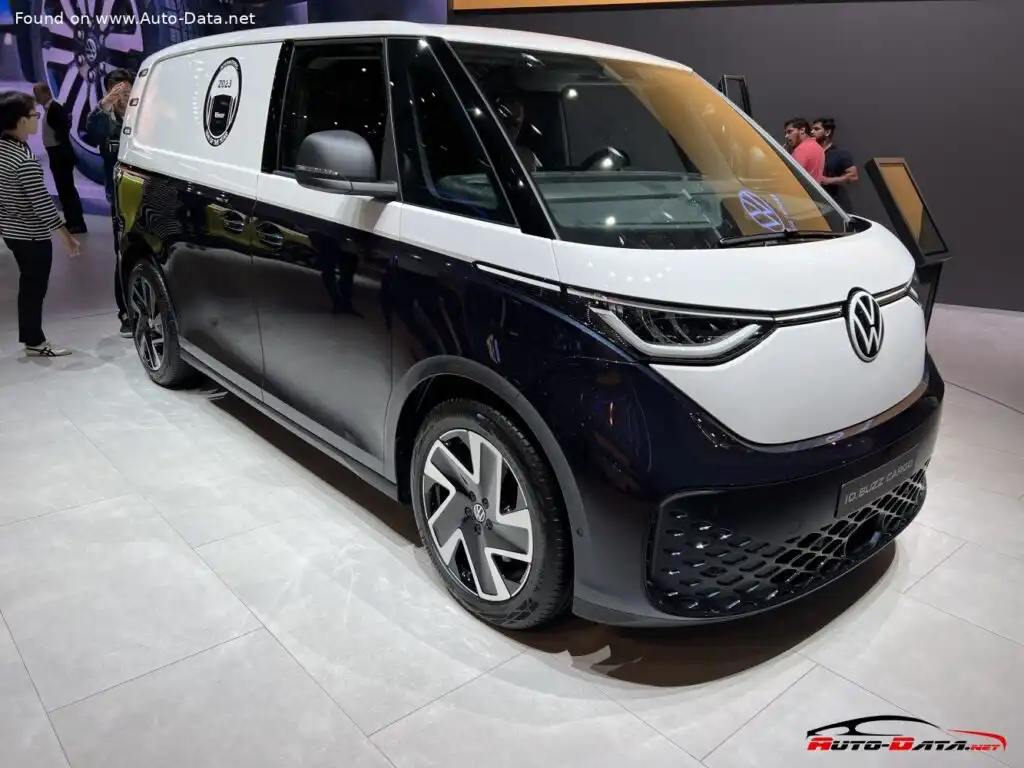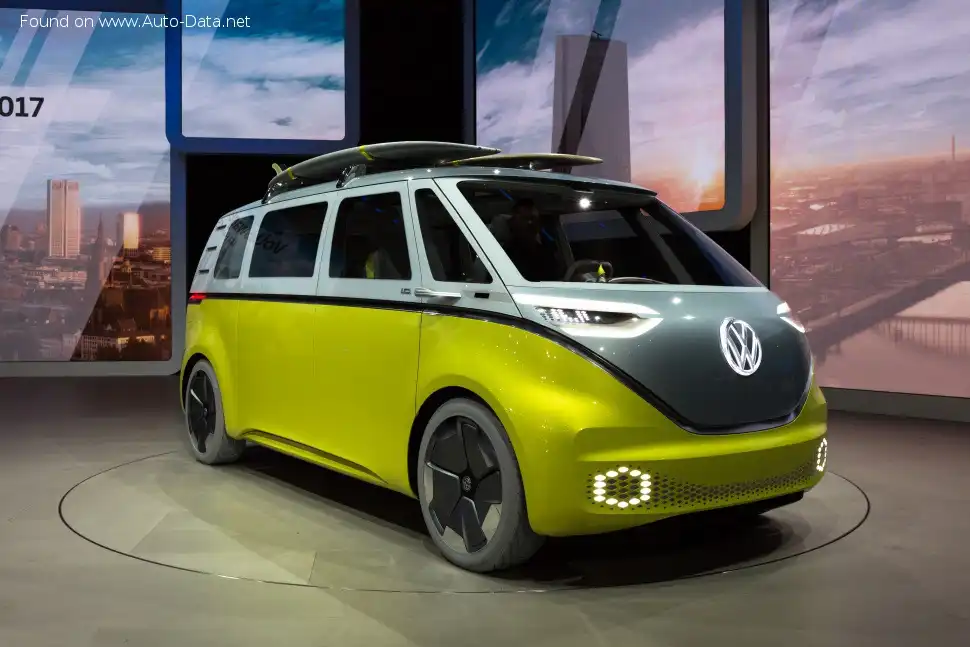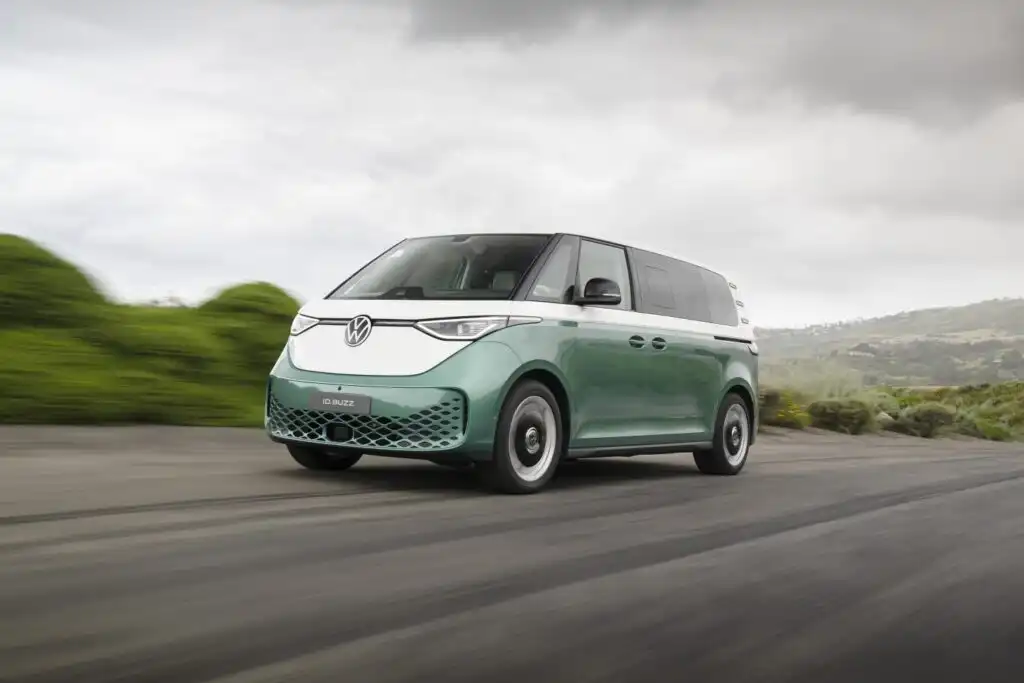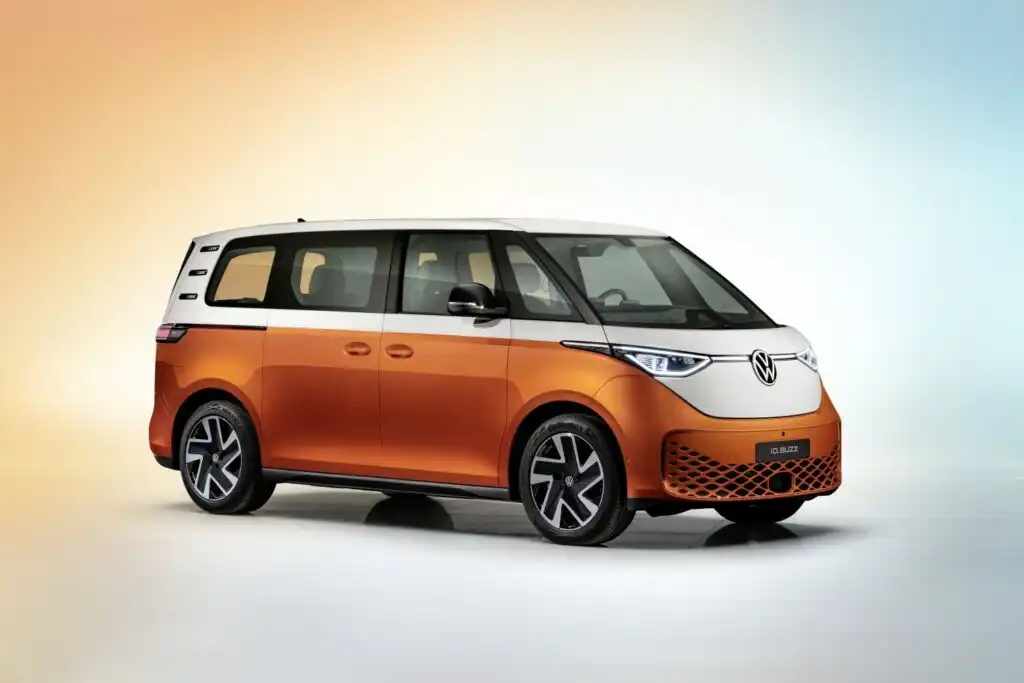
The Volkswagen ID. Buzz 82 kWh, producing 204 horsepower, represents Volkswagen’s modern interpretation of the iconic Type 2 “Bus.” Introduced in March 2022 and continuing through the 2024 model year, the ID. Buzz is a battery electric vehicle (BEV) designed to appeal to a market seeking both retro styling and contemporary electric vehicle technology. Positioned as a versatile multi-purpose vehicle (MPV), it aims to recapture the spirit of the original Bus while offering a significantly updated driving experience and a focus on sustainability. The ID. Buzz is built on the Volkswagen Group’s MEB platform, shared with other electric vehicles like the ID.4, and initially launched in Europe before a planned North American release.
Technical Specifications
| Brand | Volkswagen |
| Model | ID. Buzz |
| Generation | ID. Buzz |
| Type (Engine) | 82 kWh (204 Hp) |
| Start of production | March, 2022 |
| End of production | 2024 |
| Powertrain Architecture | BEV (Electric Vehicle) |
| Body type | MPV |
| Seats | 5 |
| Doors | 5 |
| Fuel Type | Electricity |
| Acceleration 0 – 100 km/h | 10.2 sec |
| Acceleration 0 – 62 mph | 10.2 sec |
| Acceleration 0 – 60 mph | 9.7 sec |
| Maximum speed | 145 km/h (90.1 mph) |
| Weight-to-power ratio | 12.1 kg/Hp, 83 Hp/tonne |
| Weight-to-torque ratio | 7.9 kg/Nm, 126.1 Nm/tonne |
| Gross battery capacity | 82 kWh |
| Net (usable) battery capacity | 77 kWh |
| Battery technology | Lithium-ion (Li-Ion) |
| Battery location | Below the floor |
| All-electric range (WLTP) | 402-423 km (249.79 – 262.84 mi) |
| Average Energy consumption (WLTP) | 20.5-21.7 kWh/100 km (32.99 – 34.92 kWh/100 mi) |
| Average Energy consumption (NEDC) | 18.9 kWh/100 km (30.42 kWh/100 mi) |
| Electric motor power | 204 Hp |
| Electric motor Torque | 310 Nm (228.64 lb.-ft.) |
| Electric motor model/code | EBJ |
| Electric motor location | Rear axle, Transverse |
| Electric motor type | Synchronous |
| System power | 204 Hp |
| System torque | 310 Nm (228.64 lb.-ft.) |
| Kerb Weight | 2459 kg (5421.17 lbs.) |
| Max. weight | 3000 kg (6613.87 lbs.) |
| Max load | 541 kg (1192.7 lbs.) |
| Trunk (boot) space – minimum | 1121 l (39.59 cu. ft.) |
| Trunk (boot) space – maximum | 2205 l (77.87 cu. ft.) |
| Max. roof load | 100 kg (220.46 lbs.) |
| Permitted trailer load with brakes (12%) | 1000 kg (2204.62 lbs.) |
| Permitted trailer load without brakes | 750 kg (1653.47 lbs.) |
| Permitted towbar download | 50 kg (110.23 lbs.) |
| Length | 4712 mm (185.51 in.) |
| Width | 1985 mm (78.15 in.) |
| Width including mirrors | 2212 mm (87.09 in.) |
| Height | 1937 mm (76.26 in.) |
| Wheelbase | 2988 mm (117.64 in.) |
| Front track | 1673-1683 mm (65.87 – 66.26 in.) |
| Rear (Back) track | 1667-1670 mm (65.63 – 65.75 in.) |
| Drag coefficient (Cd) | 0.285 |
| Minimum turning circle (turning diameter) | 11.1 m (36.42 ft.) |
| Drivetrain Architecture | One electric motor drives the rear wheels. |
| Drive wheel | Rear wheel drive |
| Number of gears and type of gearbox | 1 gears, automatic transmission |
| Front suspension | Independent, type McPherson with coil spring and anti-roll bar |
| Rear suspension | Independent multi-link spring suspension with stabilizer |
| Front brakes | Ventilated discs |
| Rear brakes | Drum |
| Assisting systems | ABS (Anti-lock braking system) |
| Steering type | Steering rack and pinion |
| Power steering | Electric Steering |
| Tires size | Front wheel tires: 235/60 R18; 235/60 R19Rear wheel tires: 255/55 R18; 255/50 R19 |
| Wheel rims size | Front wheel rims: 8J x 18; 8J x 19Rear wheel rims: 8.5J x 18; 9J x 19 |
Powertrain & Engine Architecture
The ID. Buzz 82 kWh utilizes a single rear-mounted synchronous electric motor, delivering 204 horsepower and 310 Nm (228.64 lb.-ft.) of torque. This motor, designated EBJ, is integrated into the MEB platform’s drivetrain. Power is drawn from an 82 kWh gross (77 kWh net/usable) lithium-ion battery pack positioned under the vehicle floor. This low placement contributes to a lower center of gravity, enhancing stability. The vehicle employs a single-speed automatic transmission, typical of electric vehicles, providing seamless acceleration. The MEB platform incorporates sophisticated thermal management systems for both the battery and the motor, optimizing performance and longevity. The ID. Buzz does not utilize a traditional internal combustion engine, and therefore lacks components like a fuel injection system or valvetrain.
Driving Characteristics
The ID. Buzz 82 kWh offers a relaxed and comfortable driving experience. Acceleration from 0-60 mph takes approximately 9.7 seconds, and 0-100 km/h in 10.2 seconds, making it adequately powered for everyday driving. The instant torque delivery characteristic of electric motors provides responsive acceleration, particularly at lower speeds. The single-speed transmission ensures smooth power delivery without gear changes. Compared to potential higher-performance variants of the ID. Buzz (which may feature dual-motor all-wheel drive), the 82 kWh model prioritizes efficiency and range over outright speed. The rear-wheel drive configuration contributes to a balanced feel, although it may require some adjustment for drivers accustomed to front-wheel drive vehicles.
Equipment & Trim Levels
The ID. Buzz 82 kWh typically comes standard with a comprehensive suite of features, reflecting its positioning as a modern MPV. Standard equipment includes LED headlights, a digital cockpit with a touchscreen infotainment system, and a range of driver-assistance systems such as automatic emergency braking and lane-keeping assist. Interior upholstery is typically cloth, with options for upgraded leatherette or leather materials. Trim levels often include variations in exterior styling elements, wheel designs, and interior finishes. Optional extras can include a panoramic sunroof, upgraded sound system, and adaptive cruise control. The interior design emphasizes spaciousness and functionality, with a focus on sustainable materials.
Chassis & Braking
The ID. Buzz features an independent suspension system, with McPherson struts at the front and a multi-link setup at the rear. This configuration provides a comfortable ride and good handling characteristics. Stabilizer bars are included at both ends to reduce body roll during cornering. The braking system utilizes ventilated discs at the front and drum brakes at the rear, a cost-saving measure common in electric vehicles where regenerative braking handles a significant portion of deceleration. Anti-lock braking system (ABS) is standard. The vehicle’s relatively high weight (2459 kg / 5421.17 lbs.) is partially offset by the low center of gravity provided by the underfloor battery pack.
Market Reception & Comparison
The ID. Buzz has been generally well-received by critics, praised for its distinctive styling, spacious interior, and comfortable ride. However, some reviews have noted the relatively modest acceleration performance of the 82 kWh variant compared to other electric vehicles in its class. Fuel economy, expressed as energy consumption, ranges from 20.5-21.7 kWh/100 km (32.99 – 34.92 kWh/100 mi), translating to approximately 102-96 MPGe. Compared to potential future higher-performance ID. Buzz models, the 82 kWh version offers a more affordable entry point and prioritizes range and efficiency. Its closest competitors include other electric MPVs and large electric SUVs.
Legacy
The ID. Buzz 82 kWh represents a significant step in Volkswagen’s transition to electric mobility. While long-term reliability data is still emerging, the MEB platform has proven relatively robust in other Volkswagen Group EVs. The ID. Buzz’s unique design and focus on practicality are expected to contribute to its enduring appeal in the used car market. As battery technology continues to evolve, the ID. Buzz’s range and performance may be further enhanced through software updates and potential battery upgrades. The vehicle’s cultural significance lies in its revival of the iconic Volkswagen Bus, blending retro charm with modern electric technology.