
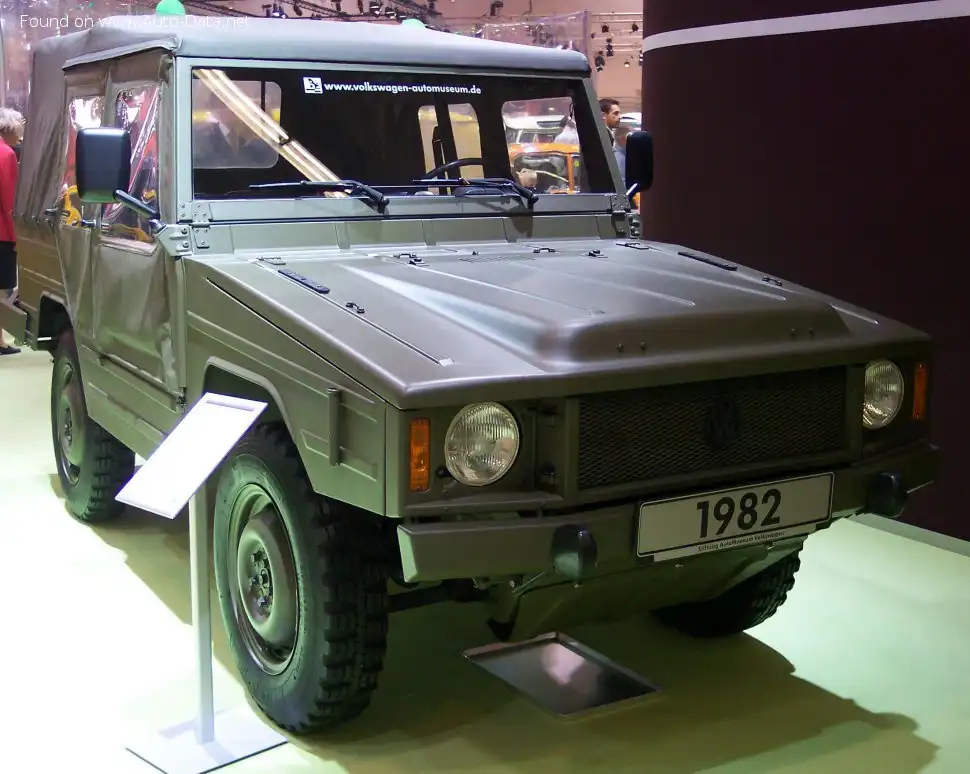
The Volkswagen Iltis, internally designated as the Type 183, was a rugged, utilitarian off-road vehicle produced by Volkswagen between 1978 and 1988. Distinct from the more widely known VW Bus and Beetle, the Iltis was designed specifically for military use, though a limited number of civilian versions were also produced. The 1.7-liter, 75 horsepower variant represents the base engine offering throughout much of its production run, serving as the workhorse of the Iltis lineup. It was a key component in Volkswagen’s bid to supply the German Bundeswehr with a light utility vehicle, a contract it ultimately won, solidifying the Iltis’s place in automotive history. The Iltis name, meaning “wolverine” in German, reflects the vehicle’s tenacious off-road capability.
Technical Specifications
| Brand | Volkswagen |
| Model | Iltis |
| Generation | Iltis (183) |
| Type (Engine) | 1.7 (183) (75 Hp) |
| Start of production | 1978 |
| End of production | 1988 |
| Powertrain Architecture | Internal Combustion Engine |
| Body type | Off-road vehicle, Cabriolet |
| Fuel Type | Petrol (Gasoline) |
| Power | 75 Hp |
| Engine Aspiration | Naturally Aspirated |
Introduction
The Volkswagen Iltis emerged from a requirement by the German Bundeswehr for a lightweight, all-terrain vehicle to replace aging Kübelwagen and Schwimmwagen models. Volkswagen, along with several other manufacturers, submitted prototypes. The Iltis, with its robust construction and four-wheel-drive system, proved the most capable and was selected in 1978. Production commenced shortly thereafter, initially for military applications. Civilian versions followed, though in significantly smaller numbers. The 1.7-liter engine, producing 75 horsepower, was the standard powerplant for the majority of the Iltis’s production run, offering a balance of reliability and sufficient power for its intended purpose. The Iltis is notable for its independent suspension on all four wheels, a relatively advanced feature for a vehicle of its type at the time. It shares some mechanical components with the Volkswagen Type 2 (Bus) but is fundamentally a different vehicle designed for far more demanding conditions.
Powertrain & Engine Architecture
The heart of the Iltis 1.7 was the Type 183 engine, a naturally aspirated, water-cooled, inline-four cylinder gasoline engine. While sharing some lineage with engines found in the Volkswagen Type 2 (Bus), the Iltis engine was specifically tuned for low-end torque and durability rather than outright horsepower. The engine displaced 1679cc and featured a single overhead camshaft (SOHC) valvetrain operating two valves per cylinder. Fuel delivery was managed by a Bosch mechanical fuel injection system, a relatively simple and reliable setup. The engine produced 75 horsepower at 5,200 rpm and approximately 108 lb-ft of torque at 3,000 rpm.
The Iltis was primarily equipped with a four-speed manual transmission, though a three-speed automatic transmission was offered as an option, particularly for military applications and some civilian models. The automatic transmission, while providing ease of use, did noticeably reduce performance and fuel economy compared to the manual. The transmission was coupled to a two-speed transfer case, providing selectable four-wheel drive with high and low range gearing. This transfer case was a crucial component of the Iltis’s off-road prowess, allowing it to tackle steep inclines and challenging terrain. The engine and transmission combination, while not particularly powerful by modern standards, proved remarkably durable and capable in the demanding environments for which the Iltis was designed.
Driving Characteristics
The Iltis 1.7 with the manual transmission offered a surprisingly capable driving experience, particularly off-road. Acceleration was modest, with a 0-60 mph time estimated around 18-20 seconds. However, the engine’s torque delivery made it well-suited to crawling over obstacles and maintaining momentum on uneven surfaces. The four-wheel-drive system, combined with the independent suspension, provided excellent traction and ride comfort, even on rough terrain. The automatic transmission version significantly dulled the driving experience, with noticeably slower acceleration and less responsive gear changes. The automatic’s gear ratios were optimized for low-speed operation, further sacrificing on-road performance. Steering was direct, though unassisted, requiring some effort at low speeds. Overall, the Iltis was not designed for high-speed cruising; its strengths lay in its ability to navigate challenging off-road conditions with confidence.
Equipment & Trim Levels
The Iltis was intentionally spartan in its equipment levels, reflecting its military origins. Standard features were minimal, focusing on functionality and durability. The interior typically featured vinyl or cloth seats, a simple dashboard with basic instrumentation (speedometer, fuel gauge, temperature gauge), and minimal sound insulation. Civilian models often included upgrades such as more comfortable seats, a radio, and optional features like a roll bar or winch. The military versions were typically painted in camouflage patterns and equipped with mounting points for radio equipment and other military gear. Trim levels were limited; the primary distinction was between military and civilian versions, with civilian models offering slightly more refinement and optional extras.
Chassis & Braking
The Iltis featured a robust ladder frame chassis, providing a solid foundation for its off-road capabilities. All four wheels were equipped with independent suspension, utilizing trailing arms and torsion bars. This independent suspension system was a key factor in the Iltis’s ability to maintain contact with the ground on uneven terrain. Braking was initially accomplished with drum brakes on all four wheels. Later models, particularly those destined for civilian use, were often upgraded with front disc brakes for improved stopping power. Steering was a recirculating ball system, providing direct but unassisted control. The Iltis’s relatively short wheelbase and high ground clearance further enhanced its off-road maneuverability.
Market Reception & Comparison
The Iltis was never intended to be a mass-market vehicle. Its primary success was as a military utility vehicle, where it proved highly reliable and capable. Civilian reception was more muted, due to its spartan interior, modest performance, and relatively high price compared to other off-road vehicles of the era. Critics generally praised the Iltis’s off-road prowess and durability but noted its lack of refinement and on-road comfort. Compared to other Volkswagen models, such as the Type 2 Bus, the Iltis offered significantly greater off-road capability but at the expense of practicality and passenger comfort. Compared to other dedicated off-road vehicles like the Jeep CJ, the Iltis offered a more sophisticated suspension system but lacked the Jeep’s established reputation and aftermarket support.
Legacy
The Volkswagen Iltis, despite its relatively short production run, left a lasting legacy. It proved Volkswagen’s ability to design and manufacture a highly capable off-road vehicle and served the German Bundeswehr faithfully for many years. The Iltis also served as the basis for the Volkswagen GX, a limited-production luxury off-road vehicle developed by Steyr-Daimler-Puch in Austria. Today, the Iltis is a sought-after vehicle among collectors and off-road enthusiasts. The 1.7-liter engine, while not particularly powerful, is known for its reliability and relative simplicity, making it a relatively easy engine to maintain. Well-maintained Iltis models command a premium in the used car market, reflecting their rarity and unique character. The Iltis stands as a testament to Volkswagen’s engineering ingenuity and its commitment to producing vehicles that can withstand the most demanding conditions.
