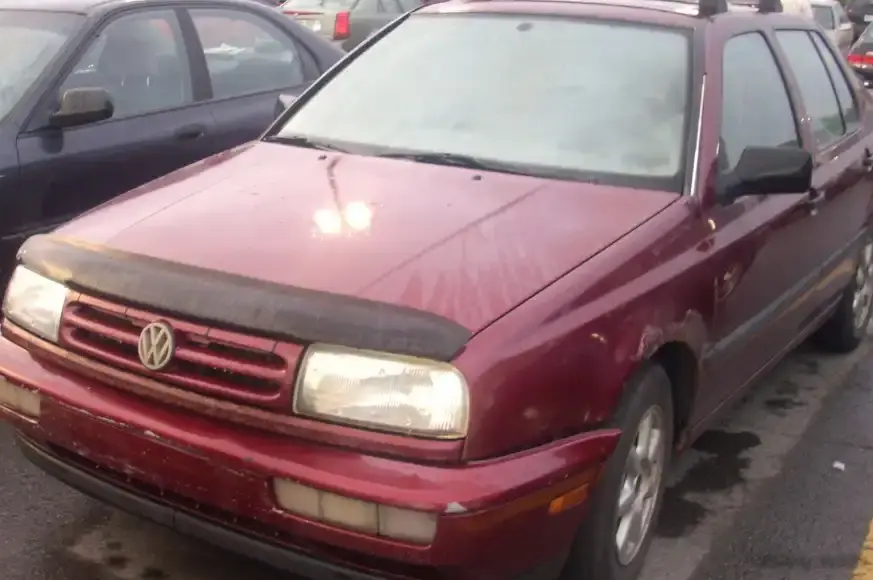
The Volkswagen Jetta III 2.0 (115 hp) Automatic, produced from 1994 to 1995, was a key offering within the third generation of Volkswagen’s popular Jetta sedan. Built on the Volkswagen Group’s A3 platform (internally designated 1HX0), this variant aimed to provide a comfortable and accessible entry point into the Jetta range, balancing fuel efficiency with adequate performance for everyday driving. It served as a more affordable and relaxed alternative to the sportier GLX and VR6 models, appealing to buyers prioritizing practicality and ease of use. This model was primarily marketed in North America and Europe, where the Jetta held a strong position as a compact family car.
Technical Specifications
| Brand | Volkswagen |
| Model | Jetta |
| Generation | Jetta III |
| Type (Engine) | 2.0 (115 Hp) Automatic |
| Start of production | 1994 |
| End of production | 1995 |
| Powertrain Architecture | Internal Combustion engine |
| Body type | Sedan |
| Seats | 4 |
| Doors | 4 |
| Fuel consumption (urban) | 11.6 l/100 km (20.3 US mpg) |
| Fuel consumption (extra urban) | 6.5 l/100 km (36.2 US mpg) |
| Fuel consumption (combined) | 8.2 l/100 km (28.7 US mpg) |
| Fuel Type | Petrol (Gasoline) |
| Acceleration 0 – 100 km/h | 11.9 sec |
| Acceleration 0 – 62 mph | 11.9 sec |
| Acceleration 0 – 60 mph | 11.3 sec |
| Maximum speed | 194 km/h (120.55 mph) |
| Weight-to-power ratio | 10.7 kg/Hp |
| Weight-to-torque ratio | 7.3 kg/Nm |
| Power | 115 Hp @ 5200 rpm |
| Torque | 170 Nm @ 2400 rpm (125.39 lb.-ft. @ 2400 rpm) |
| Engine layout | Front, Transverse |
| Engine Model/Code | ABA |
| Engine displacement | 1984 cm3 (121.07 cu. in.) |
| Number of cylinders | 4 |
| Engine configuration | Inline |
| Cylinder Bore | 82.5 mm (3.25 in.) |
| Piston Stroke | 92.8 mm (3.65 in.) |
| Compression ratio | 10:1 |
| Number of valves per cylinder | 2 |
| Fuel injection system | Multi-port manifold injection |
| Engine aspiration | Naturally aspirated engine |
| Valvetrain | OHC |
| Engine oil capacity | 4 l (4.23 US qt | 3.52 UK qt) |
| Coolant capacity | 5 l (5.28 US qt | 4.4 UK qt) |
| Kerb Weight | 1235 kg (2722.71 lbs.) |
| Max. weight | 1630 kg (3593.53 lbs.) |
| Max load | 395 kg (870.83 lbs.) |
| Trunk (boot) space – minimum | 425 l (15.01 cu. ft.) |
| Trunk (boot) space – maximum | 885 l (31.25 cu. ft.) |
| Fuel tank capacity | 55 l (14.53 US gal | 12.1 UK gal) |
| Length | 4380 mm (172.44 in.) |
| Width | 1695 mm (66.73 in.) |
| Height | 1415 mm (55.71 in.) |
| Wheelbase | 2475 mm (97.44 in.) |
| Front track | 1464 mm (57.64 in.) |
| Rear track | 1448 mm (57.01 in.) |
| Drivetrain Architecture | Front wheel drive |
| Number of gears | 4 |
| Gearbox type | Automatic transmission |
| Front suspension | Wishbone |
| Rear suspension | Suspension with traction connecting levers |
| Front brakes | Ventilated discs |
| Rear brakes | Disc |
| Assisting systems | ABS (Anti-lock braking system) |
| Steering type | Steering rack and pinion |
| Power steering | Hydraulic Steering |
| Tires size | 205/50 R15 |
| Wheel rims size | 15 |
Powertrain & Engine Architecture
The Jetta III 2.0 Automatic was powered by the Volkswagen ABA engine, a 1.984-liter (121.07 cubic inches) inline-four cylinder gasoline engine. This engine was a mainstay of the Volkswagen lineup during the early to mid-1990s, known for its relative simplicity and durability. The ABA featured a single overhead camshaft (OHC) design with two valves per cylinder. Fuel delivery was handled by a Bosch multi-port fuel injection system, providing adequate atomization for efficient combustion. The engine produced 115 horsepower at 5200 rpm and 170 Nm (125.39 lb-ft) of torque at 2400 rpm. The automatic transmission was a four-speed unit, designed to provide smooth and convenient shifting. While not particularly sporty, it was well-suited to the engine’s torque curve and the intended use case of the vehicle.
Driving Characteristics
The 2.0-liter automatic Jetta offered a comfortable, if not exhilarating, driving experience. Acceleration from 0 to 60 mph took approximately 11.3 seconds, and top speed was around 120.55 mph. Compared to the manual transmission version of the same engine, the automatic resulted in a slight performance decrease due to the inherent power loss in the torque converter. The four-speed automatic transmission featured relatively conservative gear ratios, prioritizing fuel economy and smooth cruising over rapid acceleration. Compared to the higher-performance VR6 models, the 2.0 Automatic felt significantly less powerful, but it offered a more relaxed and fuel-efficient alternative. The automatic transmission also differentiated it from the more driver-focused experience of the five-speed manual versions.
Equipment & Trim Levels
The 2.0 Automatic Jetta typically came equipped with a reasonable level of standard features. These included power steering, air conditioning, and an AM/FM radio. Interior upholstery was typically cloth, with a relatively simple dashboard layout. Optional extras included a sunroof, upgraded audio systems, and alloy wheels. The trim level generally sat in the mid-range of the Jetta lineup, offering more features than the base models but lacking the luxury appointments of the GLX or the performance enhancements of the VR6.
Chassis & Braking
The Jetta III utilized a front-wheel-drive layout with an independent wishbone suspension at the front and a semi-independent suspension with traction connecting levers at the rear. The front brakes were ventilated discs, providing adequate stopping power, while the rear brakes were solid discs. ABS (Anti-lock Braking System) was standard, enhancing safety. The suspension tuning was geared towards comfort, providing a relatively smooth ride over most road surfaces. Stabilizer bars were included to reduce body roll during cornering, but the overall handling was not particularly sporty.
Market Reception & Comparison
The Jetta III 2.0 Automatic was generally well-received as a practical and reliable family car. Critics praised its comfortable ride, spacious interior, and reasonable fuel economy. However, some noted its lack of performance compared to competitors and the more engaging driving experience offered by the manual transmission versions. Fuel economy was rated at around 28.7 US mpg combined, which was competitive for its time. Reliability was generally good, although routine maintenance was essential to prevent issues with the fuel injection system and automatic transmission. Compared to the VR6, the 2.0 Automatic was significantly more affordable to purchase and maintain, making it a popular choice for budget-conscious buyers.
Legacy
The Volkswagen Jetta III 2.0 Automatic has proven to be a relatively durable and long-lasting vehicle. Many examples are still on the road today, a testament to the quality of its engineering. The ABA engine is known for its robustness, and the automatic transmission, while not the most advanced, is generally reliable if properly maintained. In the used car market, these Jettas are often sought after by enthusiasts looking for a classic Volkswagen that is relatively affordable to own and maintain. While not a performance icon, the 2.0 Automatic Jetta III represents a solid and dependable choice for those seeking a practical and comfortable compact sedan.