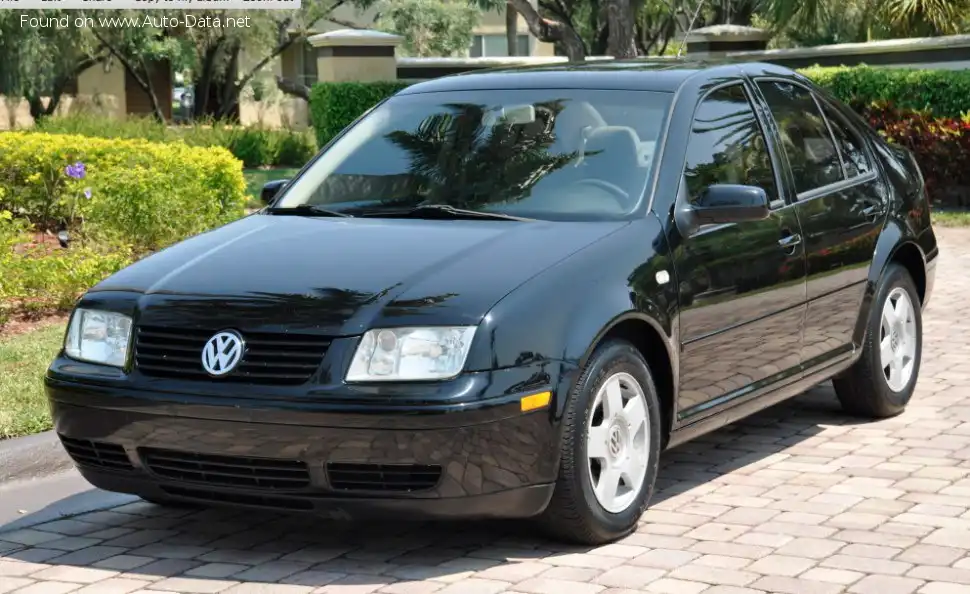
The Volkswagen Jetta IV 1.6, producing 101 horsepower, was a mainstay of the fourth-generation Jetta (Mk4) lineup, primarily marketed in Europe and other regions outside of North America between 1999 and 2000. Positioned as the entry-level engine option, it offered a balance of affordability and practicality within the A4 platform, which also underpinned models like the Golf, Bora, and New Beetle. This variant aimed at buyers prioritizing fuel efficiency and lower running costs over outright performance. It represented a significant step forward in refinement and build quality compared to its predecessor, the Mk3 Jetta, while maintaining the core values of a comfortable and reliable family sedan.
Technical Specifications
| Brand | Volkswagen |
| Model | Jetta |
| Generation | Jetta IV |
| Type (Engine) | 1.6 (101 Hp) |
| Start of production | 1999 |
| End of production | 2000 |
| Powertrain Architecture | Internal Combustion engine |
| Body type | Sedan |
| Seats | 5 |
| Doors | 4 |
| Fuel consumption (urban) | 10.6 l/100 km (22.2 US mpg, 26.6 UK mpg, 9.4 km/l) |
| Fuel consumption (extra urban) | 6 l/100 km (39.2 US mpg, 47.1 UK mpg, 16.7 km/l) |
| Fuel consumption (combined) | 7.7 l/100 km (30.5 US mpg, 36.7 UK mpg, 13 km/l) |
| Fuel Type | Petrol (Gasoline) |
| Acceleration 0 – 100 km/h | 11.7 sec |
| Acceleration 0 – 62 mph | 11.7 sec |
| Acceleration 0 – 60 mph | 11.1 sec |
| Maximum speed | 188 km/h (116.82 mph) |
| Weight-to-power ratio | 11.7 kg/Hp, 85.2 Hp/tonne |
| Weight-to-torque ratio | 8.2 kg/Nm, 122.4 Nm/tonne |
| Power | 101 Hp @ 5600 rpm |
| Power per litre | 63.3 Hp/l |
| Torque | 145 Nm @ 3800 rpm (106.95 lb.-ft. @ 3800 rpm) |
| Engine layout | Front, Longitudinal |
| Engine Model/Code | ANL |
| Engine displacement | 1595 cm3 (97.33 cu. in.) |
| Number of cylinders | 4 |
| Engine configuration | Inline |
| Cylinder Bore | 81 mm (3.19 in.) |
| Piston Stroke | 77.4 mm (3.05 in.) |
| Compression ratio | 10.3:1 |
| Number of valves per cylinder | 2 |
| Fuel injection system | Multi-port manifold injection |
| Engine aspiration | Naturally aspirated engine |
| Valvetrain | OHC |
| Engine oil capacity | 4.7 l (4.97 US qt | 4.14 UK qt) |
| Coolant capacity | 6.3 l (6.66 US qt | 5.54 UK qt) |
| Kerb Weight | 1185 kg (2612.48 lbs.) |
| Max. weight | 1720 kg (3791.95 lbs.) |
| Max load | 535 kg (1179.47 lbs.) |
| Trunk (boot) space – minimum | 455 l (16.07 cu. ft.) |
| Trunk (boot) space – maximum | 785 l (27.72 cu. ft.) |
| Fuel tank capacity | 55 l (14.53 US gal | 12.1 UK gal) |
| Length | 4376 mm (172.28 in.) |
| Width | 1735 mm (68.31 in.) |
| Height | 1446 mm (56.93 in.) |
| Wheelbase | 2513 mm (98.94 in.) |
| Front track | 1513 mm (59.57 in.) |
| Rear (Back) track | 1494 mm (58.82 in.) |
| Drivetrain Architecture | The Internal combustion engine (ICE) drives the front wheels of the vehicle. |
| Drive wheel | Front wheel drive |
| Number of gears and type of gearbox | 5 gears, manual transmission |
| Front suspension | Coil spring |
| Rear suspension | Coil spring |
| Front brakes | Ventilated discs |
| Rear brakes | Disc |
| Assisting systems | ABS (Anti-lock braking system) |
| Steering type | Steering rack and pinion |
| Power steering | Hydraulic Steering |
| Tires size | 195/65 R 15 |
| Wheel rims size | 6J x 15 |
Powertrain & Engine Architecture
The Jetta IV 1.6 utilized the Volkswagen ANL engine code, a naturally aspirated, 1.6-liter inline-four cylinder gasoline engine. This engine was a relatively simple design, featuring a single overhead camshaft (OHC) operating two valves per cylinder. Fuel delivery was managed by a multi-port fuel injection system, providing adequate, though not exceptional, combustion efficiency. The ANL engine was known for its durability and relatively straightforward maintenance requirements. The 101 horsepower output was achieved at 5600 rpm, while peak torque of 145 Nm (106.95 lb-ft) arrived at 3800 rpm. The engine’s longitudinal mounting within the engine bay was a characteristic of the Mk4 platform. The standard transmission for this variant was a five-speed manual, though a four-speed automatic transmission was also offered, impacting performance and fuel economy.
Driving Characteristics
The 1.6-liter engine, paired with the five-speed manual transmission, provided adequate performance for everyday driving. Acceleration to 60 mph took approximately 11.1 seconds, and top speed was around 116.82 mph. However, it wasn’t a particularly sporty experience. The engine felt somewhat strained when pushed hard, and overtaking maneuvers required careful planning. The automatic transmission version further diminished performance, with slower acceleration and a less engaging driving experience. Gear ratios were optimized for fuel efficiency rather than outright speed. Compared to the more powerful 1.8-liter turbocharged or VR6 engines available in the Jetta IV range, the 1.6 felt noticeably underpowered, but it offered a smoother, more linear power delivery, making it easier to drive in urban environments.
Equipment & Trim Levels
The 1.6-liter Jetta IV typically came with a base level of equipment. Standard features generally included power steering, central locking, electric front windows, and an AM/FM radio. Interior upholstery was typically cloth, and the dashboard featured a relatively simple design. Optional extras included air conditioning, alloy wheels, a sunroof, and upgraded audio systems. Trim levels varied depending on the market, but the 1.6 generally represented the entry point to the Jetta IV range. Higher trim levels, such as the GL, offered more luxurious features and upgraded interior materials.
Chassis & Braking
The Jetta IV 1.6 utilized a MacPherson strut front suspension and a multi-link rear suspension, providing a comfortable and controlled ride. Front brakes were ventilated discs, while rear brakes were typically solid discs. Anti-lock Braking System (ABS) was standard, enhancing safety. The suspension was tuned for comfort rather than sporty handling, and the car exhibited a moderate degree of body roll in corners. Stabilizer bars were present at both the front and rear, helping to reduce body roll and improve stability. The relatively light weight of the 1.6-liter model contributed to its manageable handling characteristics.
Market Reception & Comparison
The Jetta IV 1.6 was generally well-received as an affordable and practical family sedan. Critics praised its comfortable ride, spacious interior, and good build quality. However, the engine’s lack of power was a common criticism. Compared to the 1.8-liter turbocharged and VR6 models, the 1.6 offered significantly lower performance but also better fuel economy. The 1.8-liter models were favored by drivers seeking more spirited performance, while the 1.6 appealed to those prioritizing economy and affordability. Reliability was generally good, although the automatic transmission versions were sometimes prone to issues.
Legacy
The Volkswagen Jetta IV 1.6, while not the most exciting variant in the lineup, proved to be a reliable and durable vehicle. The ANL engine is known for its longevity, and many examples are still on the road today. In the used car market, these models are often sought after by buyers looking for an affordable and dependable transportation option. Maintenance costs are relatively low, and parts availability is generally good. The Jetta IV 1.6 represents a solid, if unspectacular, chapter in Volkswagen’s history, offering a practical and economical choice for drivers in the late 1990s and early 2000s.