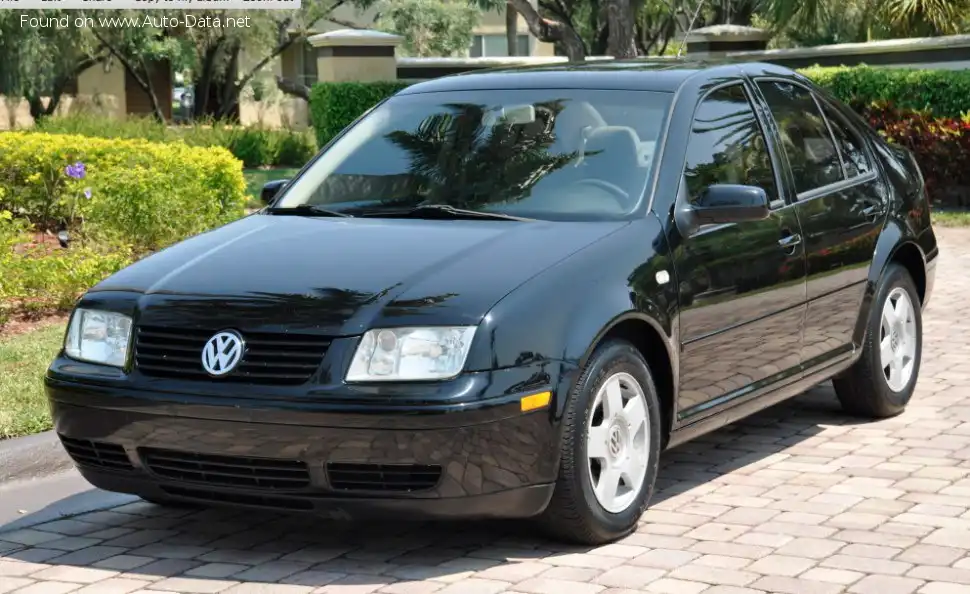
The Volkswagen Jetta IV 2.0, produced from 1998 to 2005, marked a significant step forward in Volkswagen’s compact sedan lineup. As part of the fourth-generation Jetta (internally designated 1HX0/A3), this variant occupied a middle-ground position, balancing affordability with a noticeable increase in performance over the base models. It was primarily targeted towards the North American market, where sedans were the preferred body style, and served as a direct competitor to popular vehicles like the Honda Civic and Toyota Corolla. The 2.0-liter engine offered a compelling alternative to the entry-level 1.8L options, while remaining more accessible than the range-topping VR6.
Technical Specifications
| Brand | Volkswagen |
| Model | Jetta |
| Generation | Jetta IV |
| Engine Type | 2.0 (115 Hp) |
| Start of production | 1998 |
| End of production | 2005 |
| Powertrain Architecture | Internal Combustion engine |
| Body type | Sedan |
| Seats | 5 |
| Doors | 4 |
| Fuel consumption (urban) | 11 l/100 km (21.4 US mpg) |
| Fuel consumption (extra urban) | 6.2 l/100 km (37.9 US mpg) |
| Fuel Type | Petrol (Gasoline) |
| Acceleration 0 – 100 km/h | 11 sec |
| Acceleration 0 – 62 mph | 11 sec |
| Acceleration 0 – 60 mph | 10.5 sec |
| Maximum speed | 195 km/h (121.17 mph) |
| Weight-to-power ratio | 10.8 kg/Hp |
| Weight-to-torque ratio | 7.3 kg/Nm |
| Power | 115 Hp @ 5200 rpm |
| Power per litre | 58 Hp/l |
| Torque | 170 Nm @ 2400 rpm (125.39 lb.-ft. @ 2400 rpm) |
| Engine layout | Front, Transverse |
| Engine Model/Code | AVH, BBW, BEV |
| Engine displacement | 1984 cm3 (121.07 cu. in.) |
| Number of cylinders | 4 |
| Engine configuration | Inline |
| Cylinder Bore | 82.5 mm (3.25 in.) |
| Piston Stroke | 92.8 mm (3.65 in.) |
| Compression ratio | 10:1 |
| Number of valves per cylinder | 2 |
| Fuel injection system | Multi-port manifold injection |
| Engine aspiration | Naturally aspirated engine |
| Valvetrain | OHC |
| Engine oil capacity | 4.2 l (4.44 US qt | 3.7 UK qt) |
| Coolant | 5 l (5.28 US qt | 4.4 UK qt) |
| Kerb Weight | 1237 kg (2727.12 lbs.) |
| Max. weight | 1770 kg (3902.18 lbs.) |
| Max load | 533 kg (1175.06 lbs.) |
| Trunk (boot) space – minimum | 455 l (16.07 cu. ft.) |
| Trunk (boot) space – maximum | 785 l (27.72 cu. ft.) |
| Fuel tank capacity | 55 l (14.53 US gal | 12.1 UK gal) |
| Length | 4376 mm (172.28 in.) |
| Width | 1735 mm (68.31 in.) |
| Height | 1446 mm (56.93 in.) |
| Wheelbase | 2513 mm (98.94 in.) |
| Front track | 1513 mm (59.57 in.) |
| Rear (Back) track | 1494 mm (58.82 in.) |
| Drivetrain Architecture | The Internal combustion engine (ICE) drives the front wheels of the vehicle. |
| Drive wheel | Front wheel drive |
| Number of gears and type of gearbox | 5 gears, manual transmission |
| Front suspension | Coil spring |
| Rear suspension | Coil spring |
| Front brakes | Ventilated discs |
| Rear brakes | Disc |
| Assisting systems | ABS (Anti-lock braking system) |
| Steering type | Steering rack and pinion |
| Power steering | Hydraulic Steering |
| Tires size | 195/65 R15 |
| Wheel rims size | 6J x 15 |
Powertrain & Engine Architecture
The Jetta IV 2.0 employed various iterations of the Volkswagen EA827 engine family, most commonly the AVH, BBW, and BEV engine codes, depending on the model year and specific market. These were 2.0-liter inline-four cylinder engines featuring a single overhead camshaft (SOHC) valvetrain with two valves per cylinder. The multi-port fuel injection system delivered fuel directly into the intake ports, striking a balance between fuel efficiency and performance. The engine’s design emphasized reliability and ease of maintenance, making it a practical choice for everyday use. The 2.0-liter engine generated 115 horsepower at 5200 rpm and 170 Nm (125 lb-ft) of torque at 2400 rpm. Power was typically transferred to the front wheels through a standard five-speed manual transmission, although a four-speed automatic transmission was also offered, and proved popular with buyers prioritizing convenience.
Driving Characteristics
The Jetta IV 2.0 equipped with the manual transmission provided respectable acceleration, reaching 0-60 mph in approximately 10.5 seconds. The optional four-speed automatic transmission, while offering smoother gear changes, resulted in slightly slower acceleration, generally around 11 seconds. The engine’s torque curve was relatively flat, providing sufficient power for typical driving scenarios. Compared to the more potent VR6 models, the 2.0-liter engine felt less responsive, particularly when overtaking on the highway. However, it presented a more economical and affordable alternative. The automatic transmission, while not particularly sporty, was well-suited for commuting and relaxed cruising. The gear ratios were optimized for fuel economy rather than maximizing performance.
Equipment & Trim Levels
The Jetta IV 2.0 was available in a range of trim levels, including Trend, Comfort, and GLX. The base Trend model generally included standard features such as air conditioning, power windows and door locks, and an AM/FM radio. The Comfort trim added enhancements like alloy wheels, a sunroof, and upgraded interior upholstery. The top-tier GLX trim offered premium features such as leather seats, automatic climate control, and a higher-quality sound system. Interior upholstery was typically cloth, with leather available as an option on the higher trim levels. Dashboard layouts were relatively straightforward and functional, prioritizing ease of use over elaborate aesthetics. Optional extras included a CD changer, heated front seats, and a trip computer.
Chassis & Braking
The Jetta IV featured a MacPherson strut front suspension and a multi-link rear suspension, delivering a comfortable and controlled ride quality. The suspension tuning prioritized everyday comfort over aggressive handling. Braking systems varied depending on the trim level. Base models typically had disc brakes on the front wheels and drum brakes on the rear. Higher trims often included disc brakes on all four wheels, providing improved stopping power. An anti-lock braking system (ABS) was standard across all models. Stabilizer bars were fitted to both the front and rear axles to minimize body roll during cornering maneuvers.
Market Reception & Comparison
The Jetta IV 2.0 generally received positive reviews from automotive journalists. It was praised for its comfortable ride, spacious interior, and dependable powertrain. However, some critics pointed out that the engine lacked the refinement and power found in some of its competitors. Fuel economy was considered average for its class. Compared to the 1.8L models, the 2.0-liter offered a noticeable performance improvement, but at a slightly higher price. In contrast to the VR6, it provided a more affordable and fuel-efficient option, albeit with less overall power. The automatic transmission sometimes drew criticism for feeling somewhat dated and lacking the smoothness of more modern automatic gearboxes.
Legacy
The Jetta IV 2.0, particularly those equipped with the AVH engine code, has proven to be a remarkably reliable vehicle over the long term. The EA827 engine family is well-known for its durability and relatively low maintenance costs. Common issues, such as oil leaks and occasional sensor failures, are generally inexpensive to address. In the used car market, the Jetta IV 2.0 remains a popular choice for budget-conscious buyers seeking a dependable and practical sedan. Its straightforward design and readily available parts make it an appealing option for those comfortable with DIY maintenance. While not a performance icon, the Jetta IV 2.0 represents a solid and trustworthy offering from Volkswagen during a significant period in the company’s history.