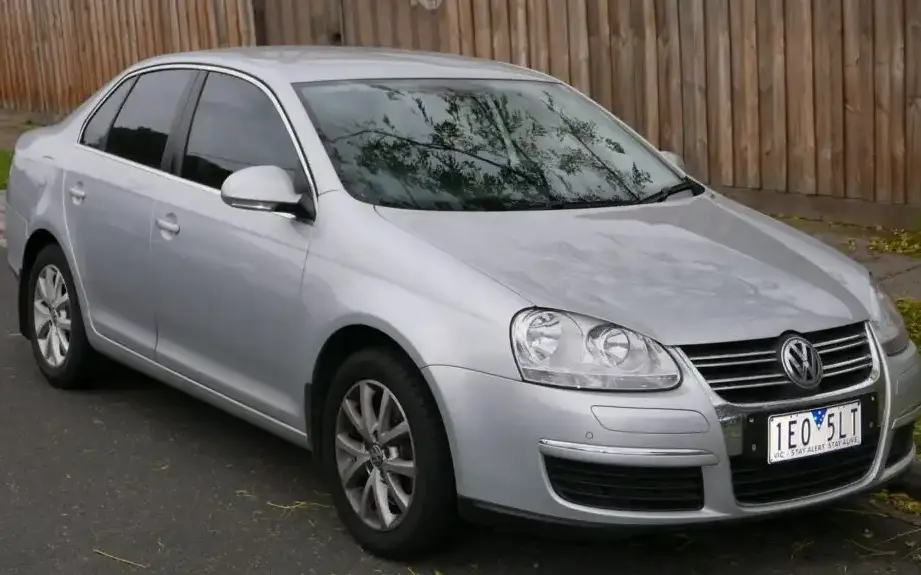
The Volkswagen Jetta V, produced from 2005 to 2010, represented a significant step forward for Volkswagen’s compact sedan. The 1.4 TSI (140 hp) variant with the Direct-Shift Gearbox (DSG) – available from 2006 to 2008 – occupied a key position in the Jetta V lineup, offering a blend of fuel efficiency and respectable performance. This model aimed to bridge the gap between the base 2.0L engine and the more powerful 2.5L options, appealing to buyers seeking a modern, technologically advanced compact car. It was primarily marketed in Europe and other global markets, with limited availability in the United States.
Technical Specifications
| Brand | Volkswagen |
| Model | Jetta |
| Generation | Jetta V |
| Type (Engine) | 1.4 TSI (140 Hp) DSG |
| Start of production | 2006 |
| End of production | 2008 |
| Powertrain Architecture | Internal Combustion engine |
| Body type | Sedan |
| Seats | 5 |
| Doors | 4 |
| Fuel consumption (urban) | 8 l/100 km (29.4 US mpg) |
| Fuel consumption (extra urban) | 5.4 l/100 km (43.6 US mpg) |
| Fuel consumption (combined) | 6.4 l/100 km (36.8 US mpg) |
| Fuel Type | Petrol (Gasoline) |
| Acceleration 0 – 100 km/h | 9.8 sec |
| Acceleration 0 – 62 mph | 9.8 sec |
| Acceleration 0 – 60 mph | 9.3 sec |
| Maximum speed | 220 km/h (136.7 mph) |
| Emission standard | Euro 4 |
| Weight-to-power ratio | 9.9 kg/Hp |
| Weight-to-torque ratio | 6.3 kg/Nm |
| Power | 140 Hp @ 5600 rpm |
| Torque | 220 Nm @ 1500-4000 rpm (162.26 lb.-ft.) |
| Engine layout | Front, Transverse |
| Engine Model/Code | BMY |
| Engine displacement | 1390 cm3 (84.82 cu. in.) |
| Number of cylinders | 4 |
| Engine configuration | Inline |
| Cylinder Bore | 76.5 mm (3.01 in.) |
| Piston Stroke | 75.6 mm (2.98 in.) |
| Number of valves per cylinder | 4 |
| Fuel injection system | Direct injection |
| Engine aspiration | Turbocharging and Supercharger, Intercooler |
| Valvetrain | DOHC |
| Engine oil capacity | 3.6 l (3.8 US qt | 3.17 UK qt) |
| Coolant | 5.6 l (5.92 US qt | 4.93 UK qt) |
| Kerb Weight | 1380 kg (3042.38 lbs.) |
| Max. weight | 1870 kg (4122.64 lbs.) |
| Max load | 490 kg (1080.27 lbs.) |
| Trunk (boot) space – minimum | 527 l (18.61 cu. ft.) |
| Fuel tank capacity | 55 l (14.53 US gal | 12.1 UK gal) |
| Length | 4554 mm (179.29 in.) |
| Width | 1781 mm (70.12 in.) |
| Height | 1459 mm (57.44 in.) |
| Wheelbase | 2578 mm (101.5 in.) |
| Front track | 1534 mm (60.39 in.) |
| Rear (Back) track | 1512 mm (59.53 in.) |
| Minimum turning circle | 10.9 m (35.76 ft.) |
| Drivetrain Architecture | Front wheel drive |
| Number of gears and type of gearbox | 6 gears, automatic transmission |
| Front suspension | Coil spring, Wishbone, Transverse stabilizer |
| Rear suspension | Independent multi-link suspension, Transverse stabilizer |
| Front brakes | Ventilated discs |
| Rear brakes | Disc |
| Assisting systems | ABS (Anti-lock braking system) |
| Steering type | Steering rack and pinion |
| Power steering | Electric Steering |
| Tires size | 205/55 R16 |
| Wheel rims size | 6.5 x 16 |
INTRODUCTION
The Jetta V, built on the Volkswagen Group’s A5 platform (also known as the 1HX0/A3 platform), represented a move upmarket for the Jetta. Compared to its predecessor, the Jetta IV, the V offered a more refined interior, improved ride quality, and a wider range of engine options. The 1.4 TSI with DSG was introduced as a technologically advanced option, combining direct fuel injection, turbocharging, and a sophisticated dual-clutch transmission. This configuration was particularly popular in Europe, where fuel economy and emissions regulations were becoming increasingly stringent. It aimed to provide a balance between performance and efficiency, appealing to drivers who wanted a more engaging driving experience than the base models but didn’t require the higher power output of the larger engines.
Powertrain & Engine Architecture
The heart of this Jetta variant is the 1.4-liter TSI (Turbocharged Stratified Injection) engine, specifically the BMY engine code. This engine is notable for its combination of a turbocharger *and* a supercharger – a relatively uncommon setup. The supercharger provides instant boost at low engine speeds, eliminating turbo lag, while the turbocharger takes over at higher speeds for sustained power delivery. This dual-charging system, coupled with direct fuel injection, allows for a broad torque curve and improved fuel efficiency. The engine utilizes a double overhead camshaft (DOHC) valvetrain with four valves per cylinder. The DSG (Direct-Shift Gearbox) is a six-speed automatic transmission that operates like a manual gearbox but without the need for a clutch pedal. It uses two separate clutches to pre-select the next gear, resulting in incredibly fast and smooth gear changes. This transmission significantly enhances the driving experience, providing quicker acceleration and improved fuel economy compared to a traditional automatic.
Driving Characteristics
The 1.4 TSI with DSG delivers a surprisingly lively driving experience. While 140 horsepower might not sound like much, the engine’s 220 Nm (162 lb-ft) of torque, available from a low 1500 rpm, provides ample pulling power for everyday driving. The DSG transmission contributes to this feeling of responsiveness, allowing for quick downshifts and seamless acceleration. Compared to the base 2.0L Jetta V, the 1.4 TSI offers noticeably quicker acceleration and a more refined feel. However, it doesn’t match the outright performance of the 2.5L models. The gear ratios in the DSG are well-tuned for both city and highway driving, providing a good balance between acceleration and fuel economy. The engine is generally quiet and refined, but can become slightly noisy under hard acceleration.
Equipment & Trim Levels
The 1.4 TSI DSG typically came equipped with a reasonable level of standard features. These generally included air conditioning, power windows and locks, a CD stereo system, and alloy wheels. Interior upholstery was typically cloth, although leather options were available. Higher trim levels offered additional features such as a sunroof, upgraded audio system, and automatic climate control. Optional extras included navigation systems, parking sensors, and heated seats. The dashboard layout was generally functional and well-designed, with a clear instrument cluster and easy-to-use controls.
Chassis & Braking
The Jetta V featured an independent suspension system, with coil springs and wishbones at the front and a multi-link suspension at the rear. This setup provides a comfortable ride and good handling characteristics. The 1.4 TSI models typically came with ventilated disc brakes at the front and solid disc brakes at the rear. ABS (Anti-lock Braking System) was standard. The suspension was tuned to provide a balance between comfort and handling, making it suitable for both city driving and longer journeys. Stabilizer bars were fitted to both the front and rear axles to reduce body roll during cornering.
Market Reception & Comparison
The 1.4 TSI DSG Jetta V was generally well-received by automotive critics. It was praised for its fuel efficiency, refined engine, and smooth-shifting DSG transmission. However, some critics noted that the engine could feel slightly strained when pushed hard, and that the interior materials weren’t quite as luxurious as some of its competitors. Compared to the 2.0L Jetta V, the 1.4 TSI offered better performance and fuel economy, but at a higher price point. Compared to the 2.5L models, it offered similar fuel economy but less power. The 1.9 TDI diesel variant was a popular alternative in Europe, offering even better fuel economy but a different driving experience.
Legacy
The 1.4 TSI engine and DSG transmission proved to be a reliable combination, although some owners have reported issues with the DSG transmission over the long term, particularly with early units. Regular maintenance, including fluid changes, is crucial for ensuring the longevity of the DSG. Today, the Jetta V 1.4 TSI DSG can be found on the used car market at relatively affordable prices. It remains a good option for buyers looking for a fuel-efficient and well-equipped compact sedan. The engine’s innovative dual-charging system and the DSG transmission were significant advancements in automotive technology, and helped to establish Volkswagen as a leader in engine design and transmission technology.