Technical Specifications
| Brand | Volkswagen |
| Model | Jetta |
| Generation | Jetta V |
| Type (Engine) | 1.6 i (102 Hp) Automatic |
| Start of production | 2005 |
| End of production | 2010 |
| Powertrain Architecture | Internal Combustion engine |
| Body type | Sedan |
| Seats | 5 |
| Doors | 4 |
| Fuel consumption (urban) | 11.3 l/100 km (20.8 US mpg) |
| Fuel consumption (extra urban) | 6.4 l/100 km (36.8 US mpg) |
| Fuel consumption (combined) | 8.2 l/100 km (28.7 US mpg) |
| Fuel Type | Petrol (Gasoline) |
| Acceleration 0 – 100 km/h | 13.3 sec |
| Acceleration 0 – 62 mph | 13.3 sec |
| Acceleration 0 – 60 mph | 12.6 sec |
| Maximum speed | 183 km/h (113.71 mph) |
| Weight-to-power ratio | 12.4 kg/Hp |
| Weight-to-torque ratio | 8.6 kg/Nm |
| Power | 102 Hp @ 5600 rpm |
| Torque | 148 Nm @ 3800 rpm (109.16 lb.-ft. @ 3800 rpm) |
| Engine layout | Front, Transverse |
| Engine Model/Code | BSE, BSF |
| Engine displacement | 1595 cm3 (97.33 cu. in.) |
| Number of cylinders | 4 |
| Engine configuration | Inline |
| Cylinder Bore | 81 mm (3.19 in.) |
| Piston Stroke | 77.4 mm (3.05 in.) |
| Compression ratio | 10.5:1 |
| Number of valves per cylinder | 2 |
| Fuel injection system | Multi-port manifold injection |
| Engine aspiration | Naturally aspirated engine |
| Valvetrain | OHC |
| Engine oil capacity | 4.5 l (4.76 US qt | 3.96 UK qt) |
| Coolant capacity | 8 l (8.45 US qt | 7.04 UK qt) |
| Kerb Weight | 1268 kg (2795.46 lbs.) |
| Max. weight | 1870 kg (4122.64 lbs.) |
| Max load | 602 kg (1327.18 lbs.) |
| Trunk (boot) space – minimum | 527 l (18.61 cu. ft.) |
| Fuel tank capacity | 55 l (14.53 US gal | 12.1 UK gal) |
| Length | 4554 mm (179.29 in.) |
| Width | 1781 mm (70.12 in.) |
| Height | 1459 mm (57.44 in.) |
| Wheelbase | 2578 mm (101.5 in.) |
| Front track | 1534 mm (60.39 in.) |
| Rear track | 1512 mm (59.53 in.) |
| Minimum turning circle | 10.9 m (35.76 ft.) |
| Drivetrain Architecture | Front wheel drive |
| Number of gears | 6 |
| Gearbox type | Automatic transmission |
| Front suspension | Coil spring, Wishbone, Transverse stabilizer |
| Rear suspension | Independent multi-link suspension, Transverse stabilizer |
| Front brakes | Ventilated discs |
| Rear brakes | Disc |
| Assisting systems | ABS (Anti-lock braking system) |
| Steering type | Steering rack and pinion |
| Power steering | Electric Steering |
| Tires size | 205/55 R16 |
| Wheel rims size | 6.5 x 16 |
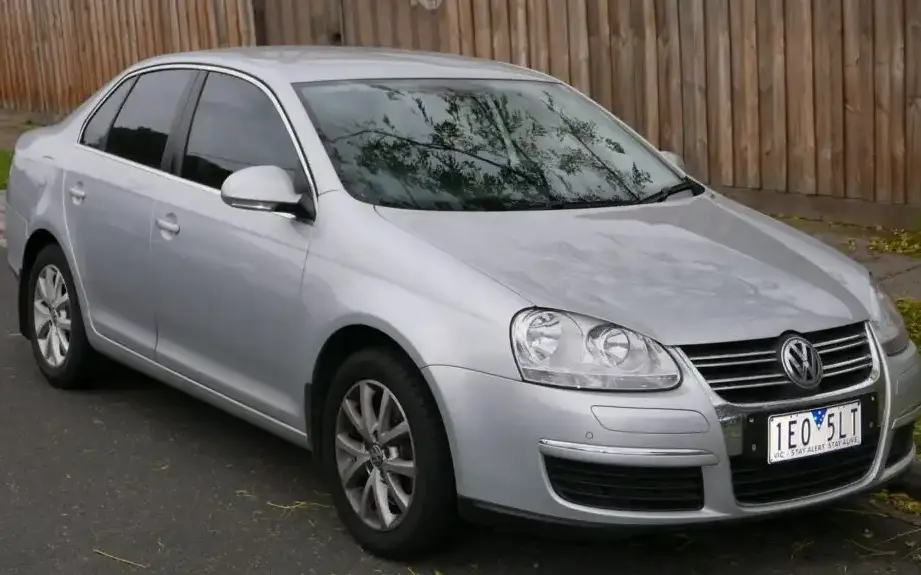
The Volkswagen Jetta V 1.6 i (102 hp) Automatic, produced between 2005 and 2010, represented an entry-level offering within the fifth generation (Mk5) Jetta lineup. Positioned as a more affordable and fuel-efficient option, it catered to buyers prioritizing practicality and economy over outright performance. This variant was primarily sold in European and Latin American markets, where compact sedans with smaller displacement engines and automatic transmissions were popular choices. It utilized the Volkswagen Group’s A5 (or 1HX) platform, shared with models like the Golf Mk5 and Audi A3. The Jetta V aimed to modernize the Jetta nameplate, moving away from the more conservative styling of its predecessor and embracing a more contemporary design language.
Powertrain & Engine Architecture
The Jetta V 1.6 i Automatic was powered by the Volkswagen BSE or BSF engine, a 1.6-liter inline-four cylinder gasoline engine. These engines were part of the EA827 family, known for their relatively simple design and durability. The BSE engine was more common in European markets, while the BSF was often found in Latin American versions. Both engines featured a single overhead camshaft (SOHC) valvetrain with two valves per cylinder. Fuel delivery was handled by a multi-point fuel injection system, providing adequate, though not exceptional, fuel atomization. The engine produced 102 horsepower at 5600 rpm and 148 Nm (109 lb-ft) of torque at 3800 rpm. The automatic transmission was typically a six-speed unit, offering smooth shifts but contributing to slightly slower acceleration compared to the available manual transmission. This transmission was designed to prioritize fuel efficiency and comfort over sporty performance.
Driving Characteristics
The driving experience in the Jetta V 1.6 i Automatic was characterized by its comfort and ease of use. Acceleration was modest, taking approximately 13.3 seconds to reach 62 mph. The automatic transmission, while smooth, could feel somewhat sluggish during quick overtaking maneuvers. The gear ratios were tuned for fuel economy, meaning the engine often operated at lower rpm ranges. Compared to the more powerful 2.0-liter FSI or the diesel variants (like the 1.9 TDI and 2.0 TDI), the 1.6-liter engine lacked the punch needed for spirited driving. However, for everyday commuting and city driving, the 1.6 i Automatic provided sufficient power and a relaxed driving experience. The steering was light and precise, making it easy to maneuver in urban environments.
Equipment & Trim Levels
The Jetta V 1.6 i Automatic typically came with a reasonable level of standard equipment. This included power windows, power door locks, air conditioning, and an audio system with CD player. Safety features such as ABS (Anti-lock Braking System) and front airbags were also standard. Higher trim levels, such as the Trendline or Comfortline, offered additional features like alloy wheels, upgraded upholstery, a multi-function steering wheel, and a more sophisticated audio system. Optional extras included a sunroof, leather seats, and a navigation system. Interior upholstery was typically cloth, with a relatively simple and functional dashboard layout. The overall interior design focused on practicality and durability rather than luxury.
Chassis & Braking
The Jetta V featured a MacPherson strut front suspension and an independent multi-link rear suspension. This setup provided a good balance between ride comfort and handling. The front suspension incorporated a transverse stabilizer bar to reduce body roll during cornering. The rear suspension also featured a stabilizer bar. Braking duties were handled by ventilated discs at the front and solid discs at the rear. The ABS system helped to maintain steering control during emergency braking situations. The chassis was designed to provide a stable and predictable driving experience, prioritizing comfort and safety over sporty handling. The suspension tuning was geared towards absorbing bumps and providing a smooth ride on various road surfaces.
Market Reception & Comparison
The Jetta V 1.6 i Automatic was generally well-received as an affordable and practical family sedan. Critics praised its fuel efficiency and comfortable ride, but noted its lack of performance compared to higher-powered variants. Compared to the 2.0-liter FSI Jetta, the 1.6-liter model offered significantly lower fuel consumption but also considerably slower acceleration. The diesel variants, while more expensive, provided superior fuel economy and torque. In terms of reliability, the 1.6-liter engine proved to be relatively robust, with few major issues reported. However, the automatic transmission could be prone to occasional issues, particularly if not properly maintained. The Jetta V 1.6 i Automatic appealed to buyers who prioritized economy and practicality over performance and driving excitement.
Legacy
The Jetta V 1.6 i Automatic remains a relatively common sight on used car markets today. Its simple engine design and generally good reliability have contributed to its longevity. While not a particularly sought-after model by enthusiasts, it represents a solid and affordable option for those seeking a dependable compact sedan. Maintenance costs are generally reasonable, and parts availability is good. However, potential buyers should be aware of the possibility of transmission issues and ensure that the vehicle has been properly maintained. The Jetta V 1.6 i Automatic served as a practical and economical entry point into the Volkswagen Jetta lineup, offering a comfortable and reliable driving experience for a wide range of drivers.