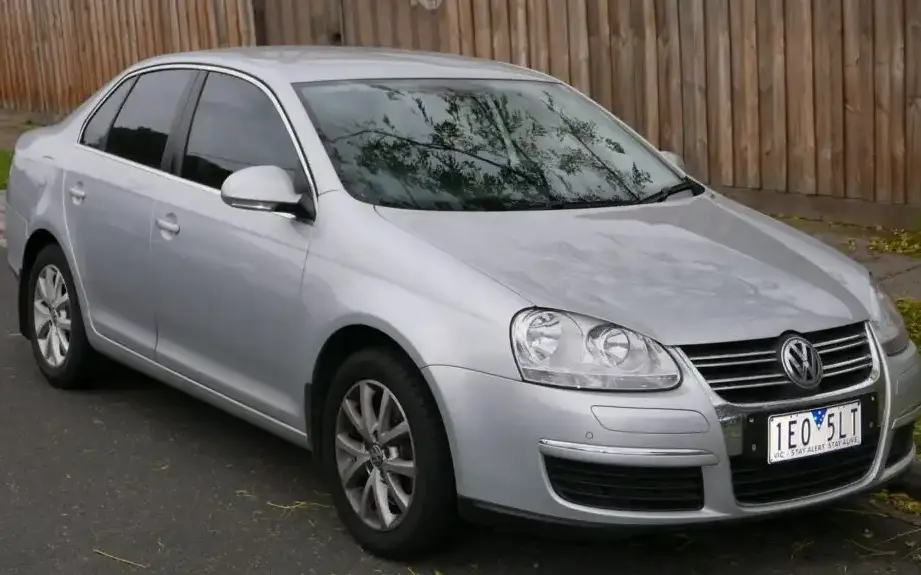
The Volkswagen Jetta V, produced from 2005 to 2008, represented a significant step forward for Volkswagen’s compact sedan. Built on the A5 (1HX0) platform shared with the Golf Mk5, the Jetta V aimed to offer a more refined and spacious alternative to its predecessor. Within the Jetta V lineup, the 2.0 FSI variant, producing 150 horsepower, occupied a middle ground, offering a balance between performance and fuel efficiency. It served as an upgrade from the base 1.6 and 2.0 liter non-FSI engines, while remaining more accessible than the performance-oriented GTI-inspired trims.
Technical Specifications
| Brand | Volkswagen |
| Model | Jetta |
| Generation | Jetta V |
| Type (Engine) | 2.0 FSI (150 Hp) |
| Start of production | 2005 |
| End of production | 2008 |
| Powertrain Architecture | Internal Combustion engine |
| Body type | Sedan |
| Seats | 5 |
| Doors | 4 |
| Fuel consumption (urban) | 11.2 l/100 km (21 US mpg, 25.2 UK mpg, 8.9 km/l) |
| Fuel consumption (extra urban) | 6.5 l/100 km (36.2 US mpg, 43.5 UK mpg, 15.4 km/l) |
| Fuel consumption (combined) | 8.2 l/100 km (28.7 US mpg, 34.4 UK mpg, 12.2 km/l) |
| Fuel Type | Petrol (Gasoline) |
| Acceleration 0 – 100 km/h | 9.2 sec |
| Acceleration 0 – 62 mph | 9.2 sec |
| Acceleration 0 – 60 mph | 8.7 sec |
| Maximum speed | 211 km/h (131.11 mph) |
| Emission standard | Euro 4 |
| Weight-to-power ratio | 8.8 kg/Hp, 113.7 Hp/tonne |
| Weight-to-torque ratio | 6.6 kg/Nm, 151.6 Nm/tonne |
| Power | 150 Hp @ 6000 rpm |
| Power per litre | 75.6 Hp/l |
| Torque | 200 Nm @ 3500 rpm (147.51 lb.-ft. @ 3500 rpm) |
| Engine layout | Front, Transverse |
| Engine Model/Code | BLR, BLX, BLY, BVX, BVY, BVZ |
| Engine displacement | 1984 cm3 (121.07 cu. in.) |
| Number of cylinders | 4 |
| Engine configuration | Inline |
| Cylinder Bore | 82.5 mm (3.25 in.) |
| Piston Stroke | 92.8 mm (3.65 in.) |
| Compression ratio | 10.5:1 |
| Number of valves per cylinder | 4 |
| Fuel injection system | Direct injection |
| Engine aspiration | Naturally aspirated engine |
| Valvetrain | DOHC |
| Engine oil capacity | 4.6 l (4.86 US qt | 4.05 UK qt) |
| Coolant | 8 l (8.45 US qt | 7.04 UK qt) |
| Kerb Weight | 1319 kg (2907.9 lbs.) |
| Max. weight | 1910 kg (4210.83 lbs.) |
| Max load | 591 kg (1302.93 lbs.) |
| Trunk (boot) space – minimum | 527 l (18.61 cu. ft.) |
| Fuel tank capacity | 55 l (14.53 US gal | 12.1 UK gal) |
| Length | 4554 mm (179.29 in.) |
| Width | 1781 mm (70.12 in.) |
| Height | 1459 mm (57.44 in.) |
| Wheelbase | 2578 mm (101.5 in.) |
| Front track | 1534 mm (60.39 in.) |
| Rear (Back) track | 1512 mm (59.53 in.) |
| Minimum turning circle | 10.9 m (35.76 ft.) |
| Drivetrain Architecture | ICE to Front Wheels |
| Drive wheel | Front wheel drive |
| Number of gears | 6 gears, manual transmission |
| Front suspension | Coil spring, Wishbone, Transverse stabilizer |
| Rear suspension | Independent multi-link suspension, Transverse stabilizer |
| Front brakes | Ventilated discs |
| Rear brakes | Disc |
| Assisting systems | ABS (Anti-lock braking system) |
| Steering type | Steering rack and pinion |
| Power steering | Electric Steering |
| Tires size | 205/55 R16 |
| Wheel rims size | 6.5 x 16 |
Powertrain & Engine Architecture
The heart of the Jetta V 2.0 FSI was the BLR, BLX, BLY, BVX, BVY, or BVZ engine code, a 1.984-liter inline-four cylinder engine. The “FSI” designation stands for Fuel Stratified Injection, a direct injection system developed by Volkswagen. Unlike traditional port fuel injection, FSI injects fuel directly into the combustion chamber, allowing for more precise fuel control, higher compression ratios, and improved efficiency. This engine utilized a dual overhead camshaft (DOHC) valvetrain with four valves per cylinder, contributing to its relatively high output for its displacement. The engine’s 150 horsepower at 6000 rpm and 147.51 lb-ft of torque at 3500 rpm were respectable figures for a naturally aspirated engine of this size in the mid-2000s. The 6-speed manual transmission was standard, providing a good balance of performance and fuel economy.
Driving Characteristics
The Jetta V 2.0 FSI offered a noticeably more refined driving experience than its predecessors. The FSI engine provided adequate power for everyday driving, with smooth acceleration and a responsive feel. While not a sports car, the 2.0 FSI offered enough grunt for highway merging and passing maneuvers. Compared to the base 1.6 or 2.0 liter engines, the FSI version felt significantly more powerful. However, it didn’t possess the outright performance of the Jetta GLI, which featured a turbocharged engine. The 6-speed manual transmission was well-matched to the engine’s powerband, allowing drivers to keep the engine in its optimal rev range. The gear ratios were spaced to provide both good acceleration and reasonable fuel economy.
Equipment & Trim Levels
The 2.0 FSI trim typically included standard features such as air conditioning, power windows and locks, a CD player, and alloy wheels. Higher trim levels added features like a sunroof, upgraded audio systems, and leather upholstery. Optional extras included a navigation system, heated seats, and automatic climate control. Interior upholstery was typically cloth, with the option of leather available on higher-spec models. The dashboard layout was functional and straightforward, with a focus on ergonomics.
Chassis & Braking
The Jetta V utilized an independent suspension setup, with coil springs and wishbones at the front and a multi-link independent suspension at the rear. This configuration provided a comfortable ride while maintaining good handling characteristics. The front brakes were ventilated discs, while the rear brakes were solid discs. Anti-lock braking system (ABS) was standard, enhancing safety. The suspension was tuned to provide a balance between comfort and handling, making it suitable for both daily commuting and longer road trips.
Market Reception & Comparison
The Jetta V 2.0 FSI was generally well-received by automotive critics. It was praised for its refined ride, spacious interior, and fuel-efficient engine. However, some critics noted that the engine could feel strained at higher speeds, and the overall driving experience wasn’t as engaging as some of its competitors. Compared to the base Jetta models, the 2.0 FSI offered a significant performance upgrade, but at a higher price point. Compared to the Jetta GLI, it offered a more affordable option with slightly less performance. Fuel economy was competitive for its class, averaging around 28.7 US mpg in combined driving.
Legacy
The Jetta V 2.0 FSI, while not without its quirks, proved to be a reliable and durable vehicle. The FSI engine, when properly maintained, could provide years of trouble-free service. Common issues included carbon buildup on the intake valves, a characteristic of direct injection engines, and occasional problems with the fuel pump. However, these issues were generally manageable with regular maintenance. Today, the Jetta V 2.0 FSI remains a popular choice in the used car market, offering a good balance of affordability, reliability, and practicality. Its relatively modern features and comfortable ride make it a compelling option for buyers seeking a well-rounded compact sedan.