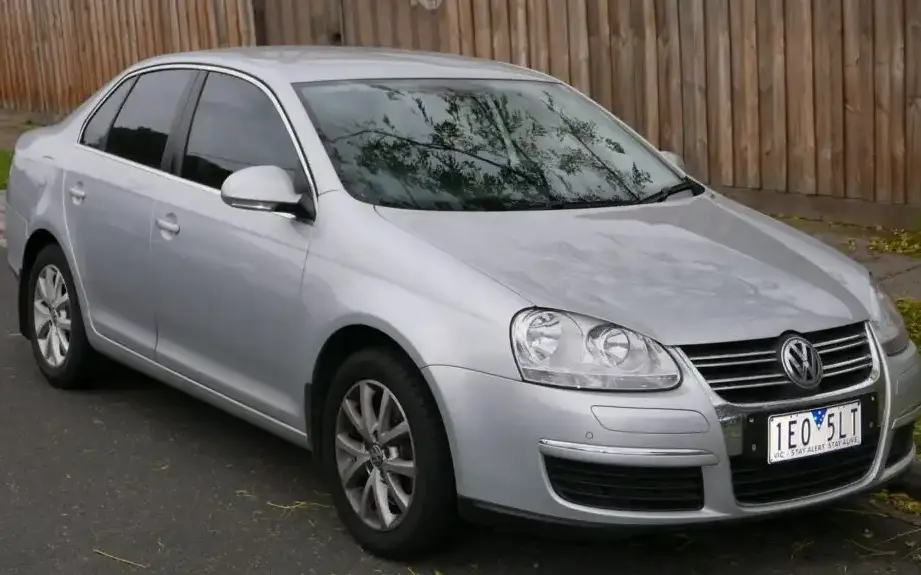
The Volkswagen Jetta V, produced from 2005 to 2008, represented a significant step forward for Volkswagen’s compact sedan in the North American market. Built on the A5 (1HX0) platform shared with the Golf Mk5, the Jetta V aimed to offer a more refined and spacious experience than its predecessor. Among the various engine and transmission combinations offered, the 2.0 FSI (150 hp) paired with the six-speed Tiptronic automatic transmission occupied a middle ground in the lineup, balancing performance with convenience and fuel efficiency. This variant was positioned as a step up from the base 2.0-liter engine, appealing to buyers seeking a more responsive driving experience without the cost or complexity of the higher-performance models like the GLI.
Technical Specifications
| Brand | Volkswagen |
| Model | Jetta |
| Generation | Jetta V |
| Type (Engine) | 2.0 FSI (150 Hp) Tiptronic |
| Start of production | 2005 |
| End of production | 2008 |
| Powertrain Architecture | Internal Combustion engine |
| Body type | Sedan |
| Seats | 5 |
| Doors | 4 |
| Fuel consumption (economy) – urban (NEDC) | 12 l/100 km (19.6 US mpg, 23.5 UK mpg, 8.3 km/l) |
| Fuel consumption (economy) – extra urban (NEDC) | 6.6 l/100 km (35.6 US mpg, 42.8 UK mpg, 15.2 km/l) |
| Fuel consumption (economy) – combined (NEDC) | 8.6 l/100 km (27.4 US mpg, 32.8 UK mpg, 11.6 km/l) |
| CO2 emissions (NEDC) | 206 g/km |
| Fuel Type | Petrol (Gasoline) |
| Acceleration 0 – 100 km/h | 9.9 sec |
| Acceleration 0 – 62 mph | 9.9 sec |
| Acceleration 0 – 60 mph | 9.4 sec |
| Maximum speed | 207 km/h (128.62 mph) |
| Emission standard | Euro 4 |
| Weight-to-power ratio | 10 kg/Hp, 100.3 Hp/tonne |
| Weight-to-torque ratio | 7.5 kg/Nm, 133.8 Nm/tonne |
| Power | 150 Hp @ 6000 rpm |
| Power per litre | 75.6 Hp/l |
| Torque | 200 Nm @ 3500 rpm (147.51 lb.-ft. @ 3500 rpm) |
| Engine layout | Front, Transverse |
| Engine Model/Code | BLR, BVY |
| Engine displacement | 1984 cm3 (121.07 cu. in.) |
| Number of cylinders | 4 |
| Engine configuration | Inline |
| Cylinder Bore | 82.5 mm (3.25 in.) |
| Piston Stroke | 92.8 mm (3.65 in.) |
| Compression ratio | 11.5:1 |
| Number of valves per cylinder | 4 |
| Fuel injection system | Direct injection |
| Engine aspiration | Naturally aspirated engine |
| Valvetrain | DOHC |
| Engine oil capacity | 4.6 l (4.86 US qt | 4.05 UK qt) |
| Coolant | 8 l (8.45 US qt | 7.04 UK qt) |
| Kerb Weight | 1495 kg (3295.91 lbs.) |
| Max. weight | 1930 kg (4254.92 lbs.) |
| Max load | 435 kg (959.01 lbs.) |
| Trunk (boot) space – minimum | 527 l (18.61 cu. ft.) |
| Fuel tank capacity | 55 l (14.53 US gal | 12.1 UK gal) |
| Max. roof load | 75 kg (165.35 lbs.) |
| Permitted trailer load with brakes (12%) | 1400 kg (3086.47 lbs.) |
| Permitted trailer load without brakes | 690 kg (1521.19 lbs.) |
| Permitted towbar download | 75 kg (165.35 lbs.) |
| Length | 4554 mm (179.29 in.) |
| Width | 1781 mm (70.12 in.) |
| Width including mirrors | 2010 mm (79.13 in.) |
| Height | 1459 mm (57.44 in.) |
| Wheelbase | 2578 mm (101.5 in.) |
| Front track | 1534 mm (60.39 in.) |
| Rear (Back) track | 1512 mm (59.53 in.) |
| Minimum turning circle (turning diameter) | 10.9 m (35.76 ft.) |
| Front suspension | Coil spring, Wishbone, Transverse stabilizer |
| Rear suspension | Independent multi-link suspension, Transverse stabilizer |
| Front brakes | Ventilated discs |
| Rear brakes | Disc |
| Number of gears and type of gearbox | 6 gears, automatic transmission Tiptronic |
Powertrain & Engine Architecture
The heart of this Jetta V variant is the 2.0-liter inline-four cylinder engine, designated BLR or BVY depending on minor variations. This engine utilizes Volkswagen’s FSI (Fuel Stratified Injection) direct injection technology. FSI injects fuel directly into the combustion chamber, allowing for more precise fuel control, higher compression ratios, and improved efficiency compared to traditional port fuel injection. The engine features a double overhead camshaft (DOHC) valvetrain with four valves per cylinder, contributing to its relatively high output for its displacement. The six-speed Tiptronic automatic transmission is a conventional torque converter automatic, but with a manual shift mode allowing the driver some control over gear selection. This transmission was known for its smooth operation, but wasn’t as sporty or fuel-efficient as some of the dual-clutch transmissions (DSG) becoming available around the same time.
Driving Characteristics
The 150 hp and 147 lb-ft of torque provided by the 2.0 FSI engine and Tiptronic transmission delivered adequate, but not exhilarating, performance. Acceleration from 0-60 mph took around 9.4 seconds, making it competitive with other similarly sized sedans in its class. The Tiptronic transmission offered smooth shifts, but could sometimes feel hesitant during quick acceleration. The gear ratios were tuned for a balance of fuel economy and drivability, rather than outright performance. Compared to the manual transmission version of the same engine, the Tiptronic suffered a slight performance penalty due to the transmission’s inherent losses. It also lacked the engaging driving experience offered by the manual. Compared to the more powerful GLI models, the 2.0 FSI Tiptronic felt noticeably less responsive, but offered a more comfortable and relaxed driving experience.
Equipment & Trim Levels
The 2.0 FSI Tiptronic Jetta V typically came standard with features such as air conditioning, power windows and locks, a CD player with MP3 compatibility, and alloy wheels. Higher trim levels added features like a sunroof, upgraded audio system, heated front seats, and leather upholstery. Interior upholstery was typically cloth, with optional leather available. The dashboard layout was functional and straightforward, with a focus on ergonomics. Optional extras included navigation systems and various appearance packages.
Chassis & Braking
The Jetta V’s chassis featured a MacPherson strut front suspension and a multi-link independent rear suspension. This setup provided a comfortable ride and decent handling characteristics. The front brakes were ventilated discs, while the rear brakes were solid discs. Anti-lock braking system (ABS) was standard. The suspension tuning was geared towards comfort, with a focus on absorbing bumps and providing a stable ride. Stabilizer bars were fitted to both the front and rear axles to reduce body roll during cornering.
Market Reception & Comparison
The 2.0 FSI Tiptronic Jetta V was generally well-received by critics as a practical and comfortable daily driver. It offered a good balance of features, fuel economy, and performance for its price point. However, some reviewers noted that the Tiptronic transmission could feel sluggish at times, and that the engine lacked the punch of some of its competitors. Fuel economy was rated at around 27 mpg combined, which was competitive for its class. Reliability was generally good, although some owners reported issues with the FSI fuel injectors and the Tiptronic transmission over the long term.
Legacy
The 2.0 FSI Tiptronic Jetta V remains a relatively affordable and practical used car option today. While not as sought after as the GLI models, it offers a comfortable and reliable driving experience. The FSI engine, while offering good performance, can require more diligent maintenance, particularly regarding fuel injector cleanliness. The Tiptronic transmission, while smooth, is known to be a potential point of failure as it ages. Overall, the 2.0 FSI Tiptronic Jetta V represents a solid, if unspectacular, entry in Volkswagen’s long history of compact sedans.