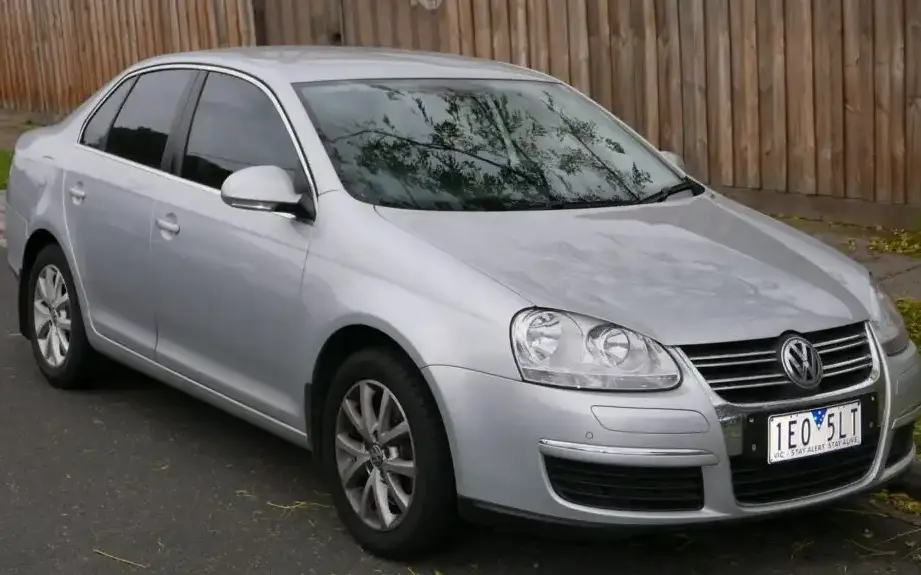
The Volkswagen Jetta V 2.0 TFSI (200 horsepower) with the Direct-Shift Gearbox (DSG) represents a significant step forward in the fifth generation (Mk5) Jetta lineup, produced between 2005 and 2006. Positioned as a performance-oriented variant, it aimed to bridge the gap between the more economical base models and the higher-performance GTI. This Jetta utilized the Volkswagen Group’s A5 (or 1HX) platform, shared with models like the Golf Mk5 and Audi A3. The 2.0 TFSI/DSG model was primarily marketed in Europe and other international markets, offering a blend of sporty handling, respectable fuel efficiency, and modern technology for its time.
Technical Specifications
| Brand | Volkswagen |
| Model | Jetta |
| Generation | Jetta V |
| Type (Engine) | 2.0 TFSI (200 Hp) DSG |
| Start of production | 2005 |
| End of production | 2006 |
| Powertrain Architecture | Internal Combustion engine |
| Body type | Sedan |
| Seats | 5 |
| Doors | 4 |
| Fuel consumption (economy) – urban (NEDC) | 10.8 l/100 km (21.8 US mpg, 26.2 UK mpg, 9.3 km/l) |
| Fuel consumption (economy) – extra urban (NEDC) | 6.3 l/100 km (37.3 US mpg, 44.8 UK mpg, 15.9 km/l) |
| Fuel consumption (economy) – combined (NEDC) | 8 l/100 km (29.4 US mpg, 35.3 UK mpg, 12.5 km/l) |
| CO2 emissions (NEDC) | 192 g/km |
| Fuel Type | Petrol (Gasoline) |
| Acceleration 0 – 100 km/h | 7.2 sec |
| Acceleration 0 – 62 mph | 7.2 sec |
| Acceleration 0 – 60 mph | 6.8 sec |
| Maximum speed | 233 km/h (144.78 mph) |
| Emission standard | Euro 4 |
| Weight-to-power ratio | 7.6 kg/Hp, 131.1 Hp/tonne |
| Weight-to-torque ratio | 5.5 kg/Nm, 183.5 Nm/tonne |
| Power | 200 Hp @ 5100 rpm |
| Power per litre | 100.8 Hp/l |
| Torque | 280 Nm @ 1800-5000 rpm (206.52 lb.-ft. @ 1800-5000 rpm) |
| Engine layout | Front, Transverse |
| Engine Model/Code | BWA |
| Engine displacement | 1984 cm3 (121.07 cu. in.) |
| Number of cylinders | 4 |
| Engine configuration | Inline |
| Cylinder Bore | 82.5 mm (3.25 in.) |
| Piston Stroke | 92.8 mm (3.65 in.) |
| Compression ratio | 10.3:1 |
| Number of valves per cylinder | 4 |
| Fuel injection system | Direct injection |
| Engine aspiration | Turbocharger, Intercooler |
| Valvetrain | DOHC |
| Engine oil capacity | 4.6 l (4.86 US qt | 4.05 UK qt) |
| Coolant | 8 l (8.45 US qt | 7.04 UK qt) |
| Kerb Weight | 1526 kg (3364.25 lbs.) |
| Max. weight | 1960 kg (4321.06 lbs.) |
| Max load | 434 kg (956.81 lbs.) |
| Trunk (boot) space – minimum | 527 l (18.61 cu. ft.) |
| Fuel tank capacity | 55 l (14.53 US gal | 12.1 UK gal) |
| Max. roof load | 75 kg (165.35 lbs.) |
| Permitted trailer load with brakes (12%) | 1400 kg (3086.47 lbs.) |
| Permitted trailer load without brakes | 720 kg (1587.33 lbs.) |
| Permitted towbar download | 75 kg (165.35 lbs.) |
| Length | 4554 mm (179.29 in.) |
| Width | 1781 mm (70.12 in.) |
| Width including mirrors | 2010 mm (79.13 in.) |
| Height | 1459 mm (57.44 in.) |
| Wheelbase | 2578 mm (101.5 in.) |
| Front track | 1534 mm (60.39 in.) |
| Rear (Back) track | 1512 mm (59.53 in.) |
| Minimum turning circle (turning diameter) | 10.9 m (35.76 ft.) |
| Front suspension | Coil spring, Wishbone, Transverse stabilizer |
| Rear suspension | Independent multi-link suspension, Transverse stabilizer |
| Front brakes | Ventilated discs |
| Rear brakes | Disc |
| Number of gears and type of gearbox | 6 gears, automatic transmission DSG |
| Drive wheel | Front wheel drive |
Powertrain & Engine Architecture
At the heart of the Jetta V 2.0 TFSI DSG lies the BWA engine code, a 1.984-liter (121.07 cubic inches) inline-four cylinder gasoline engine. This engine is characterized by its direct fuel injection (FSI) system and a single turbocharger with an intercooler. The direct injection system allows for precise fuel delivery, improving combustion efficiency and power output. The turbocharger boosts power by forcing more air into the cylinders. The engine utilizes a dual overhead camshaft (DOHC) valvetrain with four valves per cylinder, optimizing airflow for enhanced performance. The DSG (Direct-Shift Gearbox) is a six-speed automated manual transmission. It combines the efficiency of a manual gearbox with the convenience of an automatic, offering quick and smooth gear changes. The DSG’s dual-clutch design allows for pre-selection of the next gear, minimizing interruption in power delivery.
Driving Characteristics
The 200 horsepower and 280 Nm (206.52 lb-ft) of torque delivered by the 2.0 TFSI engine, coupled with the quick-shifting DSG transmission, provided a noticeably more engaging driving experience compared to the base Jetta models. Acceleration from 0 to 60 mph was achieved in approximately 6.8 seconds, and the car had a top speed of 144.78 mph. The DSG transmission’s responsiveness and the engine’s readily available torque made for effortless highway cruising and confident overtaking maneuvers. While not as raw or visceral as a manual transmission, the DSG offered a good balance of performance and convenience. Compared to the 1.6L or 2.5L Jetta variants, the 2.0 TFSI offered significantly more power and a more refined driving experience. It wasn’t quite as sporty as the Golf GTI, which had a more aggressive suspension setup and a slightly more powerful engine.
Equipment & Trim Levels
The Jetta V 2.0 TFSI DSG typically came with a fairly comprehensive list of standard features. These included air conditioning, power windows and locks, a CD stereo system, and alloy wheels. Higher trim levels offered options such as a sunroof, leather upholstery, heated front seats, and a premium sound system. Safety features included ABS brakes, front and side airbags, and electronic stability control. The interior generally featured a functional and modern design, with a focus on ergonomics. The dashboard layout was clean and straightforward, with easy-to-read gauges.
Chassis & Braking
The Jetta V 2.0 TFSI utilized an independent suspension system, with coil springs and wishbones at the front and a multi-link setup at the rear. This suspension configuration provided a comfortable ride while maintaining good handling characteristics. Front brakes were ventilated discs, while rear brakes were solid discs. ABS (Anti-lock Braking System) was standard, enhancing braking performance and stability. The chassis was designed to provide a good balance between ride comfort and handling precision, although it wasn’t as aggressively tuned as the GTI.
Market Reception & Comparison
The Jetta V 2.0 TFSI DSG was generally well-received by automotive critics. It was praised for its strong performance, refined driving experience, and modern technology. Fuel economy was considered respectable for a car of its performance class, averaging around 29.4 US mpg in combined driving. However, some critics noted that the DSG transmission could be slightly jerky at low speeds. Compared to other cars in its segment, such as the Honda Civic Si or the Mazda3, the Jetta offered a more sophisticated and refined driving experience, but it wasn’t quite as sporty or engaging. Reliability was generally good, although some owners reported minor issues with the DSG transmission over the long term.
Legacy
The Jetta V 2.0 TFSI DSG represents an important step in the evolution of the Jetta model. It introduced a new level of performance and technology to the mainstream Jetta lineup. The BWA engine and DSG transmission proved to be relatively reliable powertrains, and many examples are still on the road today. In the used car market, these models are often sought after by enthusiasts who appreciate their blend of performance, efficiency, and refinement. While maintenance costs can be higher than for simpler Jetta models due to the more complex engine and transmission, the 2.0 TFSI DSG remains a desirable and capable compact sedan.