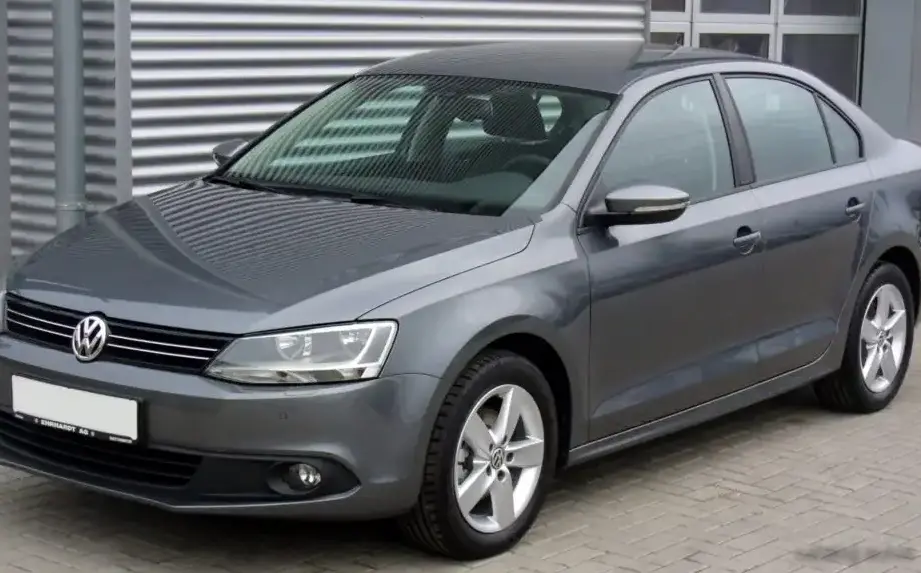
The Volkswagen Jetta VI 1.2 TSI BMT (105 hp) was a front-wheel-drive compact sedan produced between 2010 and 2014. It represented an entry-level offering within the sixth generation (Mk6) Jetta lineup, positioned below the more powerful 1.4 TSI and 2.0 TDI variants. This model aimed to provide fuel efficiency and affordability to buyers in European and other international markets, though it saw limited sales in the United States. The Jetta VI itself was based on the Volkswagen Group’s A5 (or 1HX0) platform, shared with models like the Golf Mk5 and Scirocco.
Technical Specifications
| Brand | Volkswagen |
| Model | Jetta |
| Generation | Jetta VI |
| Type (Engine) | 1.2 TSI BMT (105 Hp) |
| Start of production | 2010 |
| End of production | 2014 |
| Powertrain Architecture | Internal Combustion engine |
| Body type | Sedan |
| Seats | 5 |
| Doors | 4 |
| Fuel consumption (urban) | 6.6 l/100 km (35.6 US mpg, 42.8 UK mpg, 15.2 km/l) |
| Fuel consumption (extra urban) | 4.6 l/100 km (51.1 US mpg, 61.4 UK mpg, 21.7 km/l) |
| Fuel consumption (combined) | 5.3 l/100 km (44.4 US mpg, 53.3 UK mpg, 18.9 km/l) |
| CO2 emissions | 123 g/km |
| Fuel Type | Petrol (Gasoline) |
| Acceleration 0 – 100 km/h | 10.9 sec |
| Acceleration 0 – 62 mph | 10.9 sec |
| Acceleration 0 – 60 mph | 10.4 sec |
| Maximum speed | 190 km/h (118.06 mph) |
| Emission standard | Euro 5 |
| Weight-to-power ratio | 11.7 kg/Hp, 85.4 Hp/tonne |
| Weight-to-torque ratio | 7 kg/Nm, 142.3 Nm/tonne |
| Power | 105 Hp @ 5000 rpm |
| Power per litre | 87.7 Hp/l |
| Torque | 175 Nm @ 1500-4000 rpm (129.07 lb.-ft. @ 1500-4000 rpm) |
| Engine layout | Front, Transverse |
| Engine Model/Code | CBZB |
| Engine displacement | 1197 cm3 (73.05 cu. in.) |
| Number of cylinders | 4 |
| Engine configuration | Inline |
| Cylinder Bore | 71 mm (2.8 in.) |
| Piston Stroke | 75.6 mm (2.98 in.) |
| Compression ratio | 10.5:1 |
| Number of valves per cylinder | 2 |
| Fuel injection system | Direct injection |
| Engine aspiration | Turbocharger, Intercooler |
| Valvetrain | SOHC |
| Engine oil capacity | 3.9 l (4.12 US qt | 3.43 UK qt) |
| Kerb Weight | 1230 kg (2711.69 lbs.) |
| Max. weight | 1800 kg (3968.32 lbs.) |
| Max load | 570 kg (1256.63 lbs.) |
| Trunk (boot) space – minimum | 510 l (18.01 cu. ft.) |
| Fuel tank capacity | 55 l (14.53 US gal | 12.1 UK gal) |
| Max. roof load | 75 kg (165.35 lbs.) |
| Permitted trailer load with brakes (8%) | 1500 kg (3306.93 lbs.) |
| Permitted trailer load with brakes (12%) | 1200 kg (2645.55 lbs.) |
| Permitted trailer load without brakes | 650 kg (1433 lbs.) |
| Permitted towbar download | 75 kg (165.35 lbs.) |
| Length | 4644 mm (182.83 in.) |
| Width | 1778 mm (70 in.) |
| Width including mirrors | 2020 mm (79.53 in.) |
| Height | 1482 mm (58.35 in.) |
| Wheelbase | 2651 mm (104.37 in.) |
| Front track | 1535 mm (60.43 in.) |
| Rear (Back) track | 1538 mm (60.55 in.) |
| Ride height (ground clearance) | 139 mm (5.47 in.) |
| Minimum turning circle | 11.1 m (36.42 ft.) |
| Front suspension | Coil spring, Wishbone, Transverse stabilizer |
| Rear suspension | Independent multi-link suspension, Transverse stabilizer |
| Front brakes | Ventilated discs |
| Rear brakes | Disc |
| Assisting systems | ABS (Anti-lock braking system) |
| Steering type | Steering rack and pinion |
| Power steering | Electric Steering |
| Tires size | 205/55 R16 |
| Wheel rims size | 6.5J x 16 |
Powertrain & Engine Architecture
The heart of the Jetta VI 1.2 TSI BMT was the CBZB engine code, a 1.2-liter inline-four cylinder gasoline engine. This engine featured direct fuel injection and a turbocharger with an intercooler, technologies aimed at improving both power output and fuel economy. The “BMT” designation stands for “BlueMotion Technology,” indicating the inclusion of fuel-saving features like start-stop functionality. The engine utilized a single overhead camshaft (SOHC) valvetrain with two valves per cylinder. The direct injection system, operating at pressures up to 150 bar, allowed for precise fuel delivery and optimized combustion. The turbocharger provided a boost in power, compensating for the relatively small displacement. This engine was paired with a 7-speed dual-clutch transmission (DSG) in most markets, though a 6-speed automatic transmission was also available, depending on the region.
Driving Characteristics
The 105 hp output and 175 Nm (129 lb-ft) of torque delivered by the 1.2 TSI engine resulted in a driving experience focused on efficiency rather than outright performance. Acceleration from 0 to 100 km/h (0-62 mph) took approximately 10.9 seconds. The engine felt responsive enough for everyday driving, with the turbocharger providing a noticeable boost in power during acceleration. However, it lacked the punch of the larger 1.4 TSI or 2.0 TDI engines. The 7-speed DSG transmission offered quick and smooth gear changes, enhancing the driving experience. The automatic transmission, while providing convenience, could sometimes feel hesitant during kickdown maneuvers. Overall, the driving experience was comfortable and refined, prioritizing fuel economy and ease of use over sporty handling.
Equipment & Trim Levels
The Jetta VI 1.2 TSI BMT typically came equipped with a reasonable level of standard features. These included air conditioning, power windows, power mirrors, a basic audio system with CD player, and ABS brakes. Higher trim levels, such as Trendline or Comfortline, added features like alloy wheels, a multi-function steering wheel, cruise control, and upgraded upholstery. Optional extras included a sunroof, navigation system, and parking sensors. Interior upholstery was typically cloth, with leather options available on higher trims. The dashboard layout was functional and straightforward, with a focus on ergonomics.
Chassis & Braking
The Jetta VI featured a MacPherson strut front suspension and an independent multi-link rear suspension. This setup provided a comfortable ride and decent handling characteristics. The front brakes were ventilated discs, while the rear brakes were solid discs. ABS (Anti-lock Braking System) was standard. The suspension was tuned for comfort, prioritizing ride quality over sporty handling. Stabilizer bars were fitted to both the front and rear axles to reduce body roll during cornering. The steering was electrically assisted, providing light and precise steering feel.
Market Reception & Comparison
The Jetta VI 1.2 TSI BMT was generally well-received by critics for its fuel efficiency and affordability. However, some reviewers noted that the engine lacked power, particularly when fully loaded or driving uphill. Compared to the 1.4 TSI, the 1.2 TSI offered lower running costs but sacrificed performance. The 2.0 TDI provided significantly more torque and better fuel economy, but at a higher purchase price. The 1.2 TSI BMT appealed to buyers who prioritized fuel economy and low running costs over outright performance. It was a popular choice for city driving and commuting.
Legacy
The 1.2 TSI engine, while generally reliable, has been known to exhibit some issues with carbon buildup on the intake valves, particularly in vehicles that primarily see short trips. Regular servicing and the use of quality fuel can help mitigate this issue. The DSG transmission, while offering smooth and efficient gear changes, can be expensive to repair if it fails. Today, the Jetta VI 1.2 TSI BMT remains a relatively affordable used car option. Its fuel efficiency and comfortable ride make it a practical choice for budget-conscious buyers. However, potential buyers should be aware of the potential for carbon buildup and DSG transmission issues and factor these into their purchase decision.