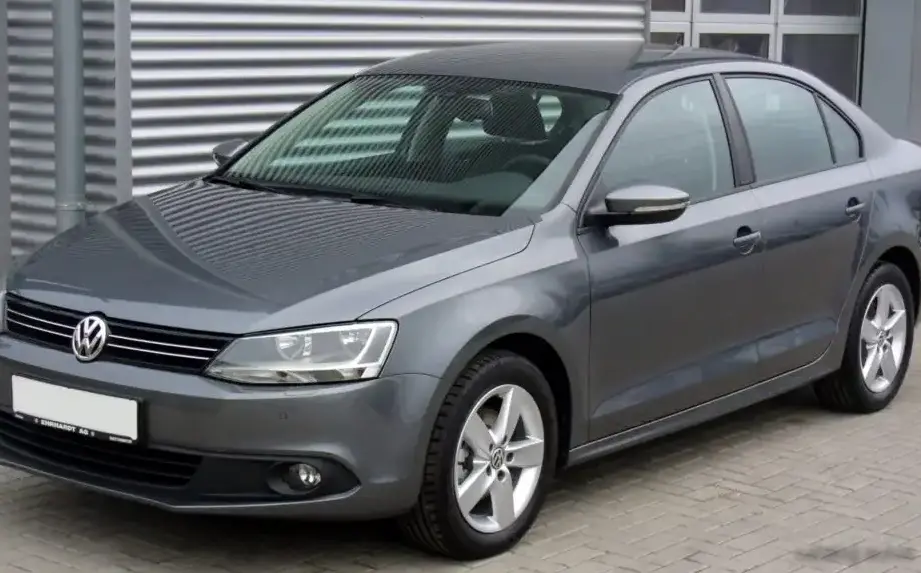
The Volkswagen Jetta VI 2.0 (115 hp) Tiptronic, produced between 2010 and 2014, represents a significant iteration of Volkswagen’s popular compact sedan. Positioned as a mid-range offering within the Jetta VI lineup (the sixth generation, internally designated as the 16A series), this variant aimed to balance affordability with a degree of convenience offered by the automatic transmission. It served as a key model for Volkswagen in the North American market, where automatic transmissions are highly preferred, and also found a solid customer base in other regions. This version bridged the gap between the base 2.0L manual and the more performance-oriented trims like those equipped with the 2.5L engine.
Technical Specifications
| Brand | Volkswagen |
| Model | Jetta |
| Generation | Jetta VI |
| Type (Engine) | 2.0 (115 Hp) Tiptronic |
| Start of production | 2010 |
| End of production | 2014 |
| Powertrain Architecture | Internal Combustion engine |
| Body type | Sedan |
| Seats | 5 |
| Doors | 4 |
| Fuel consumption (economy) – urban (EPA) | 9.8-10.2 l/100 km (24 – 23.1 US mpg) |
| Fuel consumption (economy) – extra urban (EPA) | 7.4-8.1 l/100 km (31.8 – 29 US mpg) |
| Fuel Type | Petrol (Gasoline) |
| Weight-to-power ratio | 11.4 kg/Hp, 88 Hp/tonne |
| Weight-to-torque ratio | 7.7 kg/Nm, 130.1 Nm/tonne |
| Power | 115 Hp @ 5200 rpm |
| Power per litre | 58 Hp/l |
| Torque | 170 Nm @ 4000 rpm (125.39 lb.-ft. @ 4000 rpm) |
| Engine layout | Front, Transverse |
| Engine Model/Code | CBPA |
| Engine displacement | 1984 cm3 (121.07 cu. in.) |
| Number of cylinders | 4 |
| Engine configuration | Inline |
| Cylinder Bore | 82.5 mm (3.25 in.) |
| Piston Stroke | 92.8 mm (3.65 in.) |
| Compression ratio | 10.3:1 |
| Number of valves per cylinder | 2 |
| Fuel injection system | Multi-port manifold injection |
| Engine aspiration | Naturally aspirated engine |
| Valvetrain | SOHC |
| Engine oil capacity | 3.6 l (3.8 US qt | 3.17 UK qt) |
| Coolant | 5 l (5.28 US qt | 4.4 UK qt) |
| Kerb Weight | 1307-1325 kg (2881.44 – 2921.12 lbs.) |
| Max. weight | 1850 kg (4078.55 lbs.) |
| Max load | 525-543 kg (1157.43 – 1197.11 lbs.) |
| Trunk (boot) space – minimum | 440 l (15.54 cu. ft.) |
| Fuel tank capacity | 55 l (14.53 US gal | 12.1 UK gal) |
| Length | 4628 mm (182.2 in.) |
| Width | 1778 mm (70 in.) |
| Height | 1453 mm (57.2 in.) |
| Wheelbase | 2651 mm (104.37 in.) |
| Front track | 1541 mm (60.67 in.) |
| Rear (Back) track | 1538 mm (60.55 in.) |
| Ride height (ground clearance) | 139 mm (5.47 in.) |
| Drag coefficient (Cd) | 0.30 |
| Minimum turning circle (turning diameter) | 11.1 m (36.42 ft.) |
| Drivetrain Architecture | The Internal combustion engine (ICE) drives the front wheels of the vehicle. |
| Drive wheel | Front wheel drive |
| Number of gears and type of gearbox | 6 gears, automatic transmission Tiptronic |
| Front suspension | Independent, type McPherson with coil spring and anti-roll bar |
| Rear suspension | Coil spring, Torsion |
| Front brakes | Ventilated discs, 287×25 mm |
| Rear brakes | Disc, 272×10 mm |
| Assisting systems | ABS (Anti-lock braking system) |
| Steering type | Steering rack and pinion |
| Power steering | Hydraulic Steering |
| Tires size | 195/65 R15 |
| Wheel rims size | 6J x 15 |
Powertrain & Engine Architecture
The Jetta VI 2.0 Tiptronic utilizes the CBPA engine code, a 1.984-liter (121.07 cubic inches) inline-four cylinder gasoline engine. This engine is a naturally aspirated powerplant featuring multi-port fuel injection and a single overhead camshaft (SOHC) valvetrain with two valves per cylinder. The CBPA engine was a common sight in various Volkswagen and Audi models of the era, known for its relative simplicity and durability. The Tiptronic transmission is a six-speed automatic transmission offering both fully automatic operation and a manual shift mode, allowing drivers some control over gear selection. This transmission was designed to provide smooth shifts and reasonable efficiency, though it wasn’t known for particularly sporty performance. The engine’s 115 horsepower and 170 Nm (125 lb-ft) of torque are delivered to the front wheels.
Driving Characteristics
The 2.0L Tiptronic Jetta VI offered a comfortable and predictable driving experience. Acceleration was adequate for everyday driving, but not particularly brisk. The 0-60 mph time was typically in the 10-11 second range. Compared to the manual transmission version of the same engine, the Tiptronic suffered a slight performance penalty due to the transmission’s inherent efficiency losses. The automatic transmission’s gear ratios were tuned for fuel economy and smooth cruising, rather than aggressive acceleration. The Tiptronic mode allowed for more driver involvement, but the transmission’s shift logic wasn’t as responsive as a dedicated manual gearbox. Compared to the higher-output 2.5L engine option, the 2.0L Tiptronic felt noticeably less powerful, especially when fully loaded or climbing hills.
Equipment & Trim Levels
The 2.0L Tiptronic Jetta VI typically came standard with features such as air conditioning, power windows and locks, a basic audio system with CD player, and steel wheels with wheel covers. Higher trim levels, such as the Trendline and Comfortline, added features like alloy wheels, upgraded audio systems, cruise control, and heated front seats. Optional extras included a sunroof, leather upholstery, and a navigation system. The interior generally featured durable cloth upholstery and a functional, if somewhat understated, dashboard design. The Tiptronic shifter was integrated into the center console, and the instrument cluster provided basic information about the vehicle’s operation.
Chassis & Braking
The Jetta VI utilized an independent McPherson strut front suspension and a torsion beam rear suspension. This setup provided a good balance of ride comfort and handling. The front suspension featured coil springs and an anti-roll bar to reduce body roll during cornering. Braking duties were handled by ventilated discs at the front and solid discs at the rear. Anti-lock braking system (ABS) was standard. The suspension tuning was geared towards comfort, resulting in a relatively soft ride quality. The steering was hydraulic power-assisted, providing reasonable feedback and ease of use.
Market Reception & Comparison
The Jetta VI 2.0 Tiptronic was generally well-received as a practical and affordable compact sedan. Critics praised its comfortable ride, spacious interior, and fuel efficiency. However, some reviewers noted its lack of sporty driving dynamics and the somewhat dated interior design. Compared to other automatic transmission compact sedans in its class, such as the Honda Civic and Toyota Corolla, the Jetta VI offered a slightly more European driving feel but lacked the same level of refinement and reliability reputation. Fuel economy was competitive, averaging around 25-30 mpg in mixed driving conditions. The 2.0L Tiptronic was often seen as a sensible choice for buyers prioritizing comfort and convenience over performance.
Legacy
The CBPA engine and the six-speed Tiptronic transmission proved to be relatively reliable powertrains. While not without their occasional issues (such as oil consumption and transmission control module failures), they generally held up well over time with proper maintenance. Today, Jetta VI 2.0 Tiptronic models are readily available on the used car market at affordable prices. They represent a good value for buyers seeking a practical and economical compact sedan. However, potential buyers should be aware of the potential for age-related maintenance issues and should have the vehicle thoroughly inspected before purchase. The Jetta VI, and this variant in particular, remains a common sight on roads, a testament to its initial popularity and overall durability.