Technical Specifications
| Brand | Volkswagen |
| Model | Jetta |
| Generation | Jetta VI |
| Type (Engine) | 2.0 TSI (200 Hp) DSG |
| Start of production | 2011 |
| End of production | 2013 |
| Powertrain Architecture | Internal Combustion engine |
| Body type | Sedan |
| Seats | 5 |
| Doors | 4 |
| Fuel consumption (economy) – urban (NEDC) | 10.6 l/100 km (22.2 US mpg, 26.6 UK mpg, 9.4 km/l) |
| Fuel consumption (economy) – extra urban (NEDC) | 5.9 l/100 km (39.9 US mpg, 47.9 UK mpg, 16.9 km/l) |
| Fuel consumption (economy) – combined (NEDC) | 7.7 l/100 km (30.5 US mpg, 36.7 UK mpg, 13 km/l) |
| CO2 emissions (NEDC) | 178 g/km |
| Fuel Type | Petrol (Gasoline) |
| Acceleration 0 – 100 km/h | 7.5 sec |
| Acceleration 0 – 62 mph | 7.5 sec |
| Acceleration 0 – 60 mph | 7.1 sec |
| Maximum speed | 236 km/h (146.64 mph) |
| Emission standard | Euro 5 |
| Weight-to-power ratio | 6.9 kg/Hp, 145.5 Hp/tonne |
| Weight-to-torque ratio | 4.9 kg/Nm, 203.6 Nm/tonne |
| Power | 200 Hp @ 5100-6000 rpm |
| Power per litre | 100.8 Hp/l |
| Torque | 280 Nm @ 1700-5000 rpm (206.52 lb.-ft. @ 1700-5000 rpm) |
| Engine layout | Front, Transverse |
| Engine Model/Code | CCZA |
| Engine displacement | 1984 cm3 (121.07 cu. in.) |
| Number of cylinders | 4 |
| Engine configuration | Inline |
| Cylinder Bore | 82.5 mm (3.25 in.) |
| Piston Stroke | 92.8 mm (3.65 in.) |
| Compression ratio | 9.6:1 |
| Number of valves per cylinder | 4 |
| Fuel injection system | Direct injection |
| Engine aspiration | Turbocharger, Intercooler |
| Valvetrain | DOHC |
| Engine oil capacity | 4.7 l (4.97 US qt | 4.14 UK qt) |
| Kerb Weight | 1375 kg (3031.36 lbs.) |
| Max. weight | 1940 kg (4276.97 lbs.) |
| Max load | 565 kg (1245.61 lbs.) |
| Trunk (boot) space – minimum | 510 l (18.01 cu. ft.) |
| Fuel tank capacity | 55 l (14.53 US gal | 12.1 UK gal) |
| Max. roof load | 75 kg (165.35 lbs.) |
| Permitted trailer load with brakes (8%) | 1700 kg (3747.86 lbs.) |
| Permitted trailer load with brakes (12%) | 1400 kg (3086.47 lbs.) |
| Permitted trailer load without brakes | 720 kg (1587.33 lbs.) |
| Permitted towbar download | 75 kg (165.35 lbs.) |
| Length | 4644 mm (182.83 in.) |
| Width | 1778 mm (70 in.) |
| Width including mirrors | 2020 mm (79.53 in.) |
| Height | 1482 mm (58.35 in.) |
| Wheelbase | 2651 mm (104.37 in.) |
| Front track | 1535 mm (60.43 in.) |
| Rear (Back) track | 1538 mm (60.55 in.) |
| Ride height (ground clearance) | 139 mm (5.47 in.) |
| Minimum turning circle (turning diameter) | 11.1 m (36.42 ft.) |
| Drivetrain Architecture | The Internal combustion engine (ICE) drives the front wheels of the vehicle. |
| Drive wheel | Front wheel drive |
| Number of gears and type of gearbox | 6 gears, automatic transmission DSG |
| Front suspension | Coil spring, Wishbone, Transverse stabilizer |
| Rear suspension | Independent multi-link suspension, Transverse stabilizer |
| Front brakes | Ventilated discs |
| Rear brakes | Disc |
| Assisting systems | ABS (Anti-lock braking system) |
| Steering type | Steering rack and pinion |
| Power steering | Electric Steering |
| Tires size | 225/45 R17 |
| Wheel rims size | 7J x 17 |
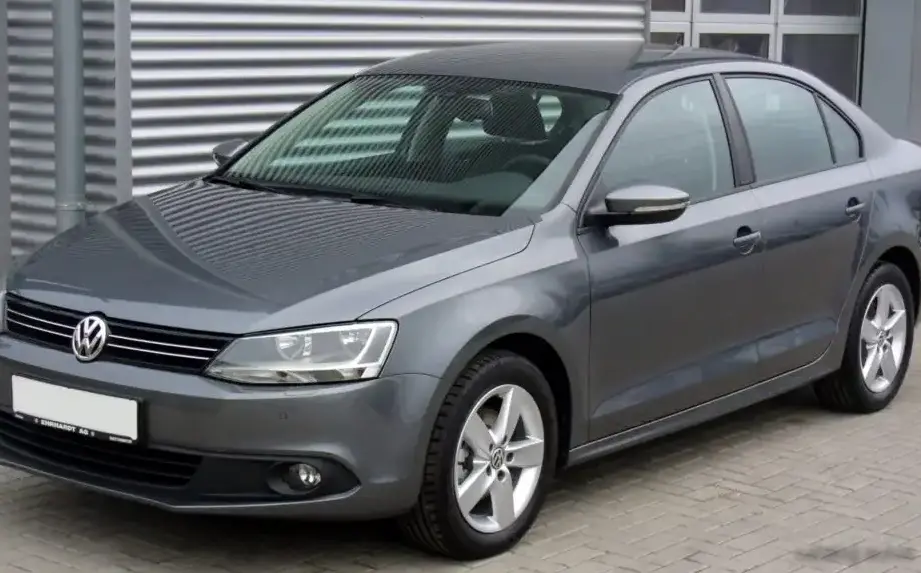
The Volkswagen Jetta VI 2.0 TSI (200 hp) DSG, produced between 2011 and 2013, represents a performance-focused iteration within the sixth generation of Volkswagen’s popular Jetta sedan. Positioned as a mid-to-upper trim level, it offered a substantial increase in power and driving dynamics compared to the base models, appealing to drivers who desired a more engaging driving experience. While primarily sold in Europe and other international markets, the Jetta lineup in North America featured different engine options during this period. Built on the A5 (PQ35) platform, the Jetta VI aimed to strike a balance between practicality, comfort, and a degree of sportiness, and the 2.0 TSI variant exemplified this ambition.
Powertrain & Engine Architecture
At the core of the Jetta VI 2.0 TSI DSG is the CCZA engine, a 1.984-liter inline-four cylinder gasoline engine. This engine belongs to Volkswagen’s EA888 family, renowned for its robust construction and potential for performance enhancements. The CCZA engine incorporates direct fuel injection (FSI) and a turbocharger with an intercooler, enabling it to generate 200 horsepower and 280 Nm (206.52 lb-ft) of torque. The direct injection system precisely controls fuel delivery into the combustion chambers, improving both efficiency and power output. Dual overhead camshafts (DOHC) with four valves per cylinder further optimize airflow and performance. The engine is mounted transversely in the front of the vehicle. The dual-clutch gearbox (DSG) is a 6-speed automatic transmission. It delivers quick and seamless gear changes, contributing to the car’s sporty feel and improved fuel economy compared to a conventional automatic.
Driving Characteristics
The combination of 200 hp and the DSG transmission results in a noticeably more spirited driving experience compared to the lower-powered Jetta VI models. Acceleration from 0 to 100 km/h (0-62 mph) is achieved in approximately 7.5 seconds. The DSG transmission facilitates rapid shifts, maintaining the engine within its optimal power range. While not a dedicated sports sedan, the 2.0 TSI provides ample power for overtaking maneuvers and comfortable highway cruising. The gear ratios are calibrated to balance acceleration with fuel efficiency. Compared to the 1.4 TSI or diesel variants, the 2.0 TSI offers a more linear power delivery and a more responsive throttle. Manual transmission versions of this engine provided a slightly more engaging experience, but the DSG offers convenience and efficiency.
Equipment & Trim Levels
The 2.0 TSI trim typically included a higher level of standard features than the base Jetta VI models. This often encompassed alloy wheels (typically 17-inch), automatic climate control, a multi-function steering wheel, and upgraded interior trim. Depending on the market and optional packages, features such as a touchscreen infotainment system, parking sensors, and a sunroof were available. Interior upholstery was generally cloth or leatherette, with higher trims offering full leather options. The dashboard layout remained consistent across the Jetta VI range, but the 2.0 TSI often featured unique trim accents and badging.
Chassis & Braking
The Jetta VI 2.0 TSI utilized a MacPherson strut front suspension and a multi-link rear suspension. This configuration provided a good compromise between ride comfort and handling. Stabilizer bars were fitted to both axles to minimize body roll during cornering. The braking system consisted of ventilated front discs and solid rear discs, providing adequate stopping power for the vehicle’s performance capabilities. ABS (Anti-lock Braking System) was standard equipment. The suspension tuning was slightly firmer than the base models to complement the increased power output.
Market Reception & Comparison
The Jetta VI 2.0 TSI was generally well-received by automotive critics, who lauded its performance and refinement. It was considered a compelling alternative to other compact sedans in its class. Fuel economy was deemed reasonable for a 200 hp engine, averaging around 7.7 l/100 km (30.5 US mpg). Compared to the 1.4 TSI, the 2.0 TSI offered significantly more power, but at the expense of slightly higher fuel consumption. The diesel variants (such as the 2.0 TDI) delivered even better fuel economy but lacked the 2.0 TSI’s outright performance. Reliability was generally good, although some owners reported occasional issues with the DSG transmission.
Legacy
The Jetta VI 2.0 TSI (200 hp) DSG continues to be a popular choice in the used car market. The EA888 engine is known for its durability and potential for tuning. The DSG transmission, when properly maintained, is generally reliable. These vehicles offer a good balance of performance, practicality, and affordability. The Jetta VI generation, and particularly the 2.0 TSI variant, helped solidify the Jetta’s reputation as a versatile and engaging compact sedan.