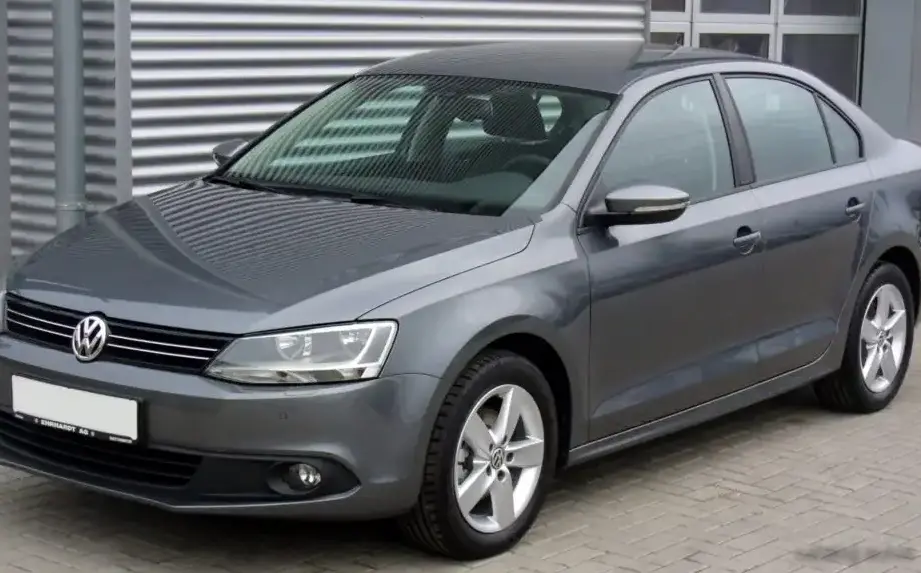
The Volkswagen Jetta VI 2.0 TSI (210 hp) represents a performance-oriented variant within the sixth generation of Volkswagen’s popular Jetta sedan, produced between 2013 and 2014. Positioned as a step up from the base models, this version aimed to deliver a more engaging driving experience while maintaining the Jetta’s reputation for practicality and refinement. It was a key offering in markets where consumers desired a blend of efficiency and spirited performance in a compact package, particularly in Europe and North America. This model utilized the EA888 engine family, known for its tuning potential and widespread use across the Volkswagen Group.
Technical Specifications
| Brand | Volkswagen |
| Model | Jetta |
| Generation | Jetta VI |
| Type (Engine) | 2.0 TSI (210 Hp) |
| Start of production | 2013 |
| End of production | 2014 |
| Powertrain Architecture | Internal Combustion engine |
| Body type | Sedan |
| Seats | 5 |
| Doors | 4 |
| Fuel consumption (economy) – urban (NEDC) | 9.9 l/100 km (23.8 US mpg, 28.5 UK mpg, 10.1 km/l) |
| Fuel consumption (economy) – extra urban (NEDC) | 5.5 l/100 km (42.8 US mpg, 51.4 UK mpg, 18.2 km/l) |
| Fuel consumption (economy) – combined (NEDC) | 7.1 l/100 km (33.1 US mpg, 39.8 UK mpg, 14.1 km/l) |
| CO2 emissions (NEDC) | 164 g/km |
| Fuel Type | Petrol (Gasoline) |
| Acceleration 0 – 100 km/h | 7.2 sec |
| Acceleration 0 – 62 mph | 7.2 sec |
| Acceleration 0 – 60 mph | 6.8 sec |
| Maximum speed | 243 km/h (150.99 mph) |
| Emission standard | Euro 5 |
| Weight-to-power ratio | 6.5 kg/Hp, 154.3 Hp/tonne |
| Weight-to-torque ratio | 4.9 kg/Nm, 205.7 Nm/tonne |
| Power | 210 Hp @ 5300-6200 rpm |
| Power per litre | 105.8 Hp/l |
| Torque | 280 Nm @ 1700-5200 rpm (206.52 lb.-ft. @ 1700-5200 rpm) |
| Engine layout | Front, Transverse |
| Engine Model/Code | EA888 / CPLA |
| Engine displacement | 1984 cm3 (121.07 cu. in.) |
| Number of cylinders | 4 |
| Engine configuration | Inline |
| Cylinder Bore | 82.5 mm (3.25 in.) |
| Piston Stroke | 92.8 mm (3.65 in.) |
| Number of valves per cylinder | 4 |
| Fuel injection system | Direct injection |
| Engine aspiration | Turbocharger, Intercooler |
| Valvetrain | DOHC |
| Engine oil capacity | 5.5 l (5.81 US qt | 4.84 UK qt) |
| Kerb Weight | 1361 kg (3000.49 lbs.) |
| Max. weight | 1920 kg (4232.88 lbs.) |
| Max load | 559 kg (1232.38 lbs.) |
| Trunk (boot) space – minimum | 510 l (18.01 cu. ft.) |
| Fuel tank capacity | 55 l (14.53 US gal | 12.1 UK gal) |
| Max. roof load | 75 kg (165.35 lbs.) |
| Permitted trailer load with brakes (8%) | 1700 kg (3747.86 lbs.) |
| Permitted trailer load with brakes (12%) | 1400 kg (3086.47 lbs.) |
| Permitted trailer load without brakes | 710 kg (1565.28 lbs.) |
| Permitted towbar download | 75 kg (165.35 lbs.) |
| Length | 4644 mm (182.83 in.) |
| Width | 1778 mm (70 in.) |
| Width including mirrors | 2020 mm (79.53 in.) |
| Height | 1482 mm (58.35 in.) |
| Wheelbase | 2651 mm (104.37 in.) |
| Front track | 1535 mm (60.43 in.) |
| Rear (Back) track | 1538 mm (60.55 in.) |
| Ride height (ground clearance) | 139 mm (5.47 in.) |
| Minimum turning circle (turning diameter) | 11.1 m (36.42 ft.) |
| Approach angle | 14.1° |
| Departure angle | 11.5° |
| Ramp-over (brakeover) angle | 10.5° |
| Drivetrain Architecture | The Internal combustion engine (ICE) drives the front wheels of the vehicle. |
| Drive wheel | Front wheel drive |
| Number of gears and type of gearbox | 6 gears, manual transmission |
| Front suspension | Coil spring, Wishbone, Transverse stabilizer |
| Rear suspension | Independent multi-link suspension, Transverse stabilizer |
| Front brakes | Ventilated discs |
| Rear brakes | Disc |
| Assisting systems | ABS (Anti-lock braking system) |
| Steering type | Steering rack and pinion |
| Power steering | Electric Steering |
| Tires size | 225/45 R17 |
| Wheel rims size | 7J x 17 |
Powertrain & Engine Architecture
At the heart of the Jetta VI 2.0 TSI lies the EA888 engine, specifically the CPLA variant. This 1984cc, turbocharged, direct-injection four-cylinder engine was a significant upgrade over the naturally aspirated engines offered in lower trims. The EA888 family was known for its robust construction and ability to handle increased boost pressures, making it popular among enthusiasts. Direct injection allowed for precise fuel delivery, improving both power and efficiency. The engine featured a double overhead camshaft (DOHC) valvetrain with four valves per cylinder, optimizing airflow for enhanced performance. The turbocharger, coupled with an intercooler, minimized intake air temperatures, further boosting power output. The 210 hp version of the EA888 utilized a more aggressive engine map and potentially different turbocharger internals compared to lower-output variants. The standard transmission was a 6-speed manual, although a 6-speed DSG (Direct-Shift Gearbox) dual-clutch automatic was also available as an option.
Driving Characteristics
The Jetta VI 2.0 TSI offered a noticeably more engaging driving experience than its lower-powered siblings. The 210 hp output, combined with 280 Nm (206.52 lb-ft) of torque, provided brisk acceleration, with 0-60 mph times around 6.8 seconds. The turbocharger provided a surge of power in the mid-range, making overtaking maneuvers effortless. While not a dedicated sports sedan, the 2.0 TSI Jetta offered a good balance between performance and everyday usability. The 6-speed manual transmission allowed for precise control, while the optional DSG provided quick and seamless gear changes. Compared to the base 1.6L or 2.0L engines, the 2.0 TSI felt significantly more responsive and capable. The suspension was tuned to provide a comfortable ride without sacrificing handling, making it suitable for both daily commuting and spirited driving.
Equipment & Trim Levels
The 2.0 TSI trim typically included a higher level of standard equipment compared to the base Jetta models. Standard features often included alloy wheels, a sport-tuned suspension, upgraded interior trim, and a premium audio system. Optional extras could include leather upholstery, a sunroof, navigation system, and advanced driver-assistance systems. The interior typically featured sport seats with enhanced bolstering, providing better support during cornering. The dashboard layout was generally consistent across the Jetta VI range, but the 2.0 TSI trim often featured unique trim accents and badging.
Chassis & Braking
The Jetta VI 2.0 TSI utilized a MacPherson strut front suspension and a multi-link rear suspension, providing a good balance between ride comfort and handling. The front brakes were typically ventilated discs, while the rear brakes were solid discs. ABS (Anti-lock Braking System) was standard, enhancing braking performance and stability. The chassis was reinforced compared to the base models to handle the increased power output of the 2.0 TSI engine. The steering was a rack-and-pinion system with electric power assistance, providing precise and responsive steering feel.
Market Reception & Comparison
The Jetta VI 2.0 TSI was generally well-received by automotive critics, who praised its performance, handling, and refinement. It was often seen as a compelling alternative to other compact sedans in its class, such as the Honda Civic Si and the Mazda3. Fuel economy was respectable for a performance-oriented model, averaging around 33.1 US mpg in combined driving. Reliability was generally good, although some owners reported minor issues with the turbocharger and fuel injectors. Compared to the lower-powered Jetta trims, the 2.0 TSI offered a significant performance upgrade, but it also came with a higher price tag.
Legacy
The Jetta VI 2.0 TSI remains a popular choice in the used car market today, particularly among enthusiasts who appreciate its performance and tuning potential. The EA888 engine is known for its durability and ability to withstand modifications. While maintenance costs may be slightly higher than those of the base models due to the turbocharger and direct injection system, the Jetta VI 2.0 TSI offers a compelling combination of performance, practicality, and refinement. Its continued presence on the used car market is a testament to its enduring appeal and the quality of its engineering.