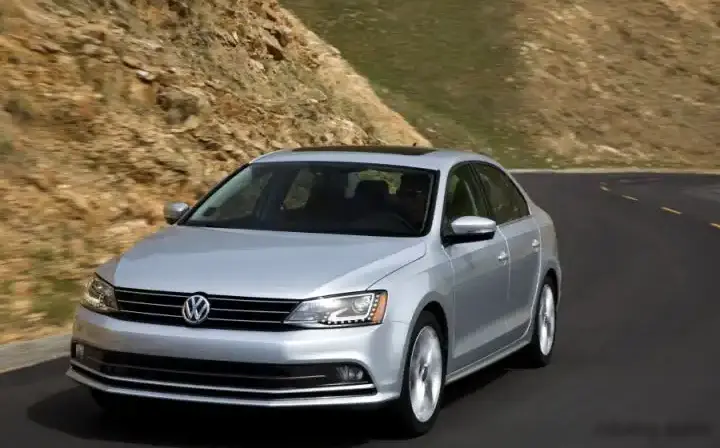
The Volkswagen Jetta VI facelift, produced from 2014 to 2018, represented a significant mid-cycle refresh of the sixth-generation Jetta (introduced in 2011). Among the various engine and transmission options offered, the 1.4 TSI (150 hp) paired with the Direct-Shift Gearbox (DSG) was a popular choice, particularly in European and Asian markets. This configuration aimed to balance fuel efficiency with acceptable performance, positioning itself as a mainstream offering within the Jetta lineup. It sat between the base 1.2 TSI engine and the more powerful 1.8 TSI and 2.0 TDI variants.
Technical Specifications
| Brand | Volkswagen |
| Model | Jetta |
| Generation | Jetta VI (facelift 2014) |
| Type (Engine) | 1.4 TSI (150 Hp) DSG |
| Start of production | 2014 |
| End of production | 2018 |
| Powertrain Architecture | Internal Combustion engine |
| Body type | Sedan |
| Seats | 5 |
| Doors | 4 |
| Fuel consumption (urban) | 6.2 l/100 km (37.9 US mpg, 45.6 UK mpg, 16.1 km/l) |
| Fuel consumption (extra urban) | 4.4 l/100 km (53.5 US mpg, 64.2 UK mpg, 22.7 km/l) |
| Fuel consumption (combined) | 5.1 l/100 km (46.1 US mpg, 55.4 UK mpg, 19.6 km/l) |
| CO2 emissions | 117 g/km |
| Fuel Type | Petrol (Gasoline) |
| Acceleration 0 – 100 km/h | 8.6 sec |
| Acceleration 0 – 62 mph | 8.6 sec |
| Acceleration 0 – 60 mph | 8.2 sec |
| Maximum speed | 220 km/h (136.7 mph) |
| Emission standard | Euro 6 |
| Weight-to-power ratio | 9.1 kg/Hp, 110 Hp/tonne |
| Weight-to-torque ratio | 5.5 kg/Nm, 183.3 Nm/tonne |
| Power | 150 Hp @ 5000-6000 rpm |
| Power per litre | 107.5 Hp/l |
| Torque | 250 Nm @ 1500-3500 rpm (184.39 lb.-ft. @ 1500-3500 rpm) |
| Engine layout | Front, Transverse |
| Engine Model/Code | CTHA |
| Engine displacement | 1395 cm3 (85.13 cu. in.) |
| Number of cylinders | 4 |
| Engine configuration | Inline |
| Number of valves per cylinder | 4 |
| Fuel injection system | Direct injection |
| Engine aspiration | Turbocharger, Intercooler |
| Engine oil capacity | 3.6 l (3.8 US qt | 3.17 UK qt) |
| Kerb Weight | 1364 kg (3007.11 lbs) |
| Max. weight | 1870 kg (4122.64 lbs) |
| Max load | 506 kg (1115.54 lbs) |
| Trunk (boot) space – minimum | 510 l (18.01 cu. ft) |
| Fuel tank capacity | 55 l (14.53 US gal | 12.1 UK gal) |
| Max. roof load | 75 kg (165.35 lbs) |
| Permitted trailer load with brakes (12%) | 1400 kg (3086.47 lbs) |
| Permitted trailer load without brakes | 670 kg (1477.1 lbs) |
| Permitted towbar download | 80 kg (176.37 lbs) |
| Length | 4659 mm (183.43 in) |
| Width | 1778 mm (70 in) |
| Height | 1482 mm (58.35 in) |
| Wheelbase | 2651 mm (104.37 in) |
| Front track | 1535 mm (60.43 in) |
| Rear (Back) track | 1538 mm (60.55 in) |
| Minimum turning circle | 11.1 m (36.42 ft) |
| Drivetrain Architecture | Front wheel drive |
| Number of gears and type of gearbox | 7 gears, automatic transmission DSG |
| Front brakes | Ventilated discs |
| Rear brakes | Disc |
| Tires size | 205/55 R16 |
| Wheel rims size | 6.5J x 16 |
Powertrain & Engine Architecture
The heart of this Jetta variant is the CTHA engine, a 1.4-liter turbocharged inline-four cylinder gasoline engine. This engine is part of Volkswagen’s EA111 family, known for its compact size and efficiency. It utilizes direct fuel injection (FSI) and a turbocharger with an intercooler to boost power output. The direct injection system precisely meters fuel into the combustion chamber, improving combustion efficiency and reducing emissions. The turbocharger, driven by exhaust gases, forces more air into the engine, increasing power. The engine’s valvetrain features four valves per cylinder, contributing to improved breathing and performance. The 150 hp output is achieved between 5000 and 6000 rpm, while the peak torque of 250 Nm (184 lb-ft) is available from a low 1500 rpm, providing good responsiveness in everyday driving situations.
The engine is mated to a 7-speed dual-clutch transmission (DSG). This transmission offers both fully automatic operation and the ability to manually shift gears via the gear selector or steering wheel-mounted paddles (depending on the specific trim level). The DSG provides quick and smooth gear changes, enhancing both performance and fuel economy. The transmission’s gear ratios are tuned to prioritize fuel efficiency while still providing adequate acceleration.
Driving Characteristics
The 1.4 TSI with DSG delivers a comfortable and refined driving experience. Acceleration from 0 to 60 mph takes approximately 8.2 seconds, which is adequate for most daily driving scenarios. While not a sports car, the turbocharger provides a noticeable boost in power when accelerating, making overtaking maneuvers relatively easy. The DSG transmission contributes to smooth and seamless gear changes, minimizing disruptions in power delivery. Compared to the base 1.2 TSI engine, the 1.4 TSI offers significantly more power and torque, resulting in a more confident and enjoyable driving experience. However, it doesn’t match the outright performance of the 1.8 TSI or the diesel-powered 2.0 TDI models. The lower power output also means that the 1.4 TSI is generally more fuel-efficient than its higher-powered siblings.
Equipment & Trim Levels
The 1.4 TSI DSG Jetta VI typically came equipped with a reasonable level of standard features. These often included air conditioning, power windows and locks, a basic audio system with a CD player and auxiliary input, and alloy wheels. Higher trim levels, such as Trendline, Comfortline, and Highline, added features like automatic climate control, a touchscreen infotainment system, Bluetooth connectivity, and upgraded interior upholstery. Optional extras included a sunroof, navigation system, and parking sensors.
Chassis & Braking
The Jetta VI utilizes a MacPherson strut front suspension and a multi-link rear suspension. This setup provides a good balance between ride comfort and handling. The suspension is tuned to prioritize comfort, but it still offers decent body control in corners. Braking duties are handled by ventilated disc brakes at the front and solid disc brakes at the rear. Anti-lock braking system (ABS) is standard, enhancing safety during emergency braking situations. The Jetta’s steering is precise and responsive, providing a confident feel behind the wheel.
Market Reception & Comparison
The 1.4 TSI DSG Jetta was generally well-received by automotive critics. It was praised for its fuel efficiency, comfortable ride, and refined driving experience. However, some critics noted that the engine could feel a bit strained when pushed hard, and the performance wasn’t as exhilarating as some of its rivals. Compared to the 1.8 TSI, the 1.4 TSI offered better fuel economy but less power. The 2.0 TDI provided even better fuel economy and more torque, but it came with the higher cost and potential maintenance concerns associated with diesel engines. The 1.4 TSI DSG represented a good compromise for buyers seeking a balance between efficiency, performance, and affordability.
Legacy
The 1.4 TSI engine, in various iterations, proved to be a relatively reliable powertrain. However, early versions of the EA111 engine family were known to experience issues with timing chain tensioners, which could lead to engine damage. Later revisions addressed these issues, improving reliability. The DSG transmission, while generally robust, can require more frequent maintenance than a traditional automatic transmission, including fluid changes and potential clutch pack replacements. Today, used Jetta VI 1.4 TSI DSG models represent a relatively affordable option for buyers seeking a comfortable and fuel-efficient compact sedan. Proper maintenance records are crucial when considering a used example, particularly regarding the timing chain and DSG transmission.