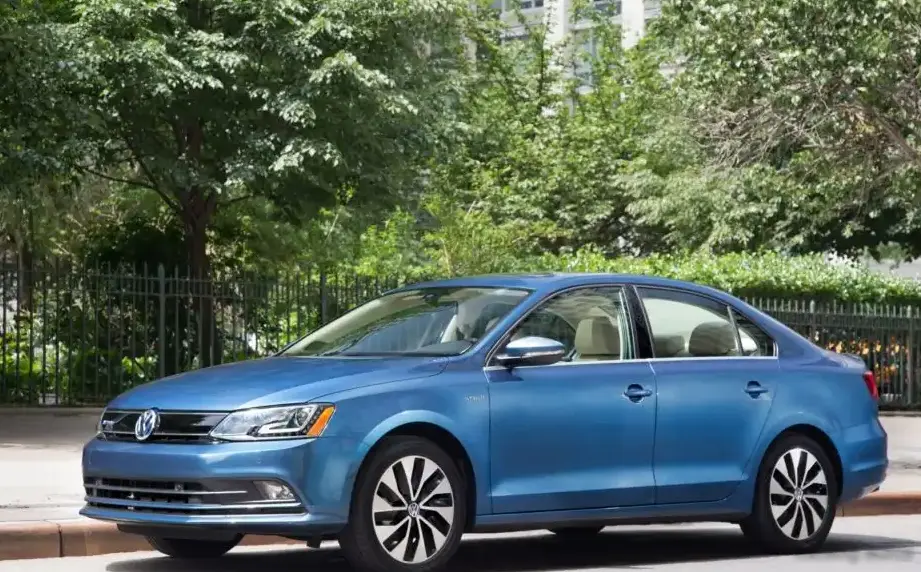
The Volkswagen Jetta VI (facelift, introduced in 2014) 1.4 TSI 170 hp Hybrid DSG represents a significant step in Volkswagen’s push towards fuel efficiency and hybrid technology within the compact sedan segment. Produced from 2014 to 2016, this variant was positioned as a mid-range offering, bridging the gap between the more affordable, lower-powered Jetta trims and the performance-oriented models. It utilized Volkswagen’s modular transverse matrix (MQB) platform, specifically the A3 iteration, shared with other models like the Golf and Audi A3. The Jetta VI facelift brought updated styling, improved interior materials, and crucially, the introduction of this hybrid powertrain option for the North American market.
Technical Specifications
| Brand | Volkswagen |
| Model | Jetta |
| Generation | Jetta VI (facelift 2014) |
| Type (Engine) | 1.4 TSI (170 Hp) Hybrid DSG |
| Start of production | 2014 |
| End of production | 2016 |
| Powertrain Architecture | FHEV (Full Hybrid Electric Vehicle) |
| Body type | Sedan |
| Seats | 5 |
| Doors | 4 |
| Fuel consumption (urban) | 4.4 l/100 km (53.5 US mpg, 64.2 UK mpg, 22.7 km/l) |
| Fuel consumption (extra urban) | 3.9 l/100 km (60.3 US mpg, 72.4 UK mpg, 25.6 km/l) |
| Fuel consumption (combined) | 4.1 l/100 km (57.4 US mpg, 68.9 UK mpg, 24.4 km/l) |
| CO2 emissions | 95 g/km |
| Fuel Type | Petrol (Gasoline) |
| Acceleration 0 – 100 km/h | 8.6 sec |
| Acceleration 0 – 62 mph | 8.6 sec |
| Acceleration 0 – 60 mph | 8.2 sec |
| Maximum speed | 210 km/h (130.49 mph) |
| Emission standard | Euro 6 |
| Weight-to-power ratio | 8.4 kg/Hp, 118.9 Hp/tonne |
| Weight-to-torque ratio | 5.7 kg/Nm, 174.8 Nm/tonne |
| Gross battery capacity | 1.1 kWh |
| Battery voltage | 220 V |
| Battery technology | Lithium-ion (Li-Ion) |
| Battery weight | 53 kg (116.84 lbs) |
| Battery location | Under the trunk |
| All-electric range | 1.6 km (0.99 mi) |
| Max speed (electric) | 71 km/h (44.12 mph) |
| Electric motor power | 27 Hp @ 2500 rpm |
| Electric motor Torque | 155 Nm (114.32 lb.-ft.) |
| Electric motor location | Between the combustion engine and the transmission |
| System power | 170 Hp @ 5000 rpm |
| System torque | 250 Nm @ 1000 rpm (184.39 lb.-ft. @ 1000 rpm) |
| Engine Power | 150 Hp @ 5000-6000 rpm |
| Engine Torque | 250 Nm @ 1600-3500 rpm (184.39 lb.-ft. @ 1600-3500 rpm) |
| Engine layout | Front, Transverse |
| Engine Model/Code | EA211 / CNLA, CRJA |
| Engine displacement | 1395 cm3 (85.13 cu. in.) |
| Number of cylinders | 4 |
| Engine configuration | Inline |
| Cylinder Bore | 74.5 mm (2.93 in.) |
| Piston Stroke | 80 mm (3.15 in.) |
| Compression ratio | 10.5:1 |
| Number of valves per cylinder | 4 |
| Fuel injection system | Direct injection |
| Engine aspiration | Turbocharger, Intercooler |
| Valvetrain | DOHC |
| Engine oil capacity | 4 l (4.23 US qt | 3.52 UK qt) |
| Coolant | 8 l (8.45 US qt | 7.04 UK qt) |
| Kerb Weight | 1430-1547 kg (3152.61 – 3410.55 lbs) |
| Max. weight | 2010-2020 kg (4431.29 – 4453.34 lbs) |
| Max load | 473-580 kg (1042.79 – 1278.68 lbs) |
| Trunk (boot) space (minimum) | 374 l (13.21 cu. ft.) |
| Fuel tank capacity | 45 l (11.89 US gal | 9.9 UK gal) |
| Max. roof load | 75 kg (165.35 lbs) |
| Length | 4659 mm (183.43 in.) |
| Width | 1778 mm (70 in.) |
| Width including mirrors | 2020 mm (79.53 in.) |
| Height | 1482 mm (58.35 in.) |
| Wheelbase | 2651 mm (104.37 in.) |
| Front track | 1535-1541 mm (60.43 – 60.67 in.) |
| Rear track | 1538-1547 mm (60.55 – 60.91 in.) |
| Ride height (ground clearance) | 138 mm (5.43 in.) |
| Drag coefficient (Cd) | 0.28 |
| Minimum turning circle | 11.1 m (36.42 ft.) |
| Drivetrain Architecture | The Internal combustion engine (ICE) and electric motor drive the front wheels with the ability to work in full electric or mixed mode. |
| Drive wheel | Front wheel drive |
| Number of gears and type of gearbox | 7 gears, automatic transmission DSG |
| Front suspension | Independent, type McPherson with coil spring and anti-roll bar |
| Rear suspension | Independent multi-link spring suspension with stabilizer |
| Front brakes | Ventilated discs, 287×25 mm |
| Rear brakes | Disc, 272×10 mm |
INTRODUCTION
The 2014-2016 Volkswagen Jetta VI 1.4 TSI 170 hp Hybrid DSG marked Volkswagen’s foray into offering a more fuel-conscious option within the popular Jetta lineup. This model year represented a facelift for the Jetta VI, bringing with it revised styling cues and, more importantly, the introduction of a hybrid powertrain. The Jetta had long been a mainstay in the North American market, known for its European handling and relatively affordable price point. The hybrid variant aimed to broaden its appeal by attracting buyers prioritizing fuel economy without sacrificing the Jetta’s core driving characteristics. It sat in the middle of the Jetta range, above the base 1.8T models and below the performance-oriented GLI.
Powertrain & Engine Architecture
At the heart of the Jetta Hybrid lies Volkswagen’s 1.4-liter TSI (Turbocharged Stratified Injection) engine, specifically the CNLA or CRJA engine code depending on the production date. This engine produces 150 horsepower and 184 lb-ft of torque. It features direct fuel injection and a turbocharger with an intercooler, optimizing both power and efficiency. The engine is paired with a 27 hp electric motor, integrated between the engine and the 7-speed DSG (Direct-Shift Gearbox) dual-clutch transmission. The electric motor draws power from a 1.1 kWh lithium-ion battery pack located under the trunk floor. The hybrid system allows for all-electric driving at low speeds and assists the gasoline engine during acceleration, resulting in a combined system output of 170 horsepower and 184 lb-ft of torque. The DSG transmission is crucial to the system’s efficiency, providing quick and smooth gear changes.
Driving Characteristics
The Jetta Hybrid offers a noticeably different driving experience compared to its gasoline-only counterparts. The electric motor provides instant torque, resulting in brisk acceleration from a standstill. While not a sports car, the 170 hp combined output delivers adequate power for everyday driving and highway merging. The DSG transmission contributes to a responsive feel, and the hybrid system seamlessly transitions between electric and gasoline power. However, the added weight of the battery pack and electric motor does slightly impact handling compared to lighter Jetta models. The steering is precise, but the suspension is tuned more for comfort than outright sportiness. In real-world conditions, the hybrid system delivers on its promise of improved fuel economy, particularly in city driving where regenerative braking captures energy during deceleration.
Equipment & Trim Levels
The Jetta Hybrid typically came well-equipped, reflecting its mid-range positioning. Standard features included automatic climate control, a touchscreen infotainment system with Bluetooth connectivity, and alloy wheels. Safety features such as anti-lock brakes, stability control, and multiple airbags were also standard. Optional extras included a premium sound system, leather upholstery, a sunroof, and advanced driver-assistance systems like forward collision warning. Interior trim levels varied, but generally featured comfortable seating and a functional, if not overly luxurious, cabin design. The dashboard layout was similar to other Jetta VI models, with a focus on ergonomics and ease of use.
Chassis & Braking
The Jetta Hybrid utilizes an independent McPherson strut front suspension and an independent multi-link rear suspension, providing a comfortable ride and decent handling. Stabilizer bars are included at both ends to reduce body roll. Braking duties are handled by ventilated discs at the front and solid discs at the rear. The anti-lock braking system (ABS) is standard, enhancing safety during emergency braking situations. The suspension tuning is geared towards providing a balance between comfort and control, making it suitable for daily commuting and long-distance driving. The weight distribution, affected by the battery pack, is carefully managed to maintain stability.
Market Reception & Comparison
The Jetta Hybrid was generally well-received by automotive critics, who praised its fuel efficiency and smooth driving experience. However, some reviewers noted that its all-electric range was relatively limited compared to other hybrid vehicles on the market. Compared to the standard 1.8T Jetta, the Hybrid offered significantly better fuel economy but came at a higher price point. Against competitors like the Toyota Prius and Honda Insight, the Jetta Hybrid offered a more conventional driving experience and a more stylish design, but lacked the same level of all-electric range. Reliability reports have been generally positive, with few major issues reported with the hybrid powertrain.
Legacy
The Volkswagen Jetta VI Hybrid represented an important step in Volkswagen’s commitment to hybrid technology. While it wasn’t a runaway sales success, it demonstrated the company’s ability to integrate hybrid systems into its popular models. On the used car market today, the Jetta Hybrid remains a relatively affordable and fuel-efficient option. The 1.4 TSI engine and DSG transmission are generally reliable, but regular maintenance is crucial to ensure long-term durability. The battery pack’s lifespan is a key consideration for potential buyers, but many Jetta Hybrids are still operating reliably with well over 100,000 miles. The Jetta Hybrid paved the way for future Volkswagen hybrid and electric vehicles, contributing to the company’s ongoing efforts to reduce emissions and improve fuel economy.