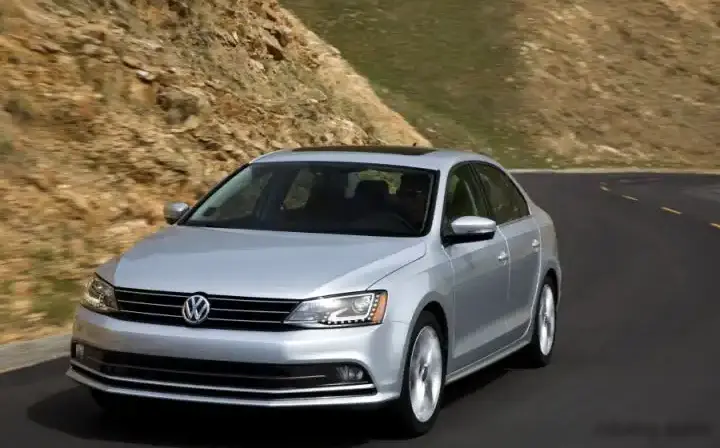
The Volkswagen Jetta VI, specifically the facelifted model produced from 2014 to 2016, represented a significant evolution of Volkswagen’s popular compact sedan. Within the Jetta VI range, the 1.8 TSI (170 hp) variant occupied a middle-ground position, offering a balance between performance, fuel efficiency, and affordability. This model was primarily aimed at the North American market, where larger displacement engines were favored, and served as a step up from the base 1.8 TSI models with lower horsepower ratings. It slotted below the more performance-oriented GLI trim and the diesel-powered TDI versions.
Technical Specifications
| Brand | Volkswagen |
| Model | Jetta |
| Generation | Jetta VI (facelift 2014) |
| Type (Engine) | 1.8 TSI (170 Hp) |
| Start of production | 2014 |
| End of production | 2016 |
| Powertrain Architecture | Internal Combustion engine |
| Body type | Sedan |
| Seats | 5 |
| Doors | 4 |
| Fuel consumption (economy) – urban (EPA) | 9.4 l/100 km (25 US mpg) |
| Fuel consumption (economy) – extra urban (EPA) | 6.4 l/100 km (36.8 US mpg) |
| Fuel consumption (economy) – combined (EPA) | 8.1 l/100 km (29 US mpg) |
| Fuel Type | Petrol (Gasoline) |
| Weight-to-power ratio | 8.1 kg/Hp, 123 Hp/tonne |
| Weight-to-torque ratio | 5.5 kg/Nm, 180.9 Nm/tonne |
| Power | 170 Hp @ 4800 rpm |
| Power per litre | 94.5 Hp/l |
| Torque | 250 Nm @ 1500-4750 rpm (184.39 lb.-ft. @ 1500-4750 rpm) |
| Engine layout | Front, Transverse |
| Engine Model/Code | EA888 / CPKA, CPRA |
| Engine displacement | 1798 cm3 (109.72 cu. in.) |
| Number of cylinders | 4 |
| Engine configuration | Inline |
| Cylinder Bore | 82.5 mm (3.25 in.) |
| Piston Stroke | 84.1 mm (3.31 in.) |
| Compression ratio | 9.6:1 |
| Number of valves per cylinder | 4 |
| Fuel injection system | Direct injection |
| Engine aspiration | Turbocharger, Intercooler |
| Valvetrain | DOHC |
| Engine oil capacity | 5.5 l (5.81 US qt | 4.84 UK qt) |
| Coolant | 8 l (8.45 US qt | 7.04 UK qt) |
| Kerb Weight | 1382 kg (3046.79 lbs.) |
| Max. weight | 1920 kg (4232.88 lbs.) |
| Max load | 538 kg (1186.09 lbs.) |
| Trunk (boot) space – minimum | 445 l (15.72 cu. ft.) |
| Fuel tank capacity | 55 l (14.53 US gal | 12.1 UK gal) |
| Length | 4659 mm (183.43 in.) |
| Width | 1778 mm (70 in.) |
| Height | 1453 mm (57.2 in.) |
| Wheelbase | 2651 mm (104.37 in.) |
| Front track | 1535 mm (60.43 in.) |
| Rear (Back) track | 1532 mm (60.31 in.) |
| Ride height (ground clearance) | 132 mm (5.2 in.) |
| Drag coefficient (Cd) | 0.30 |
| Minimum turning circle (turning diameter) | 11.1 m (36.42 ft.) |
| Drivetrain Architecture | The Internal combustion engine (ICE) drives the front wheels of the vehicle. |
| Drive wheel | Front wheel drive |
| Number of gears and type of gearbox | 5 gears, manual transmission |
| Front suspension | Independent, type McPherson with coil spring and anti-roll bar |
| Rear suspension | Independent multi-link spring suspension with stabilizer |
| Front brakes | Ventilated discs, 287×25 mm |
| Rear brakes | Disc, 254×10 mm |
| Assisting systems | ABS (Anti-lock braking system) |
| Steering type | Steering rack and pinion |
| Power steering | Electric Steering |
| Tires size | 205/55 R16; 225/45 R17 |
| Wheel rims size | 6.5J x 16; 7J x 17 |
INTRODUCTION
The 2014-2016 Volkswagen Jetta VI facelift brought with it a refreshed exterior, updated interior features, and importantly, revised powertrain options. The 1.8 TSI 170 hp variant was a key offering, designed to appeal to buyers seeking a more spirited driving experience than the base engine provided, without the added cost of the higher-performance GLI or the fuel costs associated with diesel options. Built on the A5 (1HX0) platform, the Jetta VI aimed to provide a comfortable and practical sedan experience with a touch of European refinement.
Powertrain & Engine Architecture
At the heart of the Jetta 1.8 TSI was the EA888 engine family, specifically the CPKA or CPRA engine code depending on the exact production date and market. This 1.8-liter inline-four cylinder engine utilized direct fuel injection (FSI) and a single turbocharger with an intercooler. The direct injection system allowed for precise fuel delivery, improving both power and efficiency. The engine featured a dual overhead camshaft (DOHC) valvetrain with four valves per cylinder, optimizing airflow for increased performance. The turbocharger provided a significant boost in power output, allowing the relatively small displacement engine to produce 170 horsepower and 250 Nm (184 lb-ft) of torque. The torque curve was relatively flat, providing good responsiveness across a wide RPM range (1500-4750 rpm). The engine was paired with a 5-speed manual transmission as standard, offering a direct and engaging driving experience.
Driving Characteristics
The 1.8 TSI 170 hp Jetta offered a noticeable step up in performance compared to the lower-powered 1.8 TSI variants. Acceleration was brisk, and the turbocharger provided a satisfying surge of power during overtaking maneuvers. While not a sports car, the Jetta 1.8 TSI offered a comfortable and confident driving experience. The 5-speed manual transmission was well-matched to the engine’s powerband, allowing drivers to keep the engine in its optimal torque range. Compared to the GLI, the 1.8 TSI lacked the sharper handling and more powerful engine, but it offered a more comfortable ride and better fuel economy. Compared to the TDI models, the 1.8 TSI provided quicker acceleration but sacrificed the exceptional fuel efficiency of the diesel engine.
Equipment & Trim Levels
The 1.8 TSI trim level typically included standard features such as air conditioning, power windows and locks, a basic audio system, and steel wheels with wheel covers. Higher trim levels, often denoted by designations like “SE” or “SEL,” added features such as alloy wheels, a touchscreen infotainment system, Bluetooth connectivity, a sunroof, and upgraded interior upholstery. Optional extras included a premium sound system, navigation, and driver assistance features like blind-spot monitoring. Interior materials were generally durable and functional, with a focus on practicality rather than luxury.
Chassis & Braking
The Jetta VI utilized an independent McPherson strut suspension in the front and an independent multi-link suspension in the rear. This setup provided a comfortable ride and decent handling characteristics. The front brakes were ventilated discs, while the rear brakes were solid discs. Anti-lock braking system (ABS) was standard. The suspension was tuned for comfort, prioritizing ride quality over outright sportiness. Stabilizer bars were included both front and rear to reduce body roll during cornering. The steering was electrically assisted, providing light and precise control.
Market Reception & Comparison
The Jetta 1.8 TSI was generally well-received by automotive critics. It was praised for its combination of performance, fuel efficiency, and practicality. However, some reviewers noted that the interior materials were not as refined as those found in some competing models. Fuel economy figures were competitive for the class, averaging around 29 mpg combined. Reliability was generally good, although some owners reported minor issues with the turbocharger and fuel injection system. Compared to rivals like the Honda Civic and Toyota Corolla, the Jetta offered a more European driving experience and a more stylish design.
Legacy
The 1.8 TSI engine proved to be a reliable and durable powerplant when properly maintained. The Jetta VI 1.8 TSI remains a popular choice in the used car market today, offering a good value proposition for buyers seeking a comfortable, practical, and reasonably fuel-efficient sedan. While not a collector’s item, well-maintained examples continue to provide reliable transportation and a pleasant driving experience. The EA888 engine family, in its various iterations, has continued to be a mainstay in Volkswagen’s lineup, demonstrating its enduring design and engineering.