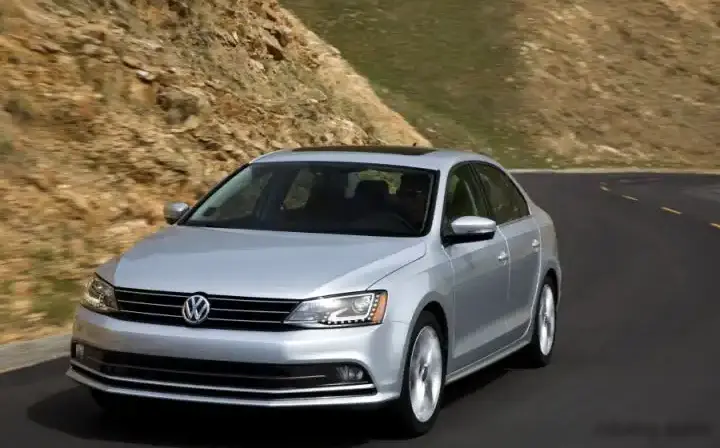
The Volkswagen Jetta VI (facelift, introduced in 2014) 2.0-liter (115 hp) represents a mid-cycle refresh of the sixth generation Jetta, a compact sedan that played a crucial role in Volkswagen’s North American strategy. Produced from 2014 to 2015, this variant aimed to offer a balance of fuel efficiency and adequate performance for the everyday commuter. It sat within the Jetta VI range as a step up from the base 1.8-liter engine, providing a noticeable increase in power without the added cost of the higher-performance options. The facelift brought revised styling, updated technology, and refinements to the existing powertrain options.
Technical Specifications
| Brand | Volkswagen |
| Model | Jetta |
| Generation | Jetta VI (facelift 2014) |
| Type (Engine) | 2.0 (115 Hp) |
| Start of production | 2014 |
| End of production | 2015 |
| Powertrain Architecture | Internal Combustion engine |
| Body type | Sedan |
| Seats | 5 |
| Doors | 4 |
| Fuel consumption (economy) – urban (EPA) | 9.4 l/100 km (25 US mpg) |
| Fuel consumption (economy) – extra urban (EPA) | 6.9 l/100 km (34.1 US mpg) |
| Fuel Type | Petrol (Gasoline) |
| Weight-to-power ratio | 11.3 kg/Hp, 88.7 Hp/tonne |
| Weight-to-torque ratio | 7.6 kg/Nm, 131.1 Nm/tonne |
| Power | 115 Hp @ 5200 rpm |
| Power per litre | 58 Hp/l |
| Torque | 170 Nm @ 4000 rpm (125.39 lb.-ft. @ 4000 rpm) |
| Engine layout | Front, Transverse |
| Engine Model/Code | CBPA |
| Engine displacement | 1984 cm3 (121.07 cu. in.) |
| Number of cylinders | 4 |
| Engine configuration | Inline |
| Cylinder Bore | 82.5 mm (3.25 in.) |
| Piston Stroke | 92.8 mm (3.65 in.) |
| Compression ratio | 10.3:1 |
| Number of valves per cylinder | 2 |
| Fuel injection system | Multi-port manifold injection |
| Engine aspiration | Naturally aspirated engine |
| Valvetrain | SOHC |
| Engine oil capacity | 4 l (4.23 US qt | 3.52 UK qt) |
| Coolant | 5 l (5.28 US qt | 4.4 UK qt) |
| Kerb Weight | 1297 kg (2859.4 lbs.) |
| Max. weight | 1870 kg (4122.64 lbs.) |
| Max load | 573 kg (1263.25 lbs.) |
| Trunk (boot) space – minimum | 445 l (15.72 cu. ft.) |
| Fuel tank capacity | 55 l (14.53 US gal | 12.1 UK gal) |
| Length | 4659 mm (183.43 in.) |
| Width | 1778 mm (70 in.) |
| Height | 1453 mm (57.2 in.) |
| Wheelbase | 2651 mm (104.37 in.) |
| Front track | 1535 mm (60.43 in.) |
| Rear (Back) track | 1532 mm (60.31 in.) |
| Ride height (ground clearance) | 132 mm (5.2 in.) |
| Drag coefficient (Cd) | 0.30 |
| Minimum turning circle (turning diameter) | 11.1 m (36.42 ft.) |
| Drivetrain Architecture | The Internal combustion engine (ICE) drives the front wheels of the vehicle. |
| Drive wheel | Front wheel drive |
| Number of gears and type of gearbox | 5 gears, manual transmission |
| Front suspension | Independent, type McPherson with coil spring and anti-roll bar |
| Rear suspension | Independent multi-link spring suspension with stabilizer |
| Front brakes | Ventilated discs, 287×25 mm |
| Rear brakes | Disc, 272×10 mm |
| Assisting systems | ABS (Anti-lock braking system) |
| Steering type | Steering rack and pinion |
| Power steering | Hydraulic Steering |
| Tires size | 195/65 R15 |
| Wheel rims size | 6J x 15 |
Powertrain & Engine Architecture
The 2014-2015 Jetta VI 2.0-liter engine utilizes the CBPA engine code, a naturally aspirated, inline-four cylinder powerplant. This engine is a member of Volkswagen’s EA888 family, known for its relatively simple design and durability. The CBPA features a single overhead camshaft (SOHC) design operating two valves per cylinder. Fuel delivery is managed by a multi-port fuel injection system, providing adequate atomization for efficient combustion. The engine’s 1984cc displacement, combined with a 10.3:1 compression ratio, yields 115 horsepower at 5200 rpm and 170 Nm (125 lb-ft) of torque at 4000 rpm. The engine is transversely mounted, driving the front wheels. The standard transmission for this variant was a 5-speed manual, although a 6-speed automatic transmission was also available as an option. The automatic transmission was designed to prioritize fuel economy and smooth operation over outright performance.
Driving Characteristics
The 2.0-liter, 115 hp Jetta offered a noticeable improvement in acceleration and overall responsiveness compared to the base 1.8-liter engine. However, it wasn’t a particularly sporty vehicle. The 5-speed manual transmission provided a reasonable level of control, while the optional 6-speed automatic aimed for smooth shifts and fuel efficiency. The automatic transmission’s gear ratios were tuned for everyday driving, prioritizing comfort over aggressive acceleration. In real-world conditions, the 2.0-liter Jetta could comfortably handle highway cruising and city driving, but lacked the punch for quick overtaking maneuvers. Compared to the more powerful Jetta GLI or those equipped with the TDI diesel engine, the 2.0-liter felt less refined and offered a more modest driving experience.
Equipment & Trim Levels
The 2.0-liter Jetta typically came in the base “S” trim level, offering a reasonable amount of standard equipment. This included air conditioning, power windows and locks, a basic audio system, and steel wheels with wheel covers. Higher trim levels, such as the “SE” and “SEL”, were available with options like alloy wheels, a sunroof, upgraded audio systems, and leather upholstery. Interior upholstery was typically cloth, with a straightforward dashboard layout. Optional extras included a touchscreen infotainment system, Bluetooth connectivity, and a rearview camera. The 2.0-liter trim was positioned as a step up from the base model, offering a bit more comfort and convenience without the premium price tag of the higher-end trims.
Chassis & Braking
The Jetta VI utilized an independent McPherson strut suspension in the front and an independent multi-link suspension in the rear. This setup provided a comfortable ride quality, absorbing bumps and irregularities in the road surface effectively. The front suspension incorporated a stabilizer bar to reduce body roll during cornering. Braking duties were handled by ventilated discs in the front and solid discs in the rear. The braking system was equipped with ABS (Anti-lock Braking System) as standard, enhancing safety and control during emergency braking situations. The suspension tuning was geared towards comfort and everyday usability, rather than sporty handling.
Market Reception & Comparison
Critics generally viewed the 2.0-liter Jetta as a competent and practical compact sedan. It was praised for its comfortable ride, spacious interior, and reasonable fuel economy. However, some reviewers noted that the engine lacked the refinement and power of competitors in the same class. Compared to the 1.8-liter Jetta, the 2.0-liter offered a noticeable performance boost, but at a slightly higher price point. The TDI diesel models were favored by those prioritizing fuel efficiency, while the Jetta GLI appealed to drivers seeking a more sporty driving experience. The 2.0-liter Jetta struck a balance between these extremes, offering a practical and affordable option for everyday commuting.
Legacy
The CBPA engine, found in the 2014-2015 Jetta VI 2.0, has proven to be a relatively reliable powertrain. While not without its potential issues (such as oil consumption in some cases), it generally holds up well with proper maintenance. In the used car market, these Jettas are often sought after for their affordability and practicality. The 2.0-liter engine provides a good balance of performance and fuel economy, making it a suitable choice for those seeking a dependable and economical compact sedan. Parts availability is generally good, and maintenance costs are relatively reasonable, contributing to its continued popularity among used car buyers.