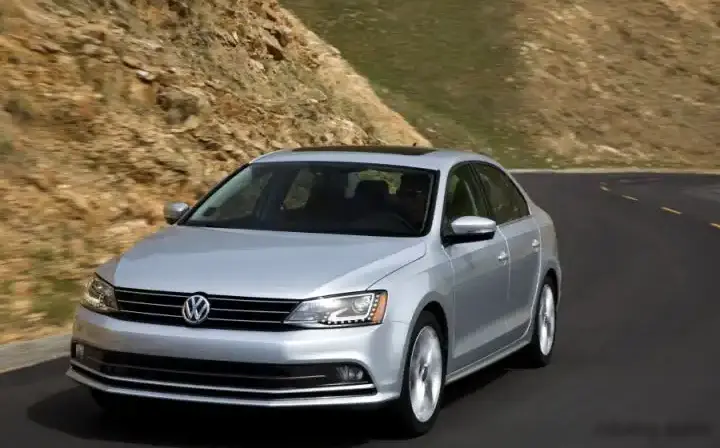
The Volkswagen Jetta VI (facelift, introduced in 2014) 2.0 TDI with 110 horsepower and a dual-clutch gearbox (DSG) represents a significant iteration within the sixth generation of Volkswagen’s popular compact sedan. Produced from 2014 to 2018, this variant was primarily aimed at the European market, where diesel engines and efficient automatic transmissions were highly favored. It occupied a middle ground in the Jetta VI lineup, offering a balance between fuel economy, reasonable performance, and modern convenience features. This model benefited from the mid-cycle refresh of the Jetta VI, incorporating updated styling and technology.
Technical Specifications
| Brand | Volkswagen |
| Model | Jetta |
| Generation | Jetta VI (facelift 2014) |
| Type (Engine) | 2.0 TDI (110 Hp) DSG |
| Start of production | 2014 |
| End of production | 2018 |
| Powertrain Architecture | Internal Combustion engine |
| Body type | Sedan |
| Seats | 5 |
| Doors | 4 |
| Fuel consumption (urban) | 4.8 l/100 km (49 US mpg, 58.9 UK mpg, 20.8 km/l) |
| Fuel consumption (extra urban) | 3.9 l/100 km (60.3 US mpg, 72.4 UK mpg, 25.6 km/l) |
| Fuel consumption (combined) | 4.2 l/100 km (56 US mpg, 67.3 UK mpg, 23.8 km/l) |
| CO2 emissions | 109 g/km |
| Fuel Type | Diesel |
| Acceleration 0 – 100 km/h | 11 sec |
| Acceleration 0 – 62 mph | 11 sec |
| Acceleration 0 – 60 mph | 10.5 sec |
| Maximum speed | 197 km/h (122.41 mph) |
| Emission standard | Euro 6 |
| Weight-to-power ratio | 12.9 kg/Hp, 77.7 Hp/tonne |
| Weight-to-torque ratio | 5.7 kg/Nm, 176.7 Nm/tonne |
| Power | 110 Hp @ 3200-4000 rpm |
| Power per litre | 55.9 Hp/l |
| Torque | 250 Nm @ 1750-3000 rpm (184.39 lb.-ft. @ 1750-3000 rpm) |
| Engine layout | Front, Transverse |
| Engine Model/Code | CLCA, CUAA |
| Engine displacement | 1968 cm3 (120.09 cu. in.) |
| Number of cylinders | 4 |
| Engine configuration | Inline |
| Number of valves per cylinder | 4 |
| Fuel injection system | Diesel Commonrail |
| Engine aspiration | Turbocharger, Intercooler |
| Engine oil capacity | 4.3 l (4.54 US qt | 3.78 UK qt) |
| Kerb Weight | 1415 kg (3119.54 lbs.) |
| Max. weight | 1930 kg (4254.92 lbs.) |
| Max load | 515 kg (1135.38 lbs.) |
| Trunk (boot) space – minimum | 510 l (18.01 cu. ft.) |
| Fuel tank capacity | 55 l (14.53 US gal | 12.1 UK gal) |
| Max. roof load | 75 kg (165.35 lbs.) |
| Permitted trailer load with brakes (12%) | 1500 kg (3306.93 lbs.) |
| Permitted trailer load without brakes | 690 kg (1521.19 lbs.) |
| Permitted towbar download | 80 kg (176.37 lbs.) |
| Length | 4659 mm (183.43 in.) |
| Width | 1778 mm (70 in.) |
| Height | 1482 mm (58.35 in.) |
| Wheelbase | 2651 mm (104.37 in.) |
| Front track | 1535 mm (60.43 in.) |
| Rear (Back) track | 1538 mm (60.55 in.) |
| Minimum turning circle (turning diameter) | 11.1 m (36.42 ft.) |
| Drivetrain Architecture | The Internal combustion engine (ICE) drives the front wheels of the vehicle. |
| Drive wheel | Front wheel drive |
| Number of gears and type of gearbox | 7 gears, automatic transmission DSG |
| Front brakes | Ventilated discs |
| Rear brakes | Disc |
| Assisting systems | ABS (Anti-lock braking system) |
| Steering type | Steering rack and pinion |
| Tires size | 205/55 R16 |
| Wheel rims size | 6.5J x 16 |
Powertrain & Engine Architecture
The heart of this Jetta variant is the 2.0-liter four-cylinder diesel engine, typically identified by engine codes CLCA or CUAA. These engines belong to the Volkswagen Group’s modular engine family and feature common rail direct injection. This system delivers fuel directly into the combustion chamber at extremely high pressure, optimizing combustion efficiency and reducing emissions. The engine utilizes a turbocharger with an intercooler to boost power output and improve torque across a wider rev range. The valvetrain consists of four valves per cylinder, contributing to efficient gas exchange. The 250 Nm (184 lb-ft) of torque is available from a relatively low 1750 rpm, providing good responsiveness for everyday driving. Paired with this engine is Volkswagen’s 7-speed dual-clutch transmission (DSG). This transmission offers quick and smooth gear changes, enhancing both performance and fuel economy. The DSG operates in both fully automatic and manual modes, allowing the driver to choose their preferred driving style.
Driving Characteristics
The 110 horsepower and 250 Nm of torque provide adequate, though not exhilarating, performance. Acceleration from 0 to 60 mph takes around 10.5 seconds, and the top speed is approximately 122 mph. The DSG transmission plays a crucial role in maximizing the available power. The gear ratios are tuned for fuel efficiency, but the transmission can quickly downshift when needed for overtaking or climbing hills. Compared to the more powerful 2.0 TDI variants (typically producing 140 or 170 hp), this version feels less urgent in its acceleration. However, it offers a more relaxed and economical driving experience. The automatic transmission makes it particularly well-suited for city driving and commuting, where frequent stop-and-go traffic is common. Compared to a manual transmission, the DSG provides greater convenience and reduces driver fatigue.
Equipment & Trim Levels
The 2.0 TDI 110 hp DSG Jetta VI typically came equipped with a reasonable level of standard features. These generally included air conditioning, power windows and mirrors, a basic audio system with CD player, and alloy wheels. Safety features such as ABS, electronic stability control, and multiple airbags were standard. Higher trim levels, such as Trendline or Comfortline, added features like automatic climate control, a more advanced audio system with touchscreen display, parking sensors, and cruise control. Optional extras included a sunroof, leather upholstery, and a navigation system. Interior upholstery was typically cloth, although leather options were available. The dashboard layout was functional and straightforward, with a focus on ergonomics.
Chassis & Braking
The Jetta VI’s chassis is based on the Volkswagen Group’s PQ35 platform. The suspension consists of independent front suspension with MacPherson struts and a multi-link rear suspension. This setup provides a comfortable ride quality and good handling characteristics. The front brakes are ventilated discs, while the rear brakes are solid discs. ABS (Anti-lock Braking System) is standard, enhancing braking performance and stability. Stabilizer bars are fitted to both the front and rear axles to reduce body roll during cornering. The suspension tuning is geared towards comfort rather than outright sportiness, making it well-suited for everyday driving.
Market Reception & Comparison
The Jetta VI 2.0 TDI 110 hp DSG was generally well-received by automotive critics as a practical and efficient family sedan. It was praised for its fuel economy, comfortable ride, and smooth-shifting DSG transmission. However, some critics noted that the engine lacked the punch of the more powerful TDI variants. Compared to the 1.6 TDI models, the 2.0 TDI offered noticeably more performance, albeit at a slightly higher price point. In terms of reliability, the 2.0 TDI engine proved to be generally robust, although some owners reported issues with the DSG transmission, particularly early versions. Fuel economy was a major selling point, with combined figures averaging around 56 US mpg.
Legacy
The Volkswagen Jetta VI 2.0 TDI 110 hp DSG remains a popular choice in the used car market, particularly in Europe. Its reputation for fuel efficiency, reliability, and practicality continues to attract buyers. While the DSG transmission requires periodic maintenance (fluid changes), it is generally considered a durable unit. The 2.0 TDI engine is known for its longevity, provided it is properly maintained. This variant represents a sweet spot in the Jetta VI lineup, offering a good balance of performance, economy, and features at a reasonable price. It remains a testament to Volkswagen’s commitment to building practical and efficient vehicles.