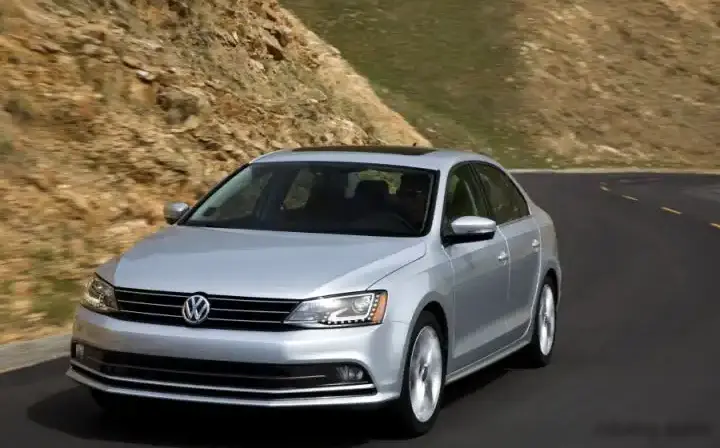
The Volkswagen Jetta VI, specifically the 2.0 TDI variant with the Dual Shift Gearbox (DSG) introduced during the 2014 facelift, represented a significant offering in the compact sedan segment. Produced from 2014 to 2018, this model year Jetta built upon the foundation of the A6 platform (internally designated as the 1HX0/A3) and aimed to balance fuel efficiency with respectable performance. This particular configuration – the 2.0 TDI with 150 horsepower and the DSG transmission – occupied a mid-range position within the Jetta VI lineup, slotting above the base gasoline engines and below the more performance-oriented trims. It was primarily marketed towards drivers seeking a refined, economical, and practical daily driver.
Technical Specifications
| Brand | Volkswagen |
| Model | Jetta |
| Generation | Jetta VI (facelift 2014) |
| Type (Engine) | 2.0 TDI (150 Hp) DSG |
| Start of production | 2014 |
| End of production | 2018 |
| Powertrain Architecture | Internal Combustion engine |
| Body type | Sedan |
| Seats | 5 |
| Doors | 4 |
| Fuel consumption (urban) | 5.5 l/100 km (42.8 US mpg, 51.4 UK mpg, 18.2 km/l) |
| Fuel consumption (extra urban) | 4.1 l/100 km (57.4 US mpg, 68.9 UK mpg, 24.4 km/l) |
| Fuel consumption (combined) | 4.5 l/100 km (52.3 US mpg, 62.8 UK mpg, 22.2 km/l) |
| CO2 emissions | 120 g/km |
| Fuel Type | Diesel |
| Acceleration 0 – 100 km/h | 8.9 sec |
| Acceleration 0 – 62 mph | 8.9 sec |
| Acceleration 0 – 60 mph | 8.5 sec |
| Maximum speed | 218 km/h (135.46 mph) |
| Emission standard | Euro 6 |
| Weight-to-power ratio | 9.7 kg/Hp, 103.6 Hp/tonne |
| Weight-to-torque ratio | 4.3 kg/Nm, 234.8 Nm/tonne |
| Power | 150 Hp @ 3500-4000 rpm |
| Power per litre | 76.2 Hp/l |
| Torque | 340 Nm @ 1750-3000 rpm (250.77 lb.-ft. @ 1750-3000 rpm) |
| Engine layout | Front, Transverse |
| Engine Model/Code | CUUB |
| Engine displacement | 1968 cm3 (120.09 cu. in.) |
| Number of cylinders | 4 |
| Engine configuration | Inline |
| Number of valves per cylinder | 4 |
| Fuel injection system | Diesel Commonrail |
| Engine aspiration | Turbocharger, Intercooler |
| Engine oil capacity | 4.6 l (4.86 US qt | 4.05 UK qt) |
| Kerb Weight | 1448 kg (3192.29 lbs.) |
| Max. weight | 1960 kg (4321.06 lbs.) |
| Max load | 512 kg (1128.77 lbs.) |
| Trunk (boot) space – minimum | 510 l (18.01 cu. ft.) |
| Fuel tank capacity | 55 l (14.53 US gal | 12.1 UK gal) |
| Length | 4659 mm (183.43 in.) |
| Width | 1778 mm (70 in.) |
| Height | 1482 mm (58.35 in.) |
| Wheelbase | 2651 mm (104.37 in.) |
| Front track | 1535 mm (60.43 in.) |
| Rear (Back) track | 1538 mm (60.55 in.) |
| Minimum turning circle | 11.1 m (36.42 ft.) |
| Drivetrain Architecture | The Internal combustion engine (ICE) drives the front wheels of the vehicle. |
| Drive wheel | Front wheel drive |
| Number of gears and type of gearbox | 6 gears, automatic transmission DSG |
| Front brakes | Ventilated discs |
| Assisting systems | ABS (Anti-lock braking system) |
| Steering type | Steering rack and pinion |
| Tires size | 205/55 R16 |
| Wheel rims size | 6.5J x 16 |
Powertrain & Engine Architecture
The heart of this Jetta variant is the 2.0-liter four-cylinder diesel engine, identified by the engine code CUUB. This engine belongs to the Volkswagen Group’s modular engine family and features common rail direct injection, a turbocharger with an intercooler, and four valves per cylinder. The common rail system, operating at extremely high pressures, allows for precise fuel metering and optimized combustion. The turbocharger boosts power output by forcing more air into the cylinders, while the intercooler cools the compressed air, further increasing efficiency. The CUUB engine is known for its relatively robust design and ability to handle moderate tuning.
The engine is paired with Volkswagen’s renowned 6-speed Dual Shift Gearbox (DSG). This transmission is a dual-clutch automated manual transmission, offering both the efficiency of a manual gearbox and the convenience of an automatic. The DSG utilizes two separate clutches – one for even-numbered gears and one for odd-numbered gears – allowing for incredibly fast and smooth gear changes. This contributes to both improved acceleration and fuel economy.
Driving Characteristics
The 150 horsepower and 340 Nm (250.77 lb-ft) of torque delivered by the 2.0 TDI/DSG combination provided a balanced driving experience. Acceleration from 0 to 60 mph took approximately 8.5 seconds, making it competitive within its class. The DSG transmission played a crucial role in maximizing the available power, providing quick shifts and keeping the engine within its optimal torque band. Compared to the base gasoline engines, the TDI offered significantly more low-end torque, making it more effortless for everyday driving and overtaking maneuvers. However, it wasn’t as sporty or responsive as the Jetta GLI with its gasoline engine and manual transmission. The DSG, while efficient, could sometimes exhibit a slight hesitation at low speeds, a characteristic noted by some reviewers.
Equipment & Trim Levels
The 2.0 TDI with DSG typically came equipped with a respectable level of standard features. These generally included air conditioning, power windows and locks, a basic audio system with a touchscreen display, and alloy wheels. Higher trim levels, such as the SEL or Limited, added features like leather upholstery, a sunroof, upgraded audio systems, and advanced safety technologies such as blind-spot monitoring and rear cross-traffic alert. Interior upholstery was typically cloth on the base models, with leatherette or full leather available as options or on higher trims. The dashboard layout was functional and straightforward, prioritizing usability over extravagant design.
Chassis & Braking
The Jetta VI’s chassis featured independent suspension in the front (MacPherson struts) and a multi-link rear suspension. This setup provided a comfortable ride quality while maintaining reasonable handling characteristics. The 2.0 TDI models generally came equipped with ventilated front disc brakes and solid rear disc brakes. Anti-lock Braking System (ABS) was standard. The suspension tuning was geared towards comfort, making it well-suited for long highway drives. Stabilizer bars were fitted to both the front and rear axles to reduce body roll during cornering.
Market Reception & Comparison
The 2.0 TDI DSG Jetta was generally well-received by automotive critics. It was praised for its fuel efficiency, comfortable ride, and refined driving experience. However, some reviewers noted that the engine could be somewhat noisy compared to gasoline alternatives. Compared to the 1.8T gasoline engine, the TDI offered superior fuel economy and low-end torque, but the 1.8T provided a more responsive and engaging driving experience. The TDI also offered a significant advantage over the base 2.5-liter gasoline engine in terms of both power and fuel efficiency.
Legacy
The 2.0 TDI engine, particularly the CUUB variant, has proven to be a relatively reliable powertrain when properly maintained. However, like all diesel engines, it is susceptible to issues related to the diesel particulate filter (DPF) and fuel injector quality. Regular oil changes and the use of high-quality diesel fuel are crucial for long-term reliability. On the used car market, these Jettas are often sought after for their fuel efficiency and practicality. They represent a good value proposition for buyers looking for a comfortable and economical compact sedan, but potential buyers should be aware of the potential maintenance costs associated with a diesel engine.