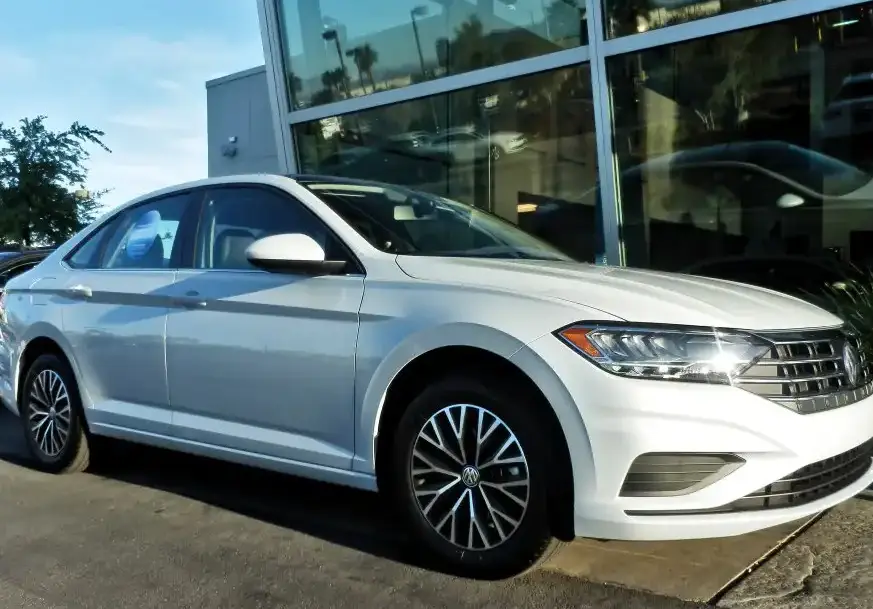
The Volkswagen Jetta VII 1.4 TSI (147 hp) Automatic, produced from April 2018 to November 2021, represented a key offering in Volkswagen’s compact sedan lineup. Positioned as a mid-range trim, it aimed to balance fuel efficiency with adequate performance for everyday driving. This variant was primarily marketed in Europe and North America, serving as a popular choice for buyers seeking a comfortable and practical sedan with modern technology. It falls within the seventh generation of the Jetta (2018-2021), built on the MQB platform, which also underpinned models like the Golf and Audi A3.
Technical Specifications
| Brand | Volkswagen |
| Model | Jetta |
| Generation | Jetta VII |
| Type (Engine) | 1.4 TSI (147 Hp) Automatic |
| Start of production | April, 2018 |
| End of production | November, 2021 |
| Powertrain Architecture | Internal Combustion engine |
| Body type | Sedan |
| Seats | 5 |
| Doors | 4 |
| Fuel consumption (urban) | 7.8 l/100 km (30.2 US mpg) |
| Fuel consumption (extra urban) | 5.8 l/100 km (40.6 US mpg) |
| Fuel consumption (combined) | 6.9 l/100 km (34.1 US mpg) |
| Fuel Type | Petrol (Gasoline) |
| Weight-to-power ratio | 9.2 kg/Hp |
| Weight-to-torque ratio | 5.4 kg/Nm |
| Power | 147 Hp @ 5000 rpm |
| Power per litre | 105.4 Hp/l |
| Torque | 249 Nm @ 1400 rpm (183.65 lb.-ft. @ 1400 rpm) |
| Engine layout | Front, Transverse |
| Engine Model/Code | EA211 / DGXA, DJXA |
| Engine displacement | 1395 cm3 (85.13 cu. in.) |
| Number of cylinders | 4 |
| Engine configuration | Inline |
| Cylinder Bore | 74.5 mm (2.93 in.) |
| Piston Stroke | 80 mm (3.15 in.) |
| Compression ratio | 10:1 |
| Number of valves per cylinder | 4 |
| Fuel injection system | Direct injection |
| Engine aspiration | Turbocharger, Intercooler |
| Valvetrain | DOHC |
| Engine oil capacity | 4 l (4.23 US qt | 3.52 UK qt) |
| Coolant | 8 l (8.45 US qt | 7.04 UK qt) |
| Kerb Weight | 1347 kg (2969.63 lbs.) |
| Max. weight | 1870 kg (4122.64 lbs.) |
| Max load | 523 kg (1153.02 lbs.) |
| Trunk (boot) space – minimum | 399 l (14.09 cu. ft.) |
| Fuel tank capacity | 50 l (13.21 US gal | 11 UK gal) |
| Length | 4702 mm (185.12 in.) |
| Width | 1799 mm (70.83 in.) |
| Height | 1458 mm (57.4 in.) |
| Wheelbase | 2686 mm (105.75 in.) |
| Front track | 1543 mm (60.75 in.) |
| Rear (Back) track | 1533 mm (60.35 in.) |
| Ride height (ground clearance) | 141 mm (5.55 in.) |
| Drag coefficient (Cd) | 0.27 |
| Minimum turning circle (turning diameter) | 11.1 m (36.42 ft.) |
| Drivetrain Architecture | Front wheel drive |
| Number of gears and type of gearbox | 8 gears, automatic transmission |
| Front suspension | Independent, type McPherson with coil spring and anti-roll bar |
| Rear suspension | Torsion |
| Front brakes | Ventilated discs |
| Rear brakes | Disc |
| Tires size | 205/60 R16 H; 205/55 R17 H |
| Wheel rims size | 6.5J x 16; 7.0J x 17 |
INTRODUCTION
The Jetta VII 1.4 TSI Automatic represented a significant step forward in Volkswagen’s efforts to provide a refined and efficient compact sedan. Introduced as part of the seventh-generation Jetta lineup, this variant aimed to appeal to a broad audience seeking a comfortable daily driver with reasonable performance and fuel economy. The 1.4 TSI engine, coupled with an eight-speed automatic transmission, was designed to offer a smooth and accessible driving experience. This model occupied a middle ground in the Jetta VII range, slotting between the base 1.0 TSI models and the more powerful 1.8 TSI and diesel options.
Powertrain & Engine Architecture
At the heart of the Jetta VII 1.4 TSI Automatic lies the EA211 engine family, specifically the DGXA or DJXA engine code depending on the market and specific year. This 1.4-liter inline-four cylinder engine utilizes direct fuel injection and a turbocharger with an intercooler to deliver a balance of power and efficiency. The direct injection system precisely meters fuel into the combustion chamber, optimizing combustion and reducing emissions. The turbocharger boosts power output by forcing more air into the engine. The engine features a dual overhead camshaft (DOHC) valvetrain with four valves per cylinder, enhancing breathing and contributing to improved performance.
The eight-speed automatic transmission (often an Aisin-sourced unit) was a key component of this variant. It provided smooth and responsive gear changes, contributing to a comfortable driving experience. The transmission’s eight forward gears allowed for optimized engine speeds at various driving conditions, improving both fuel economy and performance. Compared to the six-speed automatic found in earlier Jetta models, the eight-speed offered a wider gear ratio spread and more refined operation.
Driving Characteristics
The 147 hp and 249 Nm (183.65 lb-ft) of torque delivered by the 1.4 TSI engine and eight-speed automatic transmission provided adequate performance for everyday driving. Acceleration was respectable, though not particularly sporty. The automatic transmission was programmed for comfort, with smooth shifts and a tendency to upshift quickly to maximize fuel efficiency. In real-world conditions, the Jetta VII 1.4 TSI Automatic felt more relaxed and refined than the versions equipped with manual transmissions or the more powerful 1.8 TSI engine. While the manual transmission offered a more engaging driving experience, the automatic provided greater convenience, particularly in urban traffic. The gear ratios were tuned to prioritize fuel economy, meaning that the engine sometimes felt slightly strained during aggressive acceleration or when climbing hills.
Equipment & Trim Levels
The Jetta VII 1.4 TSI Automatic typically came standard with a reasonable level of equipment. This included features such as air conditioning, power windows and locks, a touchscreen infotainment system with Bluetooth connectivity, and basic safety features like ABS and stability control. Higher trim levels offered additional features such as leather upholstery, a sunroof, upgraded audio systems, and advanced driver-assistance systems like adaptive cruise control and lane departure warning. Interior upholstery was typically cloth, with optional leather available. Dashboard configurations were generally straightforward and functional, with a focus on ease of use.
Chassis & Braking
The Jetta VII utilized an independent McPherson strut front suspension and a torsion beam rear suspension. This setup provided a comfortable ride quality, absorbing bumps and irregularities in the road surface effectively. The front suspension incorporated a stabilizer bar to reduce body roll during cornering. Braking duties were handled by ventilated discs at the front and solid discs at the rear. ABS (Anti-lock Braking System) was standard, enhancing braking performance and stability. The suspension tuning was geared towards comfort rather than sporty handling, making it well-suited for everyday driving.
Market Reception & Comparison
The Jetta VII 1.4 TSI Automatic received generally positive reviews from automotive critics. It was praised for its comfortable ride, fuel efficiency, and refined interior. However, some critics noted that the engine lacked the punch of the more powerful 1.8 TSI or diesel options. Compared to the 1.8 TSI, the 1.4 TSI offered better fuel economy but less acceleration. The 1.4 TSI also provided a more affordable entry point into the Jetta VII range. Reliability was generally good, with the EA211 engine proving to be a durable and dependable unit. However, some owners reported minor issues with the turbocharger and fuel injection system.
Legacy
The Volkswagen Jetta VII 1.4 TSI Automatic remains a popular choice in the used car market. Its combination of fuel efficiency, comfort, and affordability makes it an attractive option for buyers seeking a practical and reliable compact sedan. The EA211 engine has proven to be relatively durable, and parts availability is generally good. While not the most exciting car to drive, the Jetta VII 1.4 TSI Automatic offers a well-rounded package that continues to appeal to a wide range of drivers. Its legacy lies in providing a sensible and efficient transportation solution for everyday needs.