Introduction to the Volkswagen Multivan (T5, facelift 2009) Long 2.0 TDI (180 Hp) 4MOTION
The Volkswagen Multivan, a name synonymous with versatility and robust engineering, represents the pinnacle of Volkswagen’s T-series commercial and passenger van lineup. The T5 generation, introduced in 2003, received a significant facelift in 2009, bringing a host of aesthetic and technological improvements. The specific variant under review, the Volkswagen Multivan (T5, facelift 2009) Long 2.0 TDI (180 Hp) 4MOTION, stands out as a premium people mover designed primarily for the European and other international markets, where such multi-purpose vehicles hold considerable sway. While not officially sold in the United States, its influence and engineering prowess are recognized globally, embodying Volkswagen’s commitment to practical, comfortable, and efficient transportation solutions.
This particular model combines an extended wheelbase with a powerful yet economical 2.0-liter BiTurbo diesel engine, delivering 180 horsepower. Crucially, it features Volkswagen’s renowned 4MOTION all-wheel-drive system, enhancing its capability and safety across diverse driving conditions. Positioned as a more luxurious and passenger-focused alternative to the commercial Transporter, the Multivan offers a sophisticated interior, flexible seating arrangements, and a refined driving experience, making it a popular choice for large families, executive shuttles, and leisure enthusiasts seeking ample space and performance.
The Volkswagen Multivan (T5, facelift 2009) Long 2.0 TDI (180 Hp) 4MOTION: A European Icon
The T5 generation of the Volkswagen Transporter/Multivan series continued the storied legacy of Volkswagen’s iconic “Bus,” evolving into a modern, highly capable platform. The 2009 facelift was a pivotal moment, introducing a more contemporary design language and significantly updated powertrains. The Multivan variant, in particular, was crafted to offer a premium experience, blending minivan practicality with car-like comfort and driving dynamics. The “Long” designation signifies an extended wheelbase model, providing even more interior volume for passengers and cargo, a critical factor for its target demographic.
Its role in its primary markets, such as Europe, is substantial. It serves as a go-to vehicle for families needing more space than traditional SUVs, for businesses requiring comfortable executive transport, and for adventurers seeking a reliable base for their travels. The combination of its spacious interior, high-quality materials, and advanced features cemented its status as a benchmark in the large MPV segment, often competing with luxury-oriented vans like the Mercedes-Benz V-Class.
Powertrain and Performance Dynamics
At the heart of the Volkswagen Multivan (T5, facelift 2009) Long 2.0 TDI (180 Hp) 4MOTION lies a sophisticated 2.0-liter, four-cylinder inline diesel engine (engine code CFCA). This unit was a significant upgrade, moving away from the older Pumpe Düse (PD) injector technology to a common rail fuel injection system, which allowed for quieter operation, improved fuel efficiency, and cleaner emissions. The engine’s standout feature is its BiTurbo aspiration, meaning it employs two turbochargers to deliver a broad and consistent power band. This setup effectively mitigates turbo lag, providing strong acceleration from low RPMs and sustained power at higher engine speeds.
The engine produces a robust 180 horsepower at 4000 rpm, translating to a healthy 91.5 horsepower per liter. More impressively for a vehicle of its size, it generates a substantial 295.02 lb.-ft. of torque, available from a low 2000 rpm. This ample torque is crucial for effortless acceleration, confident overtaking, and hauling heavy loads, contributing to a weight-to-power ratio of 13 kg/Hp (76.9 Hp/tonne) and a weight-to-torque ratio of 5.9 kg/Nm (170.9 Nm/tonne).
Power is transmitted to all four wheels via a precise 6-speed manual transmission and Volkswagen’s 4MOTION all-wheel-drive system. The 4MOTION system, typically a Haldex-based setup in the T5, intelligently distributes power between the front and rear axles as needed, providing superior traction and stability, especially in adverse weather conditions or on unpaved roads. This drivetrain configuration allows the large Multivan to accelerate from 0 to 60 mph in a respectable 11.2 seconds and reach a top speed of 116.82 mph.
Despite its performance and all-wheel-drive capability, the 2.0 TDI engine also delivered commendable fuel economy for its class. The combined fuel consumption is rated at 28 US mpg (8.4 l/100 km), with urban figures around 22.4 US mpg (10.5 l/100 km) and extra-urban figures reaching 32.7 US mpg (7.2 l/100 km). With CO2 emissions of 221 g/km, it met the Euro 4 emission standard, reflecting a balance between power and environmental considerations for its era.
Design and Practicality of the Multivan T5 Long
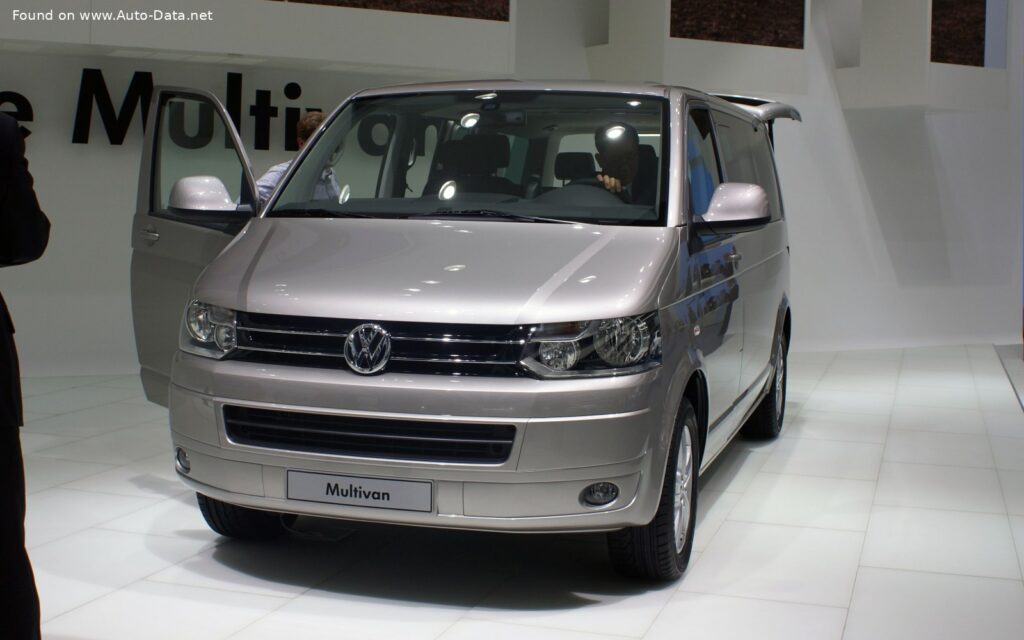
The design of the Volkswagen Multivan (T5, facelift 2009) Long is characterized by its functional elegance and purposeful stance. As a minivan with five doors and seating for up to seven passengers, its primary objective is to maximize interior space and versatility. The facelifted T5 adopted a sharper, more modern front fascia, incorporating new headlights, a revised grille, and updated bumper designs that aligned with Volkswagen’s contemporary design language seen across its passenger car range.
Measuring 208.35 inches in length, 74.96 inches in width, and 78.35 inches in height, the “Long” variant truly lives up to its name, offering an expansive interior volume. The generous 133.86-inch wheelbase is key to its stable ride and vast cabin. The exterior styling is clean and understated, emphasizing practicality with large windows for excellent visibility and sliding rear doors for easy access to the second and third rows, even in tight parking spaces.
Interior Versatility and Comfort
Inside, the Multivan T5 Long excels in modularity and comfort. The seating system is highly adaptable, typically featuring a rail system that allows the second and third-row seats to slide, recline, or be removed entirely. Options often included swivel seats in the second row, enabling a conference-style seating arrangement, and a multi-functional table. The third-row bench could often fold flat to create a bed, underscoring its appeal for leisure and travel. Material quality is robust and durable, designed to withstand family use while still offering a premium feel.
For a vehicle launched in 2009, its features were quite advanced. While specific infotainment details are not provided, these models typically offered modern audio systems, climate control, and various convenience features. Safety was also a priority, with standard Anti-lock Braking System (ABS) and likely multiple airbags, electronic stability control, and traction control systems, contributing to occupant protection. The suspension setup, featuring an independent McPherson type in the front and a double wishbone at the rear, provided a comfortable and composed ride, balancing passenger comfort with the demands of carrying significant loads.
Technical Specifications
| Category | Specification | US Equivalent / Notes |
|---|---|---|
General Information |
||
| Brand | Volkswagen | |
| Model | Multivan | |
| Generation | Multivan (T5, facelift 2009) Long | |
| Type (Engine) | 2.0 TDI (180 Hp) 4MOTION | |
| Start of production | 2009 year | |
| End of production | 2015 year | |
| Powertrain Architecture | Internal Combustion engine | |
| Body type | Minivan | |
| Seats | 7 | |
| Doors | 5 | |
Performance Specs |
||
| Fuel consumption (economy) – urban | 10.5 l/100 km | 22.4 US mpg |
| Fuel consumption (economy) – extra urban | 7.2 l/100 km | 32.7 US mpg |
| Fuel consumption (economy) – combined | 8.4 l/100 km | 28 US mpg |
| CO2 emissions | 221 g/km | |
| Fuel Type | Diesel | |
| Acceleration 0 – 60 mph | 11.2 sec | |
| Maximum speed | 188 km/h | 116.82 mph |
| Emission standard | Euro 4 | |
| Weight-to-power ratio | 13 kg/Hp | 76.9 Hp/tonne |
| Weight-to-torque ratio | 5.9 kg/Nm | 170.9 Nm/tonne |
Engine Specs |
||
| Power | 180 Hp @ 4000 rpm. | |
| Power per liter | 91.5 Hp/l | |
| Torque | 400 Nm @ 2000 rpm. | 295.02 lb.-ft. @ 2000 rpm. |
| Engine layout | Front, Transverse | |
| Engine Model/Code | CFCA | |
| Engine displacement | 1968 cm3 | 120.09 cu. in. |
| Number of cylinders | 4 | |
| Engine configuration | Inline | |
| Number of valves per cylinder | 4 | |
| Fuel injection system | Diesel Commonrail | |
| Engine aspiration | BiTurbo, Intercooler | |
| Engine oil capacity | 7 l | 7.4 US qt |
Space, Volume and Weights |
||
| Kerb Weight | 2340 kg | 5158.82 lbs. |
| Max. weight | 3080 kg | 6790.24 lbs. |
| Max load | 740 kg | 1631.42 lbs. |
| Fuel tank capacity | 80 l | 21.13 US gal |
Dimensions |
||
| Length | 5292 mm | 208.35 in. |
| Width | 1904 mm | 74.96 in. |
| Height | 1990 mm | 78.35 in. |
| Wheelbase | 3400 mm | 133.86 in. |
| Front track | 1628 mm | 64.09 in. |
| Rear (Back) track | 1628 mm | 64.09 in. |
| Ride height (ground clearance) | 201 mm | 7.91 in. |
Drivetrain, Brakes and Suspension Specs |
||
| Drive wheel | All wheel drive (4×4) | |
| Number of gears and type of gearbox | 6 gears, manual transmission | |
| Front suspension | Independent type McPherson | |
| Rear suspension | Double wishbone | |
| Front brakes | Disc | |
| Rear brakes | Disc | |
| Assisting systems | ABS (Anti-lock braking system) | |
| Steering type | Steering rack and pinion | |
| Tires size | 235/55 R17 | |
| Wheel rims size | 7J x 17 | |
Legacy and Market Impact of the Volkswagen Multivan (T5, facelift 2009) Long
The Volkswagen Multivan (T5, facelift 2009) Long 2.0 TDI (180 Hp) 4MOTION holds a significant place in the European automotive landscape, building on decades of Volkswagen’s Transporter heritage. It’s more than just a commercial van; it represents a lifestyle choice for many, offering a blend of utility, comfort, and a premium feel that few competitors could match. Its reputation for robustness and reliability is a cornerstone of its enduring appeal, making it a highly sought-after vehicle even years after its production ceased in 2015.
Its market impact was profound, particularly in its segment. The Multivan successfully carved out a niche for itself as a high-end, versatile people mover. It was often seen as a more sophisticated and comfortable alternative to larger SUVs or traditional minivans, especially for those prioritizing interior flexibility and a car-like driving experience. The availability of the 4MOTION all-wheel-drive system further broadened its appeal, making it suitable for varying climates and terrains, from alpine roads to rural tracks.
Competitors and Enduring Appeal
In its heyday, the Multivan T5 Long faced competition from a few key rivals. The Mercedes-Benz V-Class (and its commercial counterpart, the Vito/Viano) was a direct competitor, offering similar levels of luxury and versatility. Other contenders included the Ford Transit Custom (Tourneo Custom for passengers) and, to some extent, larger MPVs like the Renault Grand Espace or the Chrysler Voyager (which was sold in Europe under different badges). However, the Multivan consistently distinguished itself with its strong brand image, perceived build quality, and the highly efficient and powerful TDI engine options combined with AWD. Its distinct character, often associated with outdoor activities and family adventures, helped it maintain a loyal customer base.
The 2.0 TDI BiTurbo engine, in particular, was praised for its balance of power and efficiency, making long journeys comfortable and economical. The manual transmission and 4MOTION system offered an engaging driving experience not always found in vehicles of this size. Even today, the Multivan T5 facelift models command strong resale values, a testament to their durability, desirability, and the comprehensive package they offered. Its legacy continues with subsequent generations, but the T5 facelift remains a high point, embodying Volkswagen’s mastery in creating a truly multi-purpose vehicle that is both practical and aspirational.
The enduring appeal of the Volkswagen Multivan (T5, facelift 2009) Long 2.0 TDI (180 Hp) 4MOTION lies in its ability to adapt to diverse needs, from daily family transport to weekend adventures, all while providing a comfortable, capable, and efficient platform. It remains a celebrated model in Volkswagen’s rich history, demonstrating how a utilitarian vehicle can be elevated to a premium, sought-after icon.