The Volkswagen Multivan (T5, facelift 2009) Long: A Premium People Mover
The Volkswagen Multivan (T5, facelift 2009) Long represents a significant evolution in Volkswagen’s acclaimed T-series lineage, a family of vehicles renowned globally for their versatility, robustness, and enduring appeal. Introduced in 2009 as a refreshed version of the fifth-generation Transporter (T5) platform, this particular variant, the Long wheelbase model equipped with the potent 2.0 TSI (204 Hp) engine and DSG automatic transmission, solidified its position as a premium multi-purpose vehicle (MPV) in its primary European and select international markets. While the Multivan, a more passenger-focused derivative of the commercial Transporter van, was not widely available in the United States, it carved out a strong niche in Europe as a sophisticated and highly capable alternative to traditional minivans, offering a blend of passenger comfort, executive shuttle capabilities, and adventure-ready utility. This facelifted T5 Multivan aimed to enhance its appeal through updated styling, improved powertrains, and refined interior appointments, maintaining its heritage as a practical yet upscale family and business transporter.
Powertrain and Driving Dynamics of the Volkswagen Multivan (T5, facelift 2009) Long
Under the hood of the Volkswagen Multivan (T5, facelift 2009) Long lies a modern and efficient powertrain designed to deliver a compelling balance of performance and economy for a vehicle of its size. This specific model features Volkswagen’s highly regarded 2.0-liter TSI (Turbocharged Stratified Injection) inline-four engine, designated with the model code CJKA. This powerplant is a testament to contemporary automotive engineering, utilizing direct fuel injection and a turbocharger with an intercooler to optimize combustion and maximize output.
The 2.0 TSI engine produces a robust 204 horsepower (Hp) at 6000 revolutions per minute (rpm), providing ample power for highway cruising and confident overtaking maneuvers. Torque figures are equally impressive, with 258.15 lb.-ft. (350 Nm) available at 4000 rpm, ensuring strong acceleration from a standstill and flexible in-gear performance. Power is efficiently delivered to the front wheels via a sophisticated 7-speed DSG (Direct Shift Gearbox) automatic transmission. This dual-clutch gearbox is celebrated for its rapid, seamless shifts, contributing to both the vehicle’s lively performance and its fuel efficiency.
In terms of raw performance, the Multivan (T5, facelift 2009) Long 2.0 TSI is capable of accelerating from 0 to 60 mph in a respectable 9 seconds, with a top speed reaching 124.9 mph (201 km/h). Considering its substantial curb weight of 4874.42 lbs. (2211 kg), these figures highlight the engine’s effectiveness. Fuel economy for this powerful configuration is rated at a combined 23.3 US mpg (10.1 l/100 km), with urban consumption at 17.4 US mpg (13.5 l/100 km) and extra-urban at 29 US mpg (8.1 l/100 km). These figures, alongside CO2 emissions of 236 g/km and an Euro 4 emission standard, reflect a commendable effort by Volkswagen to balance performance with environmental considerations for its time. The drivetrain architecture is front-wheel drive, providing predictable handling and efficient packaging.
Design, Comfort, and Features
The design philosophy behind the Volkswagen Multivan (T5, facelift 2009) Long emphasizes practicality, space, and a premium aesthetic. As a minivan body type, it features five doors and a versatile seven-seat configuration, making it ideal for large families, executive transport, or even recreational use. The “Long” designation signifies an extended wheelbase model, providing even greater interior volume and flexibility compared to its standard counterpart.
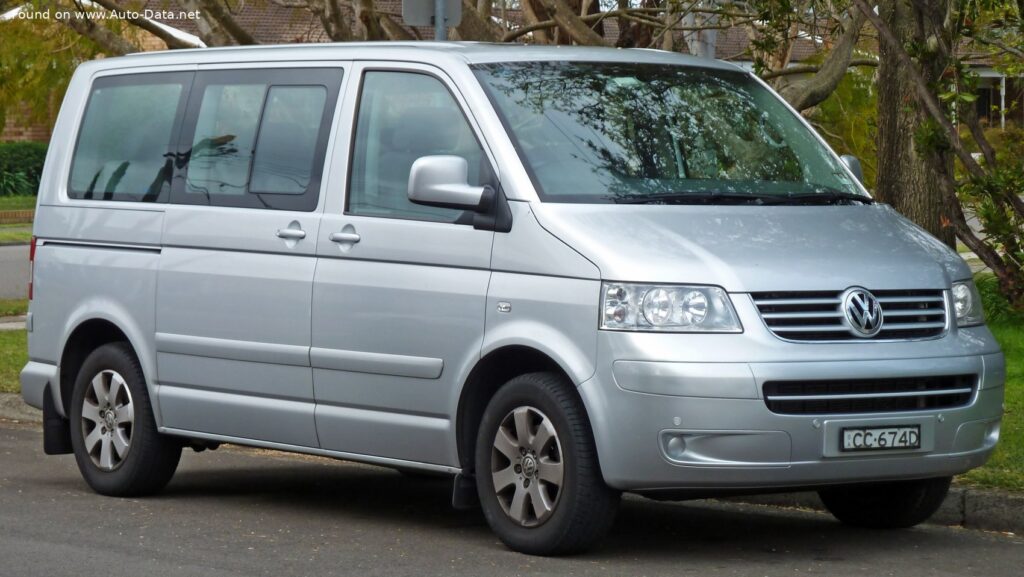
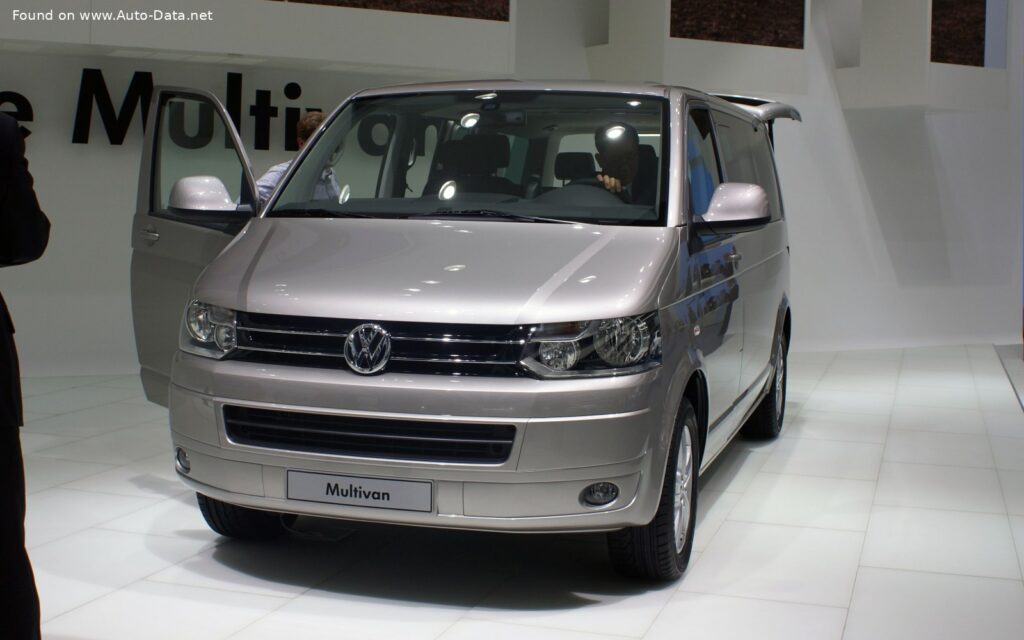
The 2009 facelift brought a series of subtle yet impactful changes to the T5 platform. Externally, these updates included a revised front fascia with new headlights, a more prominent grille, and restyled bumpers, aligning its appearance with Volkswagen’s contemporary design language. The overall silhouette remained true to the T-series’ iconic boxy yet functional form, maximizing interior space and headroom. With a length of 208.35 inches (5292 mm), a width of 74.96 inches (1904 mm), and a height of 78.35 inches (1990 mm), coupled with a generous 133.86-inch (3400 mm) wheelbase, the Multivan Long offers an expansive cabin.
Inside, the Multivan excels in modularity and comfort. While specific interior features were customizable, the Multivan typically offered high-quality materials, advanced infotainment options for its era, and innovative seating arrangements. The rear seats could often be slid, folded, or even removed entirely, transforming the passenger space into a cavernous cargo area or a mobile lounge. This adaptability is a hallmark of the Multivan’s appeal.
For ride comfort and handling, the Multivan T5 employs an independent McPherson strut front suspension and a double-wishbone rear suspension. This setup is designed to provide a smooth and controlled ride, even when fully loaded, effectively managing the vehicle’s substantial mass. Braking is handled by disc brakes on all four wheels, complemented by an Anti-lock Braking System (ABS) for enhanced safety and control. The vehicle rides on 235/55 R17 tires mounted on 7J x 17-inch wheel rims, providing a good balance of grip and ride comfort. The steering system is a rack and pinion type, offering precise control despite the vehicle’s size.
Technical Specifications
| Category | Specification | Value |
|---|---|---|
General Information |
||
| Brand | Volkswagen | |
| Model | Multivan | |
| Generation | Multivan (T5, facelift 2009) Long | |
| Type (Engine) | 2.0 TSI (204 Hp) DSG | |
| Start of Production | 2009 year | |
| End of Production | 2015 year | |
| Powertrain Architecture | Internal Combustion engine | |
| Body Type | Minivan | |
| Seats | 7 | |
| Doors | 5 | |
Performance Specs |
||
| Fuel consumption (economy) – urban | 13.5 l/100 km (17.4 US mpg) | |
| Fuel consumption (economy) – extra urban | 8.1 l/100 km (29 US mpg) | |
| Fuel consumption (economy) – combined | 10.1 l/100 km (23.3 US mpg) | |
| CO2 emissions | 236 g/km | |
| Fuel Type | Petrol (Gasoline) | |
| Acceleration 0 – 60 mph | 9 sec | |
| Acceleration 0 – 100 km/h | 9.5 sec | |
| Maximum speed | 201 km/h (124.9 mph) | |
| Emission standard | Euro 4 | |
| Weight-to-power ratio | 10.8 kg/Hp (92.3 Hp/tonne) | |
| Weight-to-torque ratio | 6.3 kg/Nm (158.3 Nm/tonne) | |
Engine Specs |
||
| Power | 204 Hp @ 6000 rpm | |
| Power per liter | 102.8 Hp/l | |
| Torque | 350 Nm @ 4000 rpm (258.15 lb.-ft. @ 4000 rpm) | |
| Engine layout | Front, Transverse | |
| Engine Model/Code | CJKA | |
| Engine displacement | 1984 cm³ (121.07 cu. in.) | |
| Number of cylinders | 4 | |
| Engine configuration | Inline | |
| Number of valves per cylinder | 4 | |
| Fuel injection system | Direct injection | |
| Engine aspiration | Turbocharger, Intercooler | |
| Engine oil capacity | 5.7 l (6.02 US qt) | |
Space, Volume and Weights |
||
| Kerb Weight | 2211 kg (4874.42 lbs.) | |
| Max. weight | 3080 kg (6790.24 lbs.) | |
| Max load | 869 kg (1915.82 lbs.) | |
| Fuel tank capacity | 80 l (21.13 US gal) | |
Dimensions |
||
| Length | 5292 mm (208.35 in.) | |
| Width | 1904 mm (74.96 in.) | |
| Height | 1990 mm (78.35 in.) | |
| Wheelbase | 3400 mm (133.86 in.) | |
| Front track | 1628 mm (64.09 in.) | |
| Rear (Back) track | 1628 mm (64.09 in.) | |
| Ride height (ground clearance) | 201 mm (7.91 in.) | |
Drivetrain, Brakes and Suspension Specs |
||
| Drivetrain Architecture | The Internal combustion engine (ICE) drives the front wheels of the vehicle. | |
| Drive wheel | Front wheel drive | |
| Number of gears and type of gearbox | 7 gears, automatic transmission DSG | |
| Front suspension | Independent type McPherson | |
| Rear suspension | Double wishbone | |
| Front brakes | Disc | |
| Rear brakes | Disc | |
| Assisting systems | ABS (Anti-lock braking system) | |
| Steering type | Steering rack and pinion | |
| Tires size | 235/55 R17 | |
| Wheel rims size | 7J x 17 | |
Legacy and Market Impact
The Volkswagen Multivan (T5, facelift 2009) Long, like its predecessors and successors, occupies a unique and significant position in the global automotive landscape, particularly in Europe. It stands as a testament to Volkswagen’s ability to transform a utilitarian commercial vehicle platform into a highly refined and versatile passenger carrier. The T5 generation, and especially its facelifted iteration, continued the Multivan’s reputation for exceptional build quality, durability, and strong resale values. Its commercial roots gave it a robust chassis and a spacious, highly adaptable interior that often surpassed the capabilities of more car-like minivans.
In its primary markets, the Multivan competed with premium people movers such as the Mercedes-Benz V-Class (and its Viano/Vito passenger variants) and the Ford Tourneo Custom. Unlike many conventional minivans, the Multivan offered a more upright driving position, greater interior height, and a perception of ruggedness derived from its Transporter heritage. This made it a favorite among large families requiring maximum space, outdoor enthusiasts needing to transport gear, and businesses operating executive shuttles or VIP transport. Its modular seating system, allowing for various configurations from a mobile office to a camper setup, was a key differentiator.
The 2.0 TSI engine combined with the DSG transmission in the facelifted T5 was particularly impactful, offering a level of driving refinement and performance previously unseen in a vehicle of this type. It demonstrated that a large van could be both powerful and relatively efficient, appealing to buyers who demanded more than just basic utility. This technological leap helped solidify the Multivan’s premium positioning.
While the Multivan (T5) was a cornerstone of Volkswagen’s European lineup, its presence in the American market was limited, primarily due to market preferences and regulatory differences. The US minivan segment historically favored lower-slung, car-based platforms like the Chrysler Pacifica, Honda Odyssey, and Toyota Sienna, which emphasized ride comfort and fuel economy over the Multivan’s more upright, commercial-derived architecture. However, the Multivan’s influence can be seen in the enduring appeal of versatile, spacious vehicles worldwide. It remains an iconic symbol of practical luxury and robust engineering, a true workhorse that can also ferry passengers in comfort and style, embodying the spirit of Volkswagen’s “Bus” legacy for the modern era.