The Volkswagen Multivan (T6.1, facelift 2019): A European Icon of Versatility
The
Volkswagen Multivan (T6.1, facelift 2019)
represents a significant evolution in Volkswagen’s storied Transporter lineage, specifically tailored as a premium passenger and leisure vehicle. Unveiled as a comprehensive facelift to the sixth-generation (T6) Multivan, the T6.1 generation, produced from 2019 to 2021, solidified its position as a highly versatile and refined minivan in its primary markets, predominantly Europe. While not available in the United States, the Multivan is a cornerstone of Volkswagen’s commercial and passenger vehicle offerings abroad, celebrated for its robust engineering, practical design, and car-like driving dynamics. This particular variant, the 2.0 TDI (150 Hp) 4MOTION, exemplifies the blend of efficient diesel power with the confidence of all-wheel drive, catering to a wide range of needs from family transport to adventure touring.
Engine and Performance of the Volkswagen Multivan (T6.1, facelift 2019)
At the heart of this
Volkswagen Multivan (T6.1, facelift 2019)
model lies a sophisticated 2.0-liter TDI (Turbocharged Direct Injection) diesel engine. This inline four-cylinder powerplant, equipped with a turbocharger and intercooler, delivers a respectable 150 horsepower at 3250-3750 rpm. More critically for a vehicle designed to carry passengers and cargo, it produces a substantial 250.77 lb.-ft. of torque, available across a broad and usable range from 1500 to 3000 rpm. This ample low-end torque is crucial for effortless acceleration, confident overtaking, and efficient hauling, even when the vehicle is fully loaded or towing.
Power is channeled through a precise 6-speed manual transmission, offering engaging control for the driver. A standout feature of this particular Multivan is its 4MOTION all-wheel-drive system. This permanent all-wheel-drive architecture ensures superior traction and stability, whether navigating challenging weather conditions, venturing onto unpaved roads, or simply enhancing grip on wet asphalt. While not a hardcore off-roader, the 4MOTION system significantly broadens the Multivan’s capabilities, making it a reliable companion for varied environments.
In terms of performance, the 2.0 TDI (150 Hp) 4MOTION Multivan accelerates from 0 to 60 mph in a calculated 12.5 seconds, with a maximum speed of 111.85 mph. These figures underscore its role as a practical, rather than overtly sporty, vehicle, perfectly adequate for highway cruising and urban commuting. Fuel efficiency is a key strength of this diesel powertrain. The combined fuel economy is impressive for a vehicle of its size and capability, ranging from 33.1 to 33.6 US mpg. Urban consumption is rated at 27.7-28 US mpg, while extra-urban driving can achieve up to 37.9 US mpg. With CO2 emissions of 185-186 g/km, the Multivan meets the stringent Euro 6d-ISC-FCM emission standard, reflecting Volkswagen’s commitment to environmental responsibility through advanced diesel technology, including a Particulate Filter and Start & Stop System.
Design and Features
The
Volkswagen Multivan (T6.1, facelift 2019)
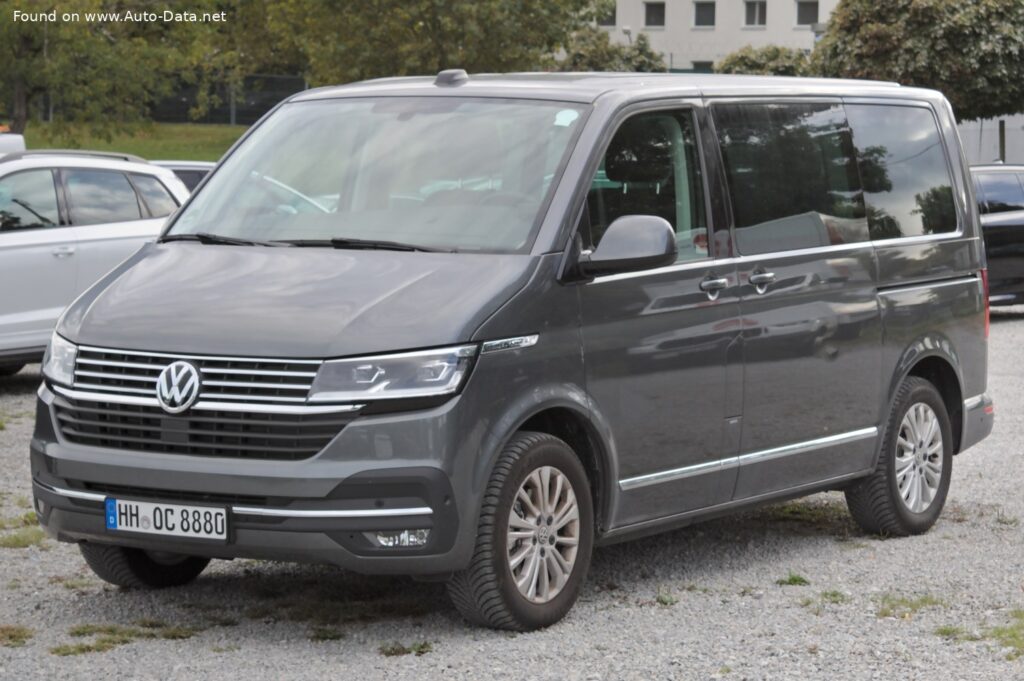
retains the iconic, boxy yet elegant silhouette that has defined the Transporter family for decades, while incorporating modern design cues from its facelift. The T6.1 updates brought a refreshed front fascia, including a larger grille and redesigned headlights, giving it a more contemporary and assertive presence. Its minivan body type, with five doors, is meticulously engineered for maximum interior space and flexibility, comfortably accommodating 5 to 7 occupants.
Measuring 193.07 inches in length, 74.96 inches in width (90.43 inches including mirrors), and standing between 77.56 and 78.35 inches tall, the Multivan boasts a commanding road presence. The generous 118.11-inch wheelbase contributes to a stable ride and expansive interior volume. Inside, the Multivan is a masterclass in modularity. The seating system is highly adaptable, allowing for various configurations to prioritize passenger comfort or cargo capacity. With the rear seats removed or folded, the maximum trunk space expands to an cavernous 151.85 cubic feet, making it incredibly practical for hauling large items, sports equipment, or camping gear.
Beyond its spaciousness, the Multivan is equipped with features designed for comfort, convenience, and safety. The suspension system features an independent McPherson type with coil springs and an anti-roll bar at the front, complemented by a wishbone and transverse stabilizer at the rear, ensuring a compliant and stable ride. Braking is handled by ventilated discs at the front and solid discs at the rear, augmented by an Anti-lock Braking System (ABS) for assured stopping power. An electric power steering system provides precise and effortless maneuverability, especially useful in urban environments, despite its substantial dimensions. The vehicle’s robust construction also allows for a significant maximum trailer load of 5511.56 lbs. with brakes, further enhancing its utility.
Technical Specifications: Volkswagen Multivan (T6.1, facelift 2019) 2.0 TDI (150 Hp) 4MOTION
| Feature | Specification |
|---|---|
General Information |
|
| Brand | Volkswagen |
| Model | Multivan |
| Generation | Multivan (T6.1, facelift 2019) |
| Engine Type | 2.0 TDI (150 Hp) 4MOTION |
| Production Start | 2019 year |
| Production End | 2021 year |
| Powertrain Architecture | Internal Combustion Engine |
| Body Type | Minivan |
| Seats | 5-7 |
| Doors | 5 |
Performance Specifications |
|
| Fuel Consumption (Urban) | 8.4-8.5 l/100 km (27.7-28 US mpg) |
| Fuel Consumption (Extra Urban) | 6.2 l/100 km (37.9 US mpg) |
| Fuel Consumption (Combined) | 7-7.1 l/100 km (33.1-33.6 US mpg) |
| CO2 Emissions | 185-186 g/km |
| Fuel Type | Diesel |
| Acceleration 0-60 mph | 12.5 seconds |
| Acceleration 0-100 km/h | 13.2 seconds |
| Maximum Speed | 180 km/h (111.85 mph) |
| Emission Standard | Euro 6d-ISC-FCM |
| Weight-to-Power Ratio | 15.5 kg/Hp (64.7 Hp/tonne) |
| Weight-to-Torque Ratio | 6.8 kg/Nm (146.6 Nm/tonne) |
Engine Specifications |
|
| Power | 150 Hp @ 3250-3750 rpm |
| Power per Liter | 76.2 Hp/l |
| Torque | 340 Nm @ 1500-3000 rpm (250.77 lb.-ft.) |
| Engine Layout | Front, Transverse |
| Engine Model/Code | CXFA, CXHA |
| Engine Displacement | 1968 cm3 (120.09 cu. in.) |
| Number of Cylinders | 4 |
| Engine Configuration | Inline |
| Number of Valves per Cylinder | 4 |
| Fuel Injection System | Diesel Commonrail |
| Engine Aspiration | Turbocharger, Intercooler |
| Valvetrain | DOHC |
| Engine Oil Capacity | 7.4 l (7.82 US qt) |
| Engine Oil Specification | Data not publicly available |
| Engine Systems | Start & Stop System, Particulate filter |
Space, Volume, and Weights |
|
| Kerb Weight | 2320-2414 kg (5114.72-5321.96 lbs.) |
| Max. Weight | 3080 kg (6790.24 lbs.) |
| Max. Load | 666-760 kg (1468.28-1675.51 lbs.) |
| Trunk (boot) Space – Maximum | 4300 l (151.85 cu. ft.) |
| Fuel Tank Capacity | 70 l (18.49 US gal) |
| AdBlue Tank | 22 l (5.81 US gal) |
| Max. Roof Load | 100 kg (220.46 lbs.) |
| Permitted Trailer Load with Brakes (12%) | 2500 kg (5511.56 lbs.) |
| Permitted Trailer Load without Brakes | 750 kg (1653.47 lbs.) |
| Permitted Towbar Download | 100 kg (220.46 lbs.) |
Dimensions |
|
| Length | 4904 mm (193.07 in.) |
| Width | 1904 mm (74.96 in.) |
| Width Including Mirrors | 2297 mm (90.43 in.) |
| Height | 1970-1990 mm (77.56-78.35 in.) |
| Wheelbase | 3000 mm (118.11 in.) |
| Front Overhang | 906 mm (35.67 in.) |
| Rear Overhang | 998 mm (39.29 in.) |
| Ride Height (Ground Clearance) | 193-209 mm (7.6-8.23 in.) |
| Minimum Turning Circle (Turning Diameter) | 11.9 m (39.04 ft.) |
| Approach Angle | 21.7-21.8° |
| Departure Angle | 16.7° |
| Ramp-over (Brakeover) Angle | 12.7-14.3° |
Drivetrain, Brakes, and Suspension |
|
| Drivetrain Architecture | The Internal Combustion Engine (ICE) drives permanently the four wheels of the vehicle. |
| Drive Wheel | All-wheel drive (4×4) |
| Number of Gears and Type of Gearbox | 6 gears, manual transmission |
| Front Suspension | Independent, type McPherson with coil spring and anti-roll bar |
| Rear Suspension | Wishbone, Transverse stabilizer |
| Front Brakes | Ventilated discs |
| Rear Brakes | Disc |
| Assisting Systems | ABS (Anti-lock braking system) |
| Steering Type | Steering rack and pinion |
| Power Steering | Electric Steering |
| Tire Sizes | 205/65 R16; 215/60 R16; 215/65 R16; 215/60 R17; 235/55 R17; 255/45 R18 |
| Wheel Rim Sizes | 6.5J x 16; 7J x 17; 8J x 18 |
Legacy and Market Impact
The
Volkswagen Multivan (T6.1, facelift 2019)
continues a legacy that stretches back to the iconic Type 2 “Bus” or “Microbus” of the 1950s. Over generations, the Transporter series, from which the Multivan is derived, has evolved from a simple workhorse to a sophisticated, multi-purpose vehicle. The Multivan specifically carved out a niche as the more premium, passenger-focused variant, offering enhanced comfort, features, and refinement compared to its commercial panel van siblings.
In its primary European and Asian markets, the Multivan (T6.1) is highly regarded for its blend of practicality, build quality, and strong residual values. It competes in a competitive segment against rivals such as the Mercedes-Benz V-Class, Ford Transit Custom, and Peugeot Traveller/Citroën Spacetourer. What sets the Multivan apart is its unique blend of heritage, robust engineering, and an almost cult-like following. Its modular interior, combined with the availability of capable powertrains like the 2.0 TDI with 4MOTION all-wheel drive, makes it an ideal choice for large families, outdoor enthusiasts, and businesses requiring executive shuttle services or mobile office solutions.
The T6.1 facelift ensured the Multivan remained technologically competitive, integrating modern infotainment, driver-assistance systems, and connectivity features that were increasingly expected in its segment. While its absence from the North American market might make it less familiar to US consumers, the Multivan’s enduring success in other regions underscores its global significance. It represents a masterclass in maximizing interior space within a relatively compact footprint, delivering a driving experience that feels more akin to a large SUV than a traditional van, and maintaining Volkswagen’s reputation for engineering excellence and practical innovation. Its journey from a simple utility vehicle to a premium, versatile people-mover is a testament to its lasting appeal and impact on the global automotive landscape.