Volkswagen Multivan (T6) 2.0 TDI (150 Hp): A European Icon of Versatility
The Volkswagen Multivan (T6) represents the sixth generation of Volkswagen’s highly revered and long-standing Transporter-based passenger van series. Introduced in 2015, the T6 Multivan continued the legacy of combining robust commercial vehicle underpinnings with the comfort, refinement, and features expected of a premium passenger car. While not officially sold in the United States, the Multivan series holds an iconic status in Europe and other international markets, serving as a benchmark for family haulers, executive shuttles, and adventure vehicles. This particular variant, the 2.0 TDI with 150 horsepower, was a popular choice for its balance of power, efficiency, and everyday usability, cementing its role in the competitive European minivan segment from its production start in 2015 until its conclusion in 2018.
Engine & Performance: The Heart of the Volkswagen Multivan (T6)
At the core of this Volkswagen Multivan (T6) variant is a sophisticated 2.0-liter TDI (Turbocharged Direct Injection) diesel engine, a powerplant renowned for its efficiency and strong torque delivery. This inline four-cylinder unit, with an engine displacement of 1968 cubic centimeters (approximately 120.09 cubic inches), features a common rail fuel injection system and is boosted by a turbocharger and intercooler, ensuring optimal performance across a wide rev range. It produces a robust 150 horsepower, peaking between 3250 and 3750 revolutions per minute, providing ample power for both urban commuting and long-distance highway cruising, even with a full load of passengers or cargo.
Perhaps more impressive than its horsepower is the engine’s torque output. The 2.0 TDI generates a substantial 340 Nm (equivalent to 250.77 pound-feet) of torque, available from a low 1500 rpm all the way up to 3000 rpm. This broad torque band is crucial for a vehicle of the Multivan’s size and intended use, enabling effortless acceleration from a standstill and strong in-gear flexibility, which is particularly beneficial when navigating European country roads or merging onto busy freeways.
Power is channeled to the front wheels via a precise 6-speed manual transmission, offering drivers an engaging and direct connection to the powertrain. This setup allows the Multivan to accelerate from 0 to 60 mph in a respectable 12.3 seconds, with a top speed of 113.09 mph (182 km/h). Despite its size and performance capabilities, the Multivan (T6) 2.0 TDI is remarkably fuel-efficient for its class. According to the NEDC (New European Driving Cycle) standards, it achieves a combined fuel economy of 37.9 – 37.3 US mpg (6.2-6.3 l/100 km). Urban consumption is rated at 31.8 – 31.4 US mpg, while extra-urban driving can see figures as high as 42.8 US mpg. These figures, combined with its Euro 6 emission standard compliance and CO2 emissions of 162-164 g/km, highlight Volkswagen’s commitment to environmental responsibility and cost-effective operation. The inclusion of a Start & Stop system and a particulate filter further contributes to its efficiency and reduced environmental footprint.
Design & Features: Practicality Meets Premium Comfort
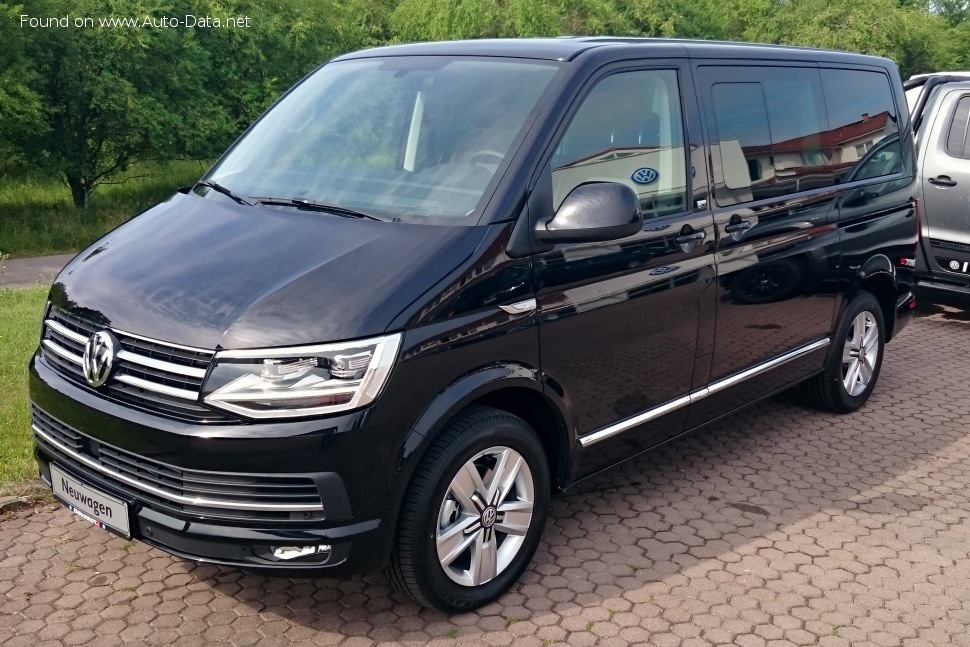
The Volkswagen Multivan (T6) retains the classic, boxy yet sophisticated silhouette that has defined the Transporter series for decades, optimizing interior space and functionality. As a five-door minivan, it offers exceptional versatility, typically configured with 5 to 7 seats, easily adaptable for various passenger and cargo needs. Its exterior dimensions are substantial, with a length of 193.07 inches (4904 mm), a width of 74.96 inches (1904 mm), and a height of 77.56 inches (1970 mm), providing a commanding road presence. The generous 118.11-inch (3000 mm) wheelbase contributes significantly to its stable ride and expansive interior volume.
Inside, the Multivan (T6) is designed with passenger comfort and practicality as paramount. The flexible seating arrangements, often featuring swivel seats and a rail system, allow owners to reconfigure the cabin to suit anything from a mobile office to a spacious lounge. When seats are removed or folded, the cargo capacity is truly impressive, boasting a minimum trunk space of 5800 liters (204.83 cubic feet), making it capable of swallowing substantial amounts of luggage, sports equipment, or even small furniture items.
In terms of ride and handling, the Multivan (T6) benefits from an advanced suspension setup. It features an independent McPherson type suspension at the front and a double wishbone system at the rear, a combination that delivers a comfortable ride quality akin to a passenger car, while maintaining the robustness required for a vehicle that might carry heavy loads. Braking performance is handled by ventilated discs at the front and solid discs at the rear, complemented by an Anti-lock Braking System (ABS) for enhanced safety. The electric power steering system, a rack and pinion type, provides precise control and ease of maneuverability, especially in tight urban environments, evidenced by its minimum turning circle of 39.04 feet (11.9 meters). Modern features for the era included a suite of safety systems, multiple airbags, and typically an advanced infotainment system with connectivity options, though specific details vary by trim. Tire sizes ranged from 215/65 R16 to 255/45 R18, mounted on 16, 17, or 18-inch wheel rims, allowing for customization in terms of aesthetics and ride dynamics.
Technical Specifications
| Category | Specification | US Equivalent / Notes |
|---|---|---|
| General Information | ||
| Brand | Volkswagen | |
| Model | Multivan | |
| Generation | Multivan (T6) | |
| Engine Type | 2.0 TDI (150 Hp) | |
| Production Start | 2015 | |
| Production End | 2018 | |
| Powertrain Architecture | Internal Combustion Engine | |
| Body Type | Minivan | |
| Seats | 5-7 | |
| Doors | 5 | |
| Performance Specs | ||
| Fuel Consumption – Urban (NEDC) | 7.4-7.5 l/100 km | 31.8 – 31.4 US mpg |
| Fuel Consumption – Extra Urban (NEDC) | 5.5 l/100 km | 42.8 US mpg |
| Fuel Consumption – Combined (NEDC) | 6.2-6.3 l/100 km | 37.9 – 37.3 US mpg |
| CO2 Emissions (NEDC) | 162-164 g/km | |
| Fuel Type | Diesel | |
| Acceleration 0-60 mph | 12.3 sec | |
| Maximum Speed | 182 km/h | 113.09 mph |
| Emission Standard | Euro 6 | |
| Weight-to-Power Ratio | 13.5 kg/Hp | 74.1 Hp/tonne |
| Weight-to-Torque Ratio | 6 kg/Nm | 168.1 Nm/tonne |
| Engine Specs | ||
| Power | 150 Hp @ 3250-3750 rpm | |
| Power per liter | 76.2 Hp/l | |
| Torque | 340 Nm @ 1500-3000 rpm | 250.77 lb.-ft. @ 1500-3000 rpm |
| Engine Layout | Front, Transverse | |
| Engine Model/Code | CXFA, CXHA | |
| Engine Displacement | 1968 cm3 | 2.0 Liters / 120.09 cu. in. |
| Number of Cylinders | 4 | Inline configuration |
| Valves per Cylinder | 4 | |
| Fuel Injection System | Diesel Commonrail | |
| Engine Aspiration | Turbocharger, Intercooler | |
| Engine Oil Capacity | 7.4 l | 7.82 US qt |
| Engine Systems | Start & Stop System, Particulate filter | |
| Space, Volume and Weights | ||
| Kerb Weight | 2023 kg | 4459.95 lbs. |
| Maximum Weight | 3000 kg | 6613.87 lbs. |
| Maximum Load | 977 kg | 2153.92 lbs. |
| Trunk (boot) Space – Minimum | 5800 l | 204.83 cu. ft. (likely maximum cargo volume with seats removed) |
| Fuel Tank Capacity | 80 l | 21.13 US gal |
| Maximum Roof Load | 100 kg | 220.46 lbs. |
| Permitted Trailer Load with Brakes (12%) | 2500 kg | 5511.56 lbs. |
| Permitted Trailer Load without Brakes | 750 kg | 1653.47 lbs. |
| Permitted Towbar Download | 100 kg | 220.46 lbs. |
| Dimensions | ||
| Length | 4904 mm | 193.07 in. |
| Width | 1904 mm | 74.96 in. |
| Width Including Mirrors | 2297 mm | 90.43 in. |
| Height | 1970 mm | 77.56 in. |
| Wheelbase | 3000 mm | 118.11 in. |
| Ride Height (Ground Clearance) | 193 mm | 7.6 in. |
| Minimum Turning Circle | 11.9 m | 39.04 ft. |
| Approach Angle | 21.8° | |
| Departure Angle | 16.7° | |
| Ramp-over (Brakeover) Angle | 14.3° | |
| Drivetrain, Brakes and Suspension | ||
| Drivetrain Architecture | Front wheel drive | Internal Combustion Engine drives the front wheels |
| Drive Wheel | Front wheel drive | |
| Number of Gears & Gearbox Type | 6 gears, manual transmission | |
| Front Suspension | Independent type McPherson | |
| Rear Suspension | Double wishbone | |
| Front Brakes | Ventilated discs | |
| Rear Brakes | Disc | |
| Assisting Systems | ABS (Anti-lock braking system) | |
| Steering Type | Steering rack and pinion | |
| Power Steering | Electric Steering | |
| Tire Sizes | 215/65 R16; 215/60 R17; 235/55 R17; 255/45 R18 | |
| Wheel Rims Size | 16; 17; 18 |
Legacy & Market Impact of the Volkswagen Multivan (T6)
The Volkswagen Multivan (T6), and its predecessors, hold an almost mythical status in many parts of the world, particularly in Europe. It’s more than just a minivan; it’s a cultural icon, representing freedom, adventure, and practicality. The T6 generation continued this legacy, building upon the robust foundation of the Transporter commercial van while elevating the passenger experience to premium levels. Its reputation for exceptional build quality, reliability, and long-term durability is a significant factor in its enduring appeal. Owners frequently praise its comfortable ride, spacious and adaptable interior, and its ability to effortlessly cover long distances with multiple passengers and their gear.
In its primary European market, the Multivan (T6) faced stiff competition from other well-regarded large passenger vans and MPVs. Key rivals included the Mercedes-Benz V-Class, which offered a similar blend of luxury and utility, and the Ford Transit Custom (specifically the Tourneo Custom passenger variant), known for its driving dynamics and value. Other competitors like the Renault Trafic (and its passenger version, the SpaceClass) and the Opel Vivaro (Life) also vied for market share. However, the Multivan consistently stood out due to its unique blend of heritage, car-like driving experience, and the premium feel of its interior appointments. Its strong residual values also made it an attractive proposition for both private buyers and fleet operators.
The historical significance of the Multivan (T6) is deeply rooted in Volkswagen’s “Bus” lineage, tracing back to the original Type 2 “Splitscreen” and continuing through the T1, T2, T3, T4, and T5 generations. Each iteration has evolved, but the core philosophy of a highly versatile, dependable, and spacious vehicle has remained constant. The T6 represented a significant step forward in terms of technology, safety, and refinement, bridging the gap between a utilitarian van and a sophisticated family vehicle. It solidified its position as the go-to choice for large families, outdoor enthusiasts, and businesses requiring comfortable and flexible passenger transport. Even after its production run concluded in 2018, paving the way for the T6.1 facelift and eventually the T7, the Multivan (T6) remains a highly sought-after used vehicle, a testament to its enduring design, engineering excellence, and significant impact on the international automotive landscape.