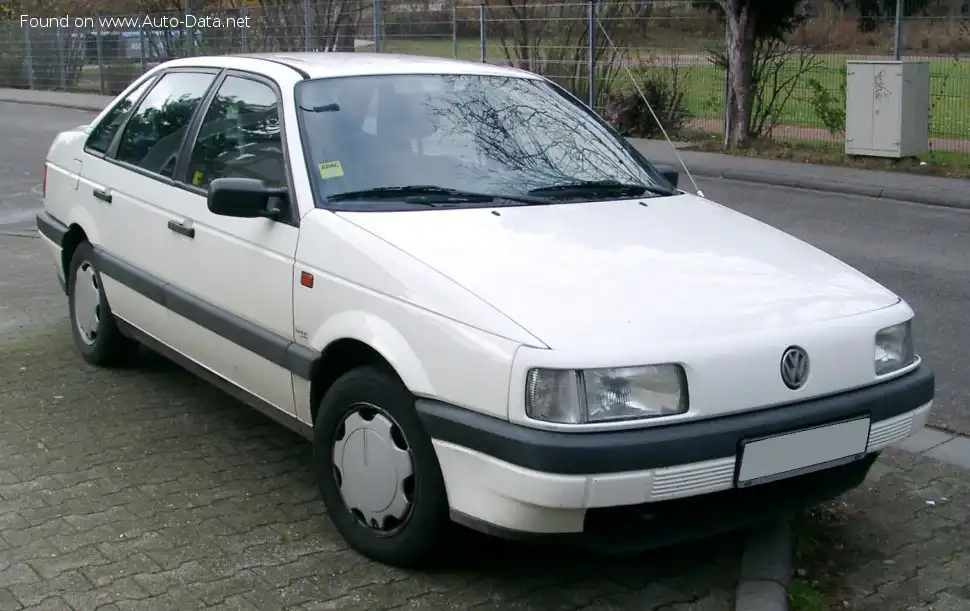
The Volkswagen Passat B3, produced from 1988 to 1993, represented a significant evolution for Volkswagen’s mid-size offering. The 1.8-liter (112 hp) variant, specifically those manufactured between 1988 and 1990, occupied an important position in the lineup, offering a balance of affordability and practicality. This model, often designated with the engine code PB, was aimed at buyers seeking a comfortable and reliable family sedan without the expense of the more powerful or technologically advanced trims. It was a key component of Volkswagen’s strategy to broaden the Passat’s appeal in a competitive market, particularly in Europe where it was a mainstay of the D-segment.
Technical Specifications
| Brand | Volkswagen |
| Model | Passat |
| Generation | Passat (B3) |
| Type (Engine) | 1.8 (112 Hp) |
| Start of production | 1988 |
| End of production | 1990 |
| Powertrain Architecture | Internal Combustion engine |
| Body type | Sedan |
| Seats | 5 |
| Doors | 4 |
| Fuel Type | Petrol (Gasoline) |
| Power | 112 Hp |
| Engine Model/Code | PB |
| Engine aspiration | Naturally aspirated engine |
| Engine oil capacity | 4 l (4.23 US qt | 3.52 UK qt) |
| Fuel tank capacity | 70 l (18.49 US gal | 15.4 UK gal) |
| Drivetrain Architecture | Front wheel drive |
| Number of gears and type of gearbox | 5 gears, manual transmission |
| Front brakes | Disc |
| Rear brakes | Disc |
| Assisting systems | ABS (Anti-lock braking system) |
Powertrain & Engine Architecture
The heart of the Passat 1.8 was the PB engine, a 1781cc inline four-cylinder gasoline engine. This engine was a naturally aspirated unit, meaning it didn’t employ a turbocharger or supercharger. It featured a single overhead camshaft (SOHC) valvetrain operating two valves per cylinder. Fuel delivery was managed by Bosch mechanical fuel injection, a system common for the era, providing a balance between efficiency and performance. The PB engine was known for its relative simplicity and durability, contributing to the Passat’s reputation for reliability. The engine produced 112 horsepower at approximately 5500 rpm and 109 lb-ft of torque at 3200 rpm. This power was delivered to the front wheels through a robust five-speed manual transmission, the standard offering for this variant. While an automatic transmission was available, it was less common and often considered to diminish the car’s responsiveness.
Driving Characteristics
The 1.8-liter Passat B3 offered a comfortable, if not particularly exhilarating, driving experience. With 112 hp propelling a car weighing around 2,600 pounds, acceleration was adequate for everyday driving, but it wasn’t designed for sporty performance. The five-speed manual transmission allowed drivers to keep the engine in its optimal power band, providing reasonable responsiveness for merging onto highways or overtaking slower traffic. The gear ratios were fairly evenly spaced, contributing to a smooth and predictable driving experience. Compared to the more powerful 1.8L 16V or the VR6 variants, the PB engine lacked the punch and high-end power. However, it offered better fuel economy and lower maintenance costs. The steering was light and precise, making it easy to maneuver in urban environments. The suspension, while not particularly sophisticated, provided a comfortable ride, absorbing bumps and imperfections in the road surface effectively.
Equipment & Trim Levels
The 1.8-liter Passat B3 typically came with a fairly basic level of equipment, reflecting its position as an entry-level or mid-range trim. Standard features generally included cloth upholstery, manual windows and door locks, and a basic stereo system. Air conditioning was often an optional extra, as were power windows and central locking. The dashboard layout was functional and straightforward, with clearly labeled controls. Interior trim was typically a durable, though somewhat plain, plastic. Higher trim levels, such as the GL, offered more luxurious features like upgraded upholstery, alloy wheels, and a more comprehensive stereo system. However, the base 1.8-liter model prioritized practicality and affordability over luxury.
Chassis & Braking
The Passat B3 utilized a MacPherson strut front suspension and a semi-independent torsion beam rear suspension. This setup provided a good balance between ride comfort and handling. The front brakes were ventilated discs, offering good stopping power, while the rear brakes were also discs, a feature that was somewhat uncommon in this class of vehicle at the time. Anti-lock braking system (ABS) was available as an option, enhancing safety by preventing wheel lockup during hard braking. The steering was a rack-and-pinion system, providing precise and responsive steering feel. Stabilizer bars were fitted to both the front and rear axles, helping to reduce body roll during cornering.
Market Reception & Comparison
The 1.8-liter Passat B3 was generally well-received by automotive critics as a practical and reliable family sedan. It was praised for its comfortable ride, spacious interior, and fuel efficiency. However, it was also criticized for its lack of performance compared to some of its rivals. Compared to the more powerful VR6 variant, the 1.8 offered significantly less horsepower and torque, resulting in slower acceleration and a less engaging driving experience. However, the 1.8 was more affordable to purchase and maintain, and it offered better fuel economy. Against competitors like the Ford Mondeo and Opel/Vauxhall Vectra, the Passat B3 1.8 held its own in terms of practicality and reliability, though it often lagged behind in terms of performance and styling.
Legacy
The Passat B3 1.8, particularly with the PB engine, has proven to be a remarkably durable and reliable vehicle. Many examples are still on the road today, a testament to the quality of its engineering and construction. The PB engine is known for its longevity and relatively simple maintenance requirements. In the used car market, these Passats are often sought after by enthusiasts and budget-conscious buyers alike. While they may not offer the performance or features of more modern vehicles, they provide a comfortable, reliable, and affordable mode of transportation. The B3 generation Passat, and the 1.8 variant specifically, represents a significant chapter in Volkswagen’s history, solidifying the Passat’s reputation as a practical and dependable family car.