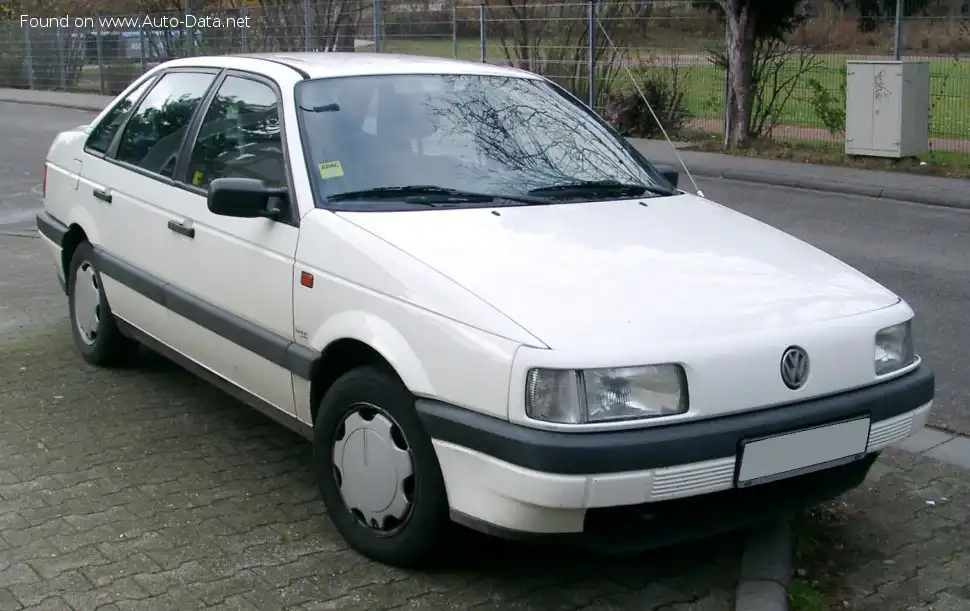
The Volkswagen Passat B3 1.8, producing 90 horsepower, was a mainstay of the Passat lineup from 1988 to 1993. Representing an entry-level to mid-range offering within the B3 generation (1988-1993), this variant played a significant role in making the Passat accessible to a wider customer base, particularly in European markets. The B3 Passat, built on the A3 platform shared with the Audi 80 and later the Audi A4, marked a substantial leap forward in terms of design, safety, and overall refinement compared to its predecessor, the B2 Passat. This specific 1.8-liter engine and automatic transmission combination aimed to provide a balance of affordability, reasonable performance, and ease of use for everyday driving.
Technical Specifications
| Brand | Volkswagen |
| Model | Passat |
| Generation | Passat (B3) |
| Type (Engine) | 1.8 (90 Hp) |
| Start of production | 1988 |
| End of production | 1993 |
| Powertrain Architecture | Internal Combustion engine |
| Body type | Sedan |
| Seats | 5 |
| Doors | 4 |
| Fuel consumption (urban) | 11.2 l/100 km (21 US mpg, 25.2 UK mpg, 8.9 km/l) |
| Fuel consumption (extra urban) | 6.4 l/100 km (36.8 US mpg, 44.1 UK mpg, 15.6 km/l) |
| Fuel consumption (combined) | 8.3 l/100 km (28.3 US mpg, 34 UK mpg, 12 km/l) |
| Fuel Type | Petrol (Gasoline) |
| Acceleration 0 – 100 km/h | 14.2 sec |
| Acceleration 0 – 62 mph | 14.2 sec |
| Acceleration 0 – 60 mph | 13.5 sec |
| Maximum speed | 172 km/h (106.88 mph) |
| Weight-to-power ratio | 12.8 kg/Hp, 77.9 Hp/tonne |
| Weight-to-torque ratio | 8 kg/Nm, 125.5 Nm/tonne |
| Power | 90 Hp @ 5500 rpm |
| Power per litre | 50.5 Hp/l |
| Torque | 145 Nm @ 2500 rpm (106.95 lb.-ft. @ 2500 rpm) |
| Engine layout | Front, Transverse |
| Engine Model/Code | RP, ABS |
| Engine displacement | 1781 cm3 (108.68 cu. in.) |
| Number of cylinders | 4 |
| Engine configuration | Inline |
| Cylinder Bore | 81 mm (3.19 in.) |
| Piston Stroke | 86.4 mm (3.4 in.) |
| Compression ratio | 10:1 |
| Number of valves per cylinder | 2 |
| Fuel injection system | Single-point injection |
| Engine aspiration | Naturally aspirated engine |
| Valvetrain | OHC |
| Engine oil capacity | 3.8 l (4.02 US qt | 3.34 UK qt) |
| Coolant capacity | 6.5 l (6.87 US qt | 5.72 UK qt) |
| Kerb Weight | 1155 kg (2546.34 lbs.) |
| Max. weight | 1700 kg (3747.86 lbs.) |
| Max load | 545 kg (1201.52 lbs.) |
| Trunk (boot) space – minimum | 495 l (17.48 cu. ft.) |
| Trunk (boot) space – maximum | 1500 l (52.97 cu. ft.) |
| Fuel tank capacity | 70 l (18.49 US gal | 15.4 UK gal) |
| Length | 4595 mm (180.91 in.) |
| Width | 1704 mm (67.09 in.) |
| Height | 1445 mm (56.89 in.) |
| Wheelbase | 2623 mm (103.27 in.) |
| Front track | 1479 mm (58.23 in.) |
| Rear (Back) track | 1422 mm (55.98 in.) |
| Drivetrain Architecture | The Internal combustion engine (ICE) drives the front wheels of the vehicle. |
| Drive wheel | Front wheel drive |
| Number of gears and type of gearbox | 5 gears, manual transmission |
| Front suspension | Independent type McPherson |
| Rear suspension | dependent spring suspension |
| Front brakes | Ventilated discs |
| Rear brakes | Drum |
| Steering type | Steering rack and pinion |
| Power steering | Hydraulic Steering |
| Tires size | 185/65 R14 |
| Wheel rims size | 14 |
INTRODUCTION
The Volkswagen Passat B3 1.8 (90 hp) was produced between 1988 and 1993, serving as a crucial entry point into the Passat range. Positioned below the more powerful 1.9-liter diesel and the performance-oriented VR6 variants, the 1.8 offered a more affordable and fuel-efficient option for buyers. It was primarily marketed towards families and individuals seeking a comfortable, reliable, and practical sedan. The B3 generation represented a significant redesign for the Passat, moving away from the angular styling of the B2 and adopting a more rounded, aerodynamic shape. This generation saw increased sales success for Volkswagen, solidifying the Passat’s position as a popular mid-size family car in Europe.
Powertrain & Engine Architecture
The heart of this Passat variant is the 1.8-liter inline four-cylinder engine, designated with engine codes RP or ABS depending on the specific year and market. This engine utilizes a single-point fuel injection system (Bosch Mono-Jetronic), which, while less sophisticated than multi-point injection, contributed to its affordability and relative simplicity. The engine features an overhead camshaft (OHC) valvetrain with two valves per cylinder. The 90 horsepower output is achieved at 5500 rpm, while peak torque of 145 Nm (106.95 lb-ft) arrives at 2500 rpm. Paired with a four-speed automatic transmission, the powertrain was designed for smooth, effortless cruising rather than outright performance. The automatic transmission, while providing convenience, was known to slightly diminish the engine’s overall efficiency compared to the available five-speed manual gearbox.
Driving Characteristics
The Passat 1.8 (90 hp) with the automatic transmission delivers a comfortable, but not particularly exhilarating, driving experience. Acceleration from 0-60 mph takes around 13.5 to 14.2 seconds, and the top speed is approximately 107 mph. The automatic transmission’s gear ratios are optimized for fuel economy and smooth transitions, but this comes at the expense of responsiveness. Compared to the manual transmission version, the automatic feels noticeably slower, especially during overtaking maneuvers. The engine’s torque curve is relatively flat, providing adequate pulling power for everyday driving situations, but it lacks the punch of the larger-displacement engines. The suspension, tuned for comfort, absorbs bumps and imperfections in the road well, making it a pleasant long-distance cruiser.
Equipment & Trim Levels
The 1.8-liter automatic Passat typically came with a reasonable level of standard equipment. This included power steering, central locking, and basic instrumentation. Interior upholstery was typically cloth, with a relatively simple dashboard layout. Optional extras included power windows, a sunroof, and upgraded audio systems. Trim levels varied depending on the market, but generally, this variant occupied a mid-range position, offering more features than the base models but lacking the luxury appointments of the higher-spec VR6 versions. Air conditioning was a popular option, particularly in warmer climates.
Chassis & Braking
The B3 Passat featured an independent McPherson strut suspension at the front, providing good handling and ride comfort. The rear suspension utilized a dependent spring suspension setup, which was a cost-effective solution but less sophisticated than a fully independent system. Braking consisted of ventilated discs at the front and drum brakes at the rear. The braking system was adequate for the car’s weight and performance, but lacked the stopping power of the larger brake systems found on the VR6 models. Stabilizer bars were fitted to both the front and rear axles to reduce body roll during cornering.
Market Reception & Comparison
The Passat 1.8 (90 hp) automatic was generally well-received by critics as a practical and affordable family car. It was praised for its comfortable ride, spacious interior, and reasonable fuel economy (around 28.3 US mpg combined). However, it was often criticized for its lack of performance, particularly when equipped with the automatic transmission. Compared to the 1.9 TDI diesel, the 1.8 offered less fuel economy but more refinement and a smoother driving experience. The VR6, while significantly more expensive, provided a substantial performance upgrade but at the cost of increased fuel consumption and maintenance costs. The 1.8 automatic appealed to buyers who prioritized comfort and convenience over outright performance.
Legacy
The Volkswagen Passat B3 1.8 (90 hp) automatic has proven to be a relatively reliable powertrain combination, with many examples still on the road today. The engine, while not particularly powerful, is known for its durability and relatively simple maintenance requirements. The automatic transmission, however, can be prone to wear and tear, and may require occasional servicing. In the used car market, these Passats are often sought after as affordable and practical classic cars. Their simple mechanical design and readily available parts make them relatively easy to maintain and repair. While not a performance icon, the B3 1.8 automatic represents a solid and dependable choice for those seeking a classic European sedan.