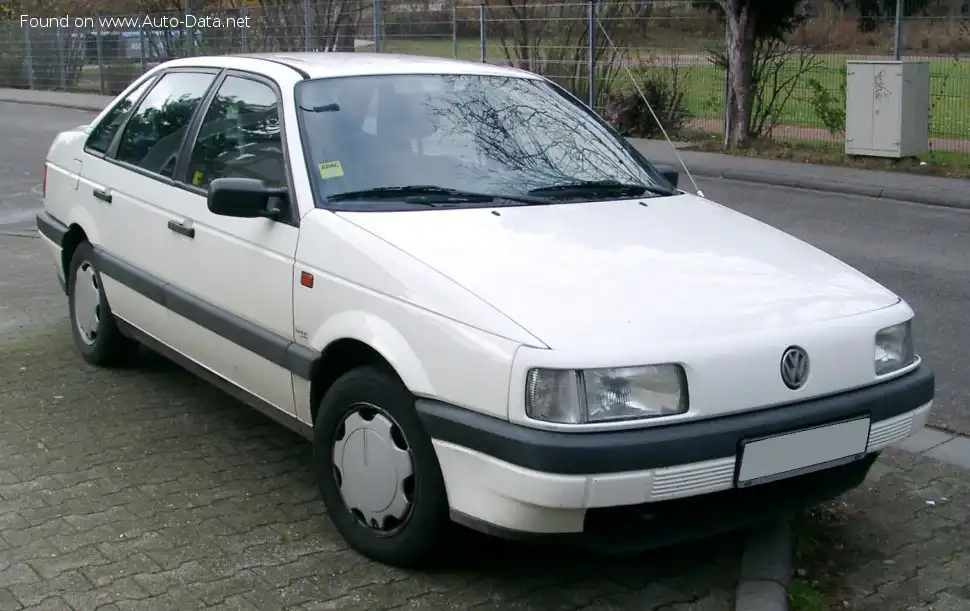
The Volkswagen Passat B3 1.9 D, produced between 1989 and 1993, represented a significant entry point into the Passat range for European buyers seeking fuel efficiency and practicality. Positioned as the diesel-powered, economy-focused variant, it served as a counterpoint to the more powerful gasoline engines available. This model was a key component of the B3 generation (Typ 35i), which itself was a crucial step in Volkswagen’s evolution, offering a more modern design and improved engineering compared to its predecessor, the B2 Passat. The 1.9 D offered a balance between affordability and the renowned build quality associated with the Passat nameplate.
Technical Specifications
| Brand | Volkswagen |
| Model | Passat |
| Generation | Passat (B3) |
| Type (Engine) | 1.9 D (68 Hp) |
| Start of production | 1989 |
| End of production | 1993 |
| Powertrain Architecture | Internal Combustion engine |
| Body type | Sedan |
| Seats | 5 |
| Doors | 4 |
| Fuel consumption (urban) | 7.4 l/100 km (31.8 US mpg) |
| Fuel consumption (extra urban) | 4.5 l/100 km (52.3 US mpg) |
| Fuel consumption (combined) | 6.3 l/100 km (37.3 US mpg) |
| Fuel Type | Diesel |
| Acceleration 0 – 100 km/h | 19 sec |
| Acceleration 0 – 62 mph | 19 sec |
| Acceleration 0 – 60 mph | 18.1 sec |
| Maximum speed | 160 km/h (99.42 mph) |
| Weight-to-power ratio | 17.4 kg/Hp |
| Weight-to-torque ratio | 8.9 kg/Nm |
| Power | 68 Hp @ 4200 rpm |
| Power per litre | 35.9 Hp/l |
| Torque | 133 Nm @ 2200 rpm (98.1 lb.-ft. @ 2200 rpm) |
| Engine layout | Front, Transverse |
| Engine Model/Code | 1Y |
| Engine displacement | 1896 cm3 (115.7 cu. in.) |
| Number of cylinders | 4 |
| Engine configuration | Inline |
| Cylinder Bore | 79.5 mm (3.13 in.) |
| Piston Stroke | 95.5 mm (3.76 in.) |
| Compression ratio | 19:1 |
| Number of valves per cylinder | 2 |
| Fuel injection system | Precombustion chamber injection |
| Engine aspiration | Naturally aspirated |
| Valvetrain | SOHC |
| Engine oil capacity | 4.5 l (4.76 US qt | 3.96 UK qt) |
| Coolant capacity | 5 l (5.28 US qt | 4.4 UK qt) |
| Kerb Weight | 1180 kg (2601.45 lbs.) |
| Max. weight | 1730 kg (3814 lbs.) |
| Max load | 550 kg (1212.54 lbs.) |
| Trunk (boot) space – minimum | 495 l (17.48 cu. ft.) |
| Trunk (boot) space – maximum | 820 l (28.96 cu. ft.) |
| Fuel tank capacity | 70 l (18.49 US gal | 15.4 UK gal) |
| Length | 4575 mm (180.12 in.) |
| Width | 1705 mm (67.13 in.) |
| Height | 1460 mm (57.48 in.) |
| Wheelbase | 2625 mm (103.35 in.) |
| Front track | 1480 mm (58.27 in.) |
| Rear track | 1420 mm (55.91 in.) |
| Drivetrain Architecture | Front wheel drive |
| Number of gears | 5 |
| Gearbox type | Manual transmission |
| Front suspension | Coil spring |
| Rear suspension | Coil spring |
| Front brakes | Disc |
| Rear brakes | Drum |
| Assisting systems | ABS (Anti-lock braking system) |
| Steering type | Steering rack and pinion |
| Power steering | Hydraulic |
| Tires size | 185/65 R14 |
| Wheel rims size | 14 |
INTRODUCTION
The Volkswagen Passat B3 1.9 D, manufactured from 1989 to 1993, was a mainstay of the Passat lineup, particularly in Europe where diesel engines held a significant market share. It was built on the Volkswagen B3 platform (also known as the Typ 35i), which was shared with models like the Golf Mk3 and the SEAT Toledo. This platform represented a move towards more aerodynamic styling and improved safety features. The 1.9 D variant specifically targeted buyers prioritizing fuel economy and low running costs, making it a popular choice for fleet vehicles and private drivers covering long distances. It occupied the entry-level position in the Passat range, below the more powerful and expensive gasoline-powered models.
Powertrain & Engine Architecture
The heart of the Passat B3 1.9 D was the 1Y engine, a 1.9-liter inline four-cylinder diesel engine. This engine utilized a precombustion chamber injection system, a common technology for diesel engines of the era. This system involved injecting fuel into a small precombustion chamber connected to the main cylinder, where it was partially ignited before entering the main combustion chamber. This improved combustion efficiency and reduced engine noise. The engine featured a single overhead camshaft (SOHC) valvetrain, operating two valves per cylinder. The 1.9 D produced 68 horsepower at 4200 rpm and 133 Nm (98.1 lb-ft) of torque at 2200 rpm. The engine was transversely mounted, driving the front wheels. The standard transmission was a five-speed manual gearbox, although a four-speed automatic transmission was also available, albeit less common. The automatic transmission, while offering convenience, noticeably impacted acceleration and fuel economy.
Driving Characteristics
The driving experience in the Passat B3 1.9 D was characterized by its practicality and fuel efficiency rather than outright performance. Acceleration was modest, taking approximately 19 seconds to reach 62 mph (100 km/h). The engine’s torque, however, provided reasonable pulling power for everyday driving, making it suitable for highway cruising and carrying passengers. The five-speed manual transmission allowed drivers to optimize engine speed for fuel economy or to extract the most performance available. The automatic transmission, while smoother, resulted in slower acceleration and increased fuel consumption. The steering was relatively light, making it easy to maneuver in urban environments, but lacked the precision of more modern systems. Overall, the 1.9 D offered a comfortable and predictable driving experience, prioritizing usability over sporty handling.
Equipment & Trim Levels
The Passat B3 1.9 D typically came with a fairly basic level of equipment, reflecting its position as the entry-level model. Standard features generally included central locking, power steering, and a basic stereo system. Interior upholstery was typically cloth, with a durable and practical design. Higher trim levels, often denoted by additions like “GL” or “CLX”, offered upgrades such as electric windows, upgraded upholstery, alloy wheels, and a sunroof. Optional extras included air conditioning, a more sophisticated stereo system, and metallic paint finishes. The dashboard layout was functional and straightforward, with clearly labeled controls. Safety features were relatively basic by modern standards, typically including seatbelts and an anti-lock braking system (ABS) as an option.
Chassis & Braking
The Passat B3 1.9 D featured a relatively simple chassis design. Front suspension consisted of coil springs and independent suspension, while the rear suspension utilized a semi-independent torsion beam setup. This configuration provided a comfortable ride, although it wasn’t particularly sporty. The braking system consisted of disc brakes on the front wheels and drum brakes on the rear wheels. ABS was available as an option, significantly improving braking performance, particularly on slippery surfaces. The steering system employed a rack and pinion setup with hydraulic power assistance, providing relatively light and easy steering. Tire size was typically 185/65 R14.
Market Reception & Comparison
The Passat B3 1.9 D was generally well-received by critics and buyers alike, particularly for its fuel efficiency and reliability. It was often praised for its practicality and comfortable ride. Compared to the more powerful gasoline-powered Passat variants, the 1.9 D offered significantly better fuel economy, making it a popular choice for high-mileage drivers. However, it lacked the performance and refinement of its more expensive siblings. Compared to other diesel-powered cars in its class, such as the Ford Sierra and Opel/Vauxhall Vectra, the Passat 1.9 D offered a good balance of fuel economy, reliability, and build quality. The automatic transmission version, while convenient, was often criticized for its sluggish performance and reduced fuel economy compared to the manual version.
Legacy
The Volkswagen Passat B3 1.9 D has proven to be a remarkably durable and reliable vehicle. Many examples are still on the road today, testament to the quality of its engineering and construction. The 1Y engine is known for its longevity, provided it is properly maintained. In the used car market, the 1.9 D variant remains a popular choice for buyers seeking an affordable and reliable vehicle. However, potential buyers should be aware of the age-related issues common to older cars, such as corrosion and wear and tear on suspension components. The simplicity of the engine and its mechanical components makes it relatively easy and inexpensive to repair, contributing to its continued popularity among enthusiasts and budget-conscious buyers.