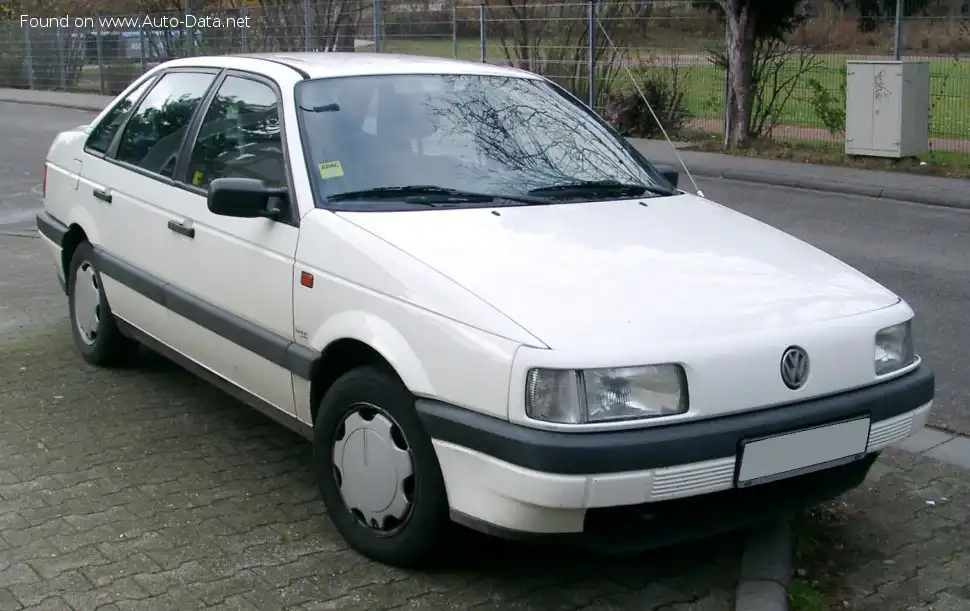
The Volkswagen Passat B3 2.8 VR6, produced between 1991 and 1993, represented a significant step forward for Volkswagen’s mid-size offering. Positioned as the performance variant within the B3 Passat range (which spanned from late 1988 to 1993), the VR6 aimed to deliver a more engaging driving experience than the traditionally economical four-cylinder models. Built on the Volkswagen Group’s B3 platform – shared with models like the Audi 80/90 and the SEAT Córdoba – the Passat B3 VR6 was primarily marketed in Europe, offering a blend of practicality, comfort, and a uniquely smooth power delivery. This model year marked the introduction of Volkswagen’s innovative VR6 engine, a narrow-angle V6 designed to offer the smoothness of a V6 in a package closer in size to an inline-six.
Technical Specifications
| Brand | Volkswagen |
| Model | Passat |
| Generation | Passat (B3) |
| Type (Engine) | 2.8 VR6 (174 Hp) |
| Start of production | 1991 |
| End of production | 1993 |
| Powertrain Architecture | Internal Combustion engine |
| Body type | Sedan |
| Seats | 5 |
| Doors | 4 |
| Fuel consumption (economy) – urban | 14.5 l/100 km (16.2 US mpg, 19.5 UK mpg, 6.9 km/l) |
| Fuel consumption (economy) – extra urban | 8.2 l/100 km (28.7 US mpg, 34.4 UK mpg, 12.2 km/l) |
| Fuel consumption (economy) – combined | 9.7 l/100 km (24.2 US mpg, 29.1 UK mpg, 10.3 km/l) |
| Fuel Type | Petrol (Gasoline) |
| Acceleration 0 – 100 km/h | 8.7 sec |
| Acceleration 0 – 62 mph | 8.7 sec |
| Acceleration 0 – 60 mph | 8.3 sec |
| Maximum speed | 224 km/h (139.19 mph) |
| Weight-to-power ratio | 7.6 kg/Hp, 131.3 Hp/tonne |
| Weight-to-torque ratio | 5.6 kg/Nm, 177.4 Nm/tonne |
| Power | 174 Hp @ 5800 rpm |
| Power per litre | 62.3 Hp/l |
| Torque | 235 Nm @ 4200 rpm (173.33 lb.-ft. @ 4200 rpm) |
| Engine layout | Front, Transverse |
| Engine Model/Code | AAA |
| Engine displacement | 2792 cm3 (170.38 cu. in.) |
| Number of cylinders | 6 |
| Engine configuration | V-engine |
| Cylinder Bore | 81 mm (3.19 in.) |
| Piston Stroke | 90.3 mm (3.56 in.) |
| Compression ratio | 10:1 |
| Number of valves per cylinder | 2 |
| Fuel injection system | Multi-port manifold injection |
| Engine aspiration | Naturally aspirated engine |
| Valvetrain | OHC |
| Engine oil capacity | 6 l (6.34 US qt | 5.28 UK qt) |
| Coolant | 8.2 l (8.66 US qt | 7.21 UK qt) |
| Kerb Weight | 1325 kg (2921.12 lbs.) |
| Max. weight | 1860 kg (4100.6 lbs.) |
| Max load | 535 kg (1179.47 lbs.) |
| Trunk (boot) space – minimum | 495 l (17.48 cu. ft.) |
| Trunk (boot) space – maximum | 820 l (28.96 cu. ft.) |
| Fuel tank capacity | 70 l (18.49 US gal | 15.4 UK gal) |
| Length | 4575 mm (180.12 in.) |
| Width | 1705 mm (67.13 in.) |
| Height | 1480 mm (58.27 in.) |
| Wheelbase | 2625 mm (103.35 in.) |
| Front track | 1480 mm (58.27 in.) |
| Rear (Back) track | 1420 mm (55.91 in.) |
| Drivetrain Architecture | The Internal combustion engine (ICE) drives the front wheels of the vehicle. |
| Drive wheel | Front wheel drive |
| Number of gears and type of gearbox | 5 gears, manual transmission |
| Front suspension | Coil spring |
| Rear suspension | Spring Strut |
| Front brakes | Ventilated discs |
| Rear brakes | Disc |
| Assisting systems | ABS (Anti-lock braking system) |
| Steering type | Steering rack and pinion |
| Power steering | Hydraulic Steering |
| Tires size | 205/50 R15 V |
| Wheel rims size | 15 |
Powertrain & Engine Architecture
The heart of the Passat B3 VR6 is the AAA engine code, a 2.8-liter naturally aspirated V6. What set this engine apart was its unique 15-degree V-angle, narrower than a traditional V6. This design allowed it to be packaged more compactly, fitting into the engine bay without requiring extensive chassis modifications. The engine featured a single overhead camshaft (OHC) per cylinder bank, operating two valves per cylinder. Fuel delivery was handled by Bosch Motronic multi-port fuel injection, optimizing fuel efficiency and power output. The VR6’s smooth power delivery was a hallmark, with a relatively flat torque curve peaking at 235 Nm (173 lb-ft) at 4200 rpm. The standard transmission for the VR6 was a five-speed manual gearbox, although a four-speed automatic transmission was also available, albeit less common and impacting performance.
Driving Characteristics
The Passat B3 VR6 offered a noticeably more refined and powerful driving experience compared to the four-cylinder variants. Acceleration to 60 mph took approximately 8.3 seconds, and it could reach a top speed of 139 mph. The narrow-angle V6 provided a smooth and responsive feel, with minimal vibration. The five-speed manual transmission allowed drivers to fully exploit the engine’s power band, while the optional automatic, while convenient, resulted in some power loss and a less engaging driving experience. The VR6’s front-wheel-drive configuration meant that traction could be a limitation, particularly under hard acceleration, but the standard ABS system helped to mitigate this.
Equipment & Trim Levels
The VR6 trim generally came well-equipped, reflecting its position as the top-of-the-line Passat. Standard features typically included central locking, electric windows, power steering, and an upgraded interior with cloth upholstery. Optional extras included a sunroof, alloy wheels, and a more sophisticated audio system. The interior design was functional and relatively understated, focusing on practicality and comfort. The dashboard layout was typical of early 1990s Volkswagen, with clear instrumentation and logically placed controls.
Chassis & Braking
The Passat B3 VR6 utilized a MacPherson strut front suspension and a semi-independent torsion beam rear suspension. The suspension was tuned to provide a balance between comfort and handling. Braking duties were handled by ventilated disc brakes at the front and solid discs at the rear. The inclusion of ABS was a significant safety feature for the time. The VR6 models often featured slightly thicker stabilizer bars compared to the base models to reduce body roll during cornering.
Market Reception & Comparison
The Passat B3 VR6 was generally well-received by automotive critics. It was praised for its smooth engine, comfortable ride, and overall refinement. However, some critics noted that the front-wheel-drive configuration limited its handling potential compared to rear-wheel-drive competitors. Compared to the four-cylinder Passats, the VR6 offered a substantial performance upgrade, but it also came with a higher price tag and slightly increased fuel consumption. The VR6 was also positioned as a more premium alternative to rivals like the Ford Mondeo and Opel/Vauxhall Vectra.
Legacy
The Passat B3 VR6 holds a special place in Volkswagen history as the first production car to feature the VR6 engine. The engine proved to be remarkably durable and reliable, and many examples are still on the road today. The VR6 engine continued to be used in various Volkswagen Group models for many years, becoming a popular choice for enthusiasts. In the used car market, the Passat B3 VR6 is sought after by collectors and enthusiasts who appreciate its unique engine and classic styling. While maintenance can be more expensive than the four-cylinder models due to the complexity of the VR6 engine, its enduring appeal and smooth performance ensure its continued desirability.