Technical Specifications
| Brand | Volkswagen |
| Model | Passat |
| Generation | Passat (B4) |
| Type (Engine) | 1.9 TDI (110 Hp) |
| Start of production | 1996 |
| End of production | 1996 |
| Powertrain Architecture | Internal Combustion engine |
| Body type | Sedan |
| Seats | 5 |
| Doors | 4 |
| Fuel consumption (urban) | 6 l/100 km (39.2 US mpg) |
| Fuel consumption (extra urban) | 4 l/100 km (58.8 US mpg) |
| Fuel Type | Diesel |
| Acceleration 0 – 100 km/h | 11.9 sec |
| Acceleration 0 – 62 mph | 11.9 sec |
| Acceleration 0 – 60 mph | 11.3 sec |
| Maximum speed | 193 km/h (119.92 mph) |
| Emission standard | Euro 2 |
| Power | 110 Hp @ 4150 rpm |
| Torque | 235 Nm @ 1900 rpm (173.33 lb.-ft. @ 1900 rpm) |
| Engine layout | Front, Transverse |
| Engine Model/Code | AFN |
| Engine displacement | 1896 cm3 (115.7 cu. in.) |
| Number of cylinders | 4 |
| Engine configuration | Inline |
| Cylinder Bore | 79.5 mm (3.13 in.) |
| Piston Stroke | 95.5 mm (3.76 in.) |
| Compression ratio | 19.5:1 |
| Number of valves per cylinder | 2 |
| Fuel injection system | Direct injection |
| Engine aspiration | Turbocharger, Intercooler |
| Valvetrain | SOHC |
| Engine oil capacity | 4.3 l (4.54 US qt | 3.78 UK qt) |
| Coolant capacity | 6.5 l (6.87 US qt | 5.72 UK qt) |
| Max. weight | 1820 kg (4012.41 lbs.) |
| Trunk (boot) space – minimum | 578 l (20.41 cu. ft.) |
| Trunk (boot) space – maximum | 990 l (34.96 cu. ft.) |
| Fuel tank capacity | 70 l (18.49 US gal | 15.4 UK gal) |
| Max. roof load | 75 kg (165.35 lbs.) |
| Permitted trailer load with brakes (12%) | 1300 kg (2866.01 lbs.) |
| Permitted trailer load without brakes | 650 kg (1433 lbs.) |
| Length | 4605 mm (181.3 in.) |
| Width | 1720 mm (67.72 in.) |
| Height | 1430 mm (56.3 in.) |
| Wheelbase | 2625 mm (103.35 in.) |
| Front track | 1479 mm (58.23 in.) |
| Rear track | 1422 mm (55.98 in.) |
| Front overhang | 915 mm (36.02 in.) |
| Rear overhang | 1065 mm (41.93 in.) |
| Minimum turning circle | 10.7 m (35.1 ft.) |
| Drivetrain Architecture | Front wheel drive |
| Number of gears and type of gearbox | 5 gears, manual transmission |
| Front suspension | Coil spring, Wishbone, Transverse stabilizer |
| Rear suspension | Wishbone, Transverse stabilizer, Coil spring |
| Front brakes | Disc |
| Rear brakes | Drum |
| Assisting systems | ABS (Anti-lock braking system) |
| Steering type | Steering rack and pinion |
| Power steering | Hydraulic Steering |
| Tires size | 195/60 R14 |
| Wheel rims size | 6J x 14 |
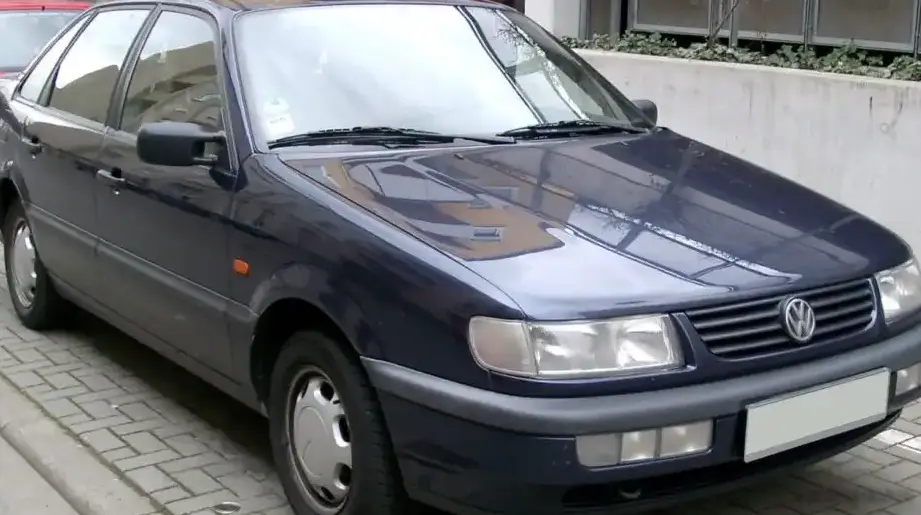
The Volkswagen Passat B4 1.9 TDI, produced primarily between 1995 and 1996, represented a significant step forward in diesel technology for the mid-size family car segment. Positioned as a fuel-efficient and practical option within the B4 Passat range (produced 1993-1997), the 1.9 TDI offered a compelling alternative to the gasoline-powered variants. This model was particularly popular in Europe, where diesel engines held a substantial market share, and it marked Volkswagen’s increasing commitment to direct-injection diesel technology. The B4 generation itself was a significant evolution of the Passat, offering improved aerodynamics, interior space, and safety features compared to its predecessor.
Powertrain & Engine Architecture
The heart of the Passat B4 1.9 TDI is the 1.9-liter, four-cylinder diesel engine, specifically the AFN engine code. This engine was a key component of Volkswagen’s advancements in direct-injection diesel technology. Unlike earlier indirect-injection diesels, the AFN utilizes a high-pressure direct injection system, injecting fuel directly into the combustion chamber. This resulted in more complete combustion, increased power output, and improved fuel efficiency. The engine features a single overhead camshaft (SOHC) valvetrain operating two valves per cylinder. A turbocharger with an intercooler further enhances performance by forcing more air into the engine, boosting horsepower and torque. The intercooler cools the compressed air, increasing its density and further improving combustion. The engine’s 19.5:1 compression ratio is typical for a diesel engine, contributing to its efficiency. The 1.9 TDI was paired with a five-speed manual transmission, providing a balance between fuel economy and drivability. While an automatic transmission was available on other Passat B4 models, it was less common with the 1.9 TDI due to concerns about efficiency and the transmission’s ability to handle the engine’s torque.
Driving Characteristics
The Passat B4 1.9 TDI with the five-speed manual transmission offered a surprisingly engaging driving experience for a diesel-powered family sedan. While not a sports car, the 110 horsepower and 235 Nm (173 lb-ft) of torque provided adequate performance for everyday driving and even comfortable highway cruising. The engine’s torque curve is relatively flat, meaning that a significant amount of power is available from low engine speeds. This made it easy to accelerate from a standstill or overtake other vehicles without needing to downshift frequently. The five-speed manual transmission was well-matched to the engine, with gear ratios that allowed for both efficient cruising and responsive acceleration. Compared to the gasoline-powered Passat variants, the 1.9 TDI offered significantly better fuel economy. However, it lacked the higher top-end power and refinement of the gasoline engines. Compared to the later, more powerful TDI variants (like the 1.9 TDI PD engines), the AFN engine was noticeably less refined and produced more engine noise, a characteristic of early direct-injection diesels.
Equipment & Trim Levels
The 1.9 TDI typically occupied a mid-range position in the Passat B4 lineup. Standard equipment generally included power steering, central locking, electric front windows, and an anti-lock braking system (ABS). Interior upholstery was typically cloth, and the dashboard featured a functional, if somewhat dated, design. Optional extras included air conditioning, a sunroof, alloy wheels, and upgraded audio systems. Higher trim levels offered features like leather upholstery, wood trim, and more advanced audio systems. The specific equipment level varied depending on the market and individual customer preferences.
Chassis & Braking
The Passat B4 featured a MacPherson strut front suspension and a semi-independent wishbone rear suspension. The suspension was tuned for comfort, providing a relatively smooth ride over most road surfaces. A transverse stabilizer bar was fitted to both the front and rear axles to reduce body roll during cornering. Braking duties were handled by disc brakes at the front and drum brakes at the rear. The ABS system helped to prevent wheel lockup during hard braking, improving stability and control. The chassis was designed to provide a good balance between handling and ride comfort, making the Passat B4 a pleasant car to drive on a daily basis.
Market Reception & Comparison
The Passat B4 1.9 TDI was well-received by critics and consumers alike, particularly in Europe. It was praised for its fuel efficiency, practicality, and relatively low running costs. Compared to other diesel-powered cars in its class, the Passat B4 1.9 TDI offered a good combination of performance, comfort, and features. However, some critics noted that the engine was somewhat noisy and lacked the refinement of some of its competitors. Compared to the gasoline-powered Passat variants, the 1.9 TDI offered significantly better fuel economy but less overall performance. The 1.9 TDI also represented a more affordable option than the more powerful VR6 gasoline engine.
Legacy
The Volkswagen Passat B4 1.9 TDI, particularly with the AFN engine, has proven to be a remarkably durable and reliable car. Many examples are still on the road today, a testament to the quality of its engineering and construction. The AFN engine, while not without its quirks, is generally considered to be a robust and long-lasting unit. However, like any older car, it requires regular maintenance to keep it in good condition. In the used car market, the Passat B4 1.9 TDI remains a popular choice for those seeking a fuel-efficient, practical, and affordable family car. Its reputation for reliability and low running costs continues to make it a desirable option for budget-conscious buyers.