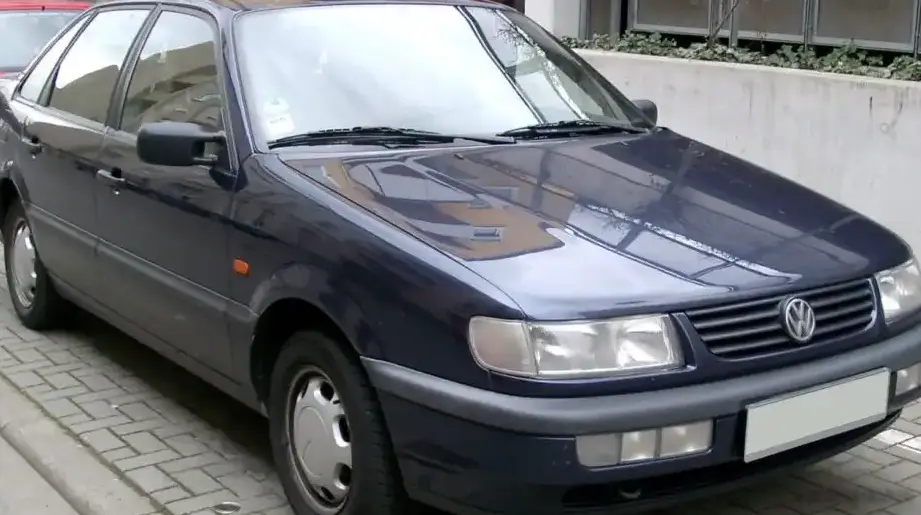
The Volkswagen Passat B4 2.0, producing 115 horsepower, represented a significant offering in the mid-size sedan segment during its 1993-1994 production run. Positioned as a step up from the base 1.8L models, it aimed to provide a balance of performance and affordability within the Passat lineup, which was itself a crucial model for Volkswagen in Europe and increasingly, in North America. The B4 generation, built on the 1HX0 platform, was a substantial evolution of the Passat, offering increased refinement and a more modern design compared to its predecessor. This variant, with its 2.0-liter engine, served as a popular choice for buyers seeking a more capable and comfortable driving experience than the entry-level options.
Technical Specifications
| Brand | Volkswagen |
| Model | Passat |
| Generation | Passat (B4) |
| Type (Engine) | 2.0 (115 Hp) |
| Start of production | 1993 |
| End of production | 1994 |
| Powertrain Architecture | Internal Combustion engine |
| Body type | Sedan |
| Seats | 5 |
| Doors | 4 |
| Fuel consumption (urban) | 10.8 l/100 km (21.8 US mpg) |
| Fuel consumption (extra urban) | 6 l/100 km (39.2 US mpg) |
| Fuel Type | Petrol (Gasoline) |
| Acceleration 0 – 100 km/h | 11.8 sec |
| Acceleration 0 – 62 mph | 11.8 sec |
| Acceleration 0 – 60 mph | 11.2 sec |
| Maximum speed | 195 km/h (121.17 mph) |
| Emission standard | Euro 2 |
| Weight-to-power ratio | 10.4 kg/Hp |
| Weight-to-torque ratio | 7.2 kg/Nm |
| Power | 115 Hp @ 5400 rpm |
| Torque | 166 Nm @ 3200 rpm (122.44 lb.-ft. @ 3200 rpm) |
| Engine layout | Front, Transverse |
| Engine Model/Code | 2E |
| Engine displacement | 1984 cm3 (121.07 cu. in.) |
| Number of cylinders | 4 |
| Engine configuration | Inline |
| Cylinder Bore | 82.5 mm (3.25 in.) |
| Piston Stroke | 92.8 mm (3.65 in.) |
| Compression ratio | 10.4:1 |
| Number of valves per cylinder | 2 |
| Fuel injection system | Multi-port manifold injection |
| Engine aspiration | Naturally aspirated engine |
| Valvetrain | SOHC |
| Engine oil capacity | 4 l (4.23 US qt | 3.52 UK qt) |
| Coolant capacity | 5 l (5.28 US qt | 4.4 UK qt) |
| Kerb Weight | 1199 kg (2643.34 lbs.) |
| Max. weight | 1770 kg (3902.18 lbs.) |
| Max load | 571 kg (1258.84 lbs.) |
| Trunk (boot) space – minimum | 578 l (20.41 cu. ft.) |
| Trunk (boot) space – maximum | 990 l (34.96 cu. ft.) |
| Fuel tank capacity | 70 l (18.49 US gal | 15.4 UK gal) |
| Max. roof load | 75 kg (165.35 lbs.) |
| Permitted trailer load with brakes (12%) | 1500 kg (3306.93 lbs.) |
| Permitted trailer load without brakes | 650 kg (1433 lbs.) |
| Length | 4605 mm (181.3 in.) |
| Width | 1720 mm (67.72 in.) |
| Height | 1430 mm (56.3 in.) |
| Wheelbase | 2625 mm (103.35 in.) |
| Front track | 1479-1485 mm (58.23 – 58.46 in.) |
| Rear (Back) track | 1422-1428 mm (55.98 – 56.22 in.) |
| Front overhang | 915 mm (36.02 in.) |
| Rear overhang | 1065 mm (41.93 in.) |
| Minimum turning circle | 10.7 m (35.1 ft.) |
| Drivetrain Architecture | Front wheel drive |
| Number of gears and type of gearbox | 5 gears, manual transmission |
| Front suspension | Coil spring, Wishbone, Transverse stabilizer |
| Rear suspension | Wishbone, Transverse stabilizer, Coil spring |
| Front brakes | Ventilated discs |
| Rear brakes | Disc |
| Assisting systems | ABS (Anti-lock braking system) |
| Steering type | Steering rack and pinion |
| Power steering | Hydraulic Steering |
| Tires size | 195/60 R14; 205/50 R15 |
| Wheel rims size | 6J x 14; 6J x 15 |
Powertrain & Engine Architecture
The heart of the Passat B4 2.0 was the 2E engine, a 1984cc inline-four cylinder gasoline engine. This engine utilized a single overhead camshaft (SOHC) valvetrain operating two valves per cylinder. Fuel delivery was managed by a Bosch multi-port fuel injection system, providing a balance between efficiency and performance. The 2E engine was known for its relative simplicity and durability, characteristics valued in a family sedan. The engine’s 10.4:1 compression ratio contributed to its respectable power output for its displacement. While not a high-revving engine, it delivered a usable powerband suitable for everyday driving. The five-speed manual transmission was the standard offering, providing drivers with full control over the engine’s power.
Driving Characteristics
The 115 hp 2.0-liter engine in the Passat B4 provided a noticeable step up in performance compared to the base 1.8L models. Acceleration to 60 mph took approximately 11.2 seconds, and it could achieve a top speed of around 121 mph. The five-speed manual transmission allowed for efficient cruising on the highway, while still providing enough power for overtaking maneuvers. The gear ratios were well-matched to the engine’s torque curve, offering a reasonably responsive driving experience. Compared to the more powerful VR6 variant, the 2.0L felt less eager to rev, but it offered better fuel economy and a more relaxed driving experience. The front-wheel-drive configuration provided predictable handling, although it wasn’t as engaging as some rear-wheel-drive alternatives.
Equipment & Trim Levels
The Passat B4 2.0 typically came with a reasonable level of standard equipment. This included power steering, central locking, electric windows, and an adjustable steering column. Interior upholstery was typically cloth, with options for upgraded materials available. Dashboard configuration was functional and straightforward, prioritizing usability over flashy design. Optional extras included air conditioning, a sunroof, and upgraded audio systems. Trim levels varied depending on the market, but generally, the 2.0L model was positioned as a mid-range offering, bridging the gap between the basic trims and the more luxurious VR6 versions.
Chassis & Braking
The Passat B4 featured a MacPherson strut front suspension and a semi-independent wishbone rear suspension. A transverse stabilizer bar was fitted to both axles, helping to reduce body roll during cornering. The braking system consisted of ventilated discs on the front wheels and solid discs on the rear. Anti-lock braking system (ABS) was standard, enhancing safety and control during emergency braking situations. The suspension setup provided a comfortable ride quality, absorbing bumps and imperfections in the road surface effectively. The chassis was robust and well-engineered, contributing to the Passat’s overall stability and handling.
Market Reception & Comparison
The Passat B4 2.0 was generally well-received by automotive critics. It was praised for its comfortable ride, spacious interior, and respectable performance. Fuel economy was considered to be good for a car of its size and class. Compared to the 1.8L models, the 2.0L offered a noticeable improvement in performance, making it a more appealing option for drivers who frequently traveled on the highway or carried passengers. However, it wasn’t as sporty or refined as the VR6 variant. Reliability was generally good, although routine maintenance was essential to ensure long-term durability.
Legacy
The Volkswagen Passat B4 2.0 has proven to be a relatively reliable and durable vehicle. Many examples are still on the road today, testament to the quality of its engineering. The 2E engine is known for its longevity, provided it has been properly maintained. In the used car market, the B4 2.0 represents a good value proposition for buyers seeking an affordable and practical mid-size sedan. Its simple design and readily available parts make it relatively easy to maintain and repair. While it may not offer the latest technology or features, it remains a capable and comfortable vehicle for everyday use, and a significant piece of Volkswagen’s history.