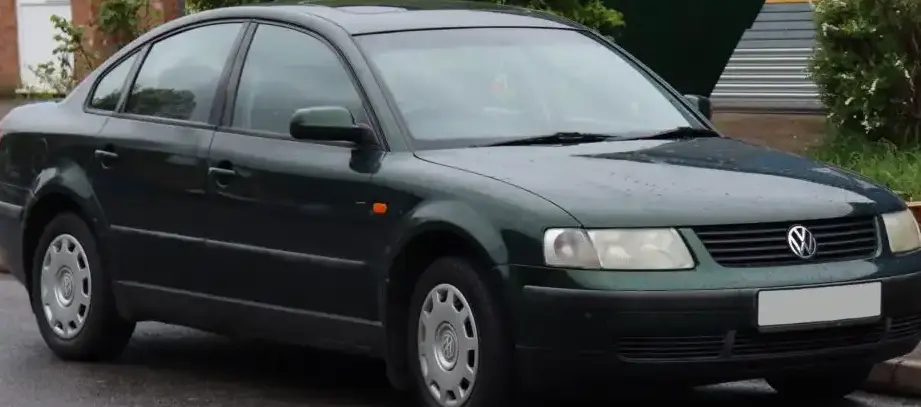
The Volkswagen Passat B5 1.6, producing 101 horsepower with an automatic transmission, was a mainstay of the Passat lineup in Europe from 1996 to 2000. Positioned as the entry-level engine option, it offered a balance of affordability and practicality for buyers seeking a comfortable and spacious family sedan. This variant played a significant role in making the B5 Passat a popular choice in the mid-size segment, particularly for those prioritizing fuel economy and ease of driving over outright performance. It was a key component of Volkswagen’s strategy to offer a broad range of Passat models to cater to diverse customer needs.
Technical Specifications
| Brand | Volkswagen |
| Model | Passat |
| Generation | Passat (B5) |
| Type (Engine) | 1.6 (101 Hp) Automatic |
| Start of production | 1996 |
| End of production | 2000 |
| Powertrain Architecture | Internal Combustion engine |
| Body type | Sedan |
| Seats | 5 |
| Doors | 4 |
| Fuel consumption (urban) | 12.1 l/100 km (19.4 US mpg) |
| Fuel consumption (extra urban) | 6.7 l/100 km (35.1 US mpg) |
| Fuel Type | Petrol (Gasoline) |
| Acceleration 0 – 100 km/h | 15.2 sec |
| Acceleration 0 – 62 mph | 15.2 sec |
| Acceleration 0 – 60 mph | 14.4 sec |
| Maximum speed | 186 km/h (115.58 mph) |
| Weight-to-power ratio | 11.9 kg/Hp |
| Weight-to-torque ratio | 8.3 kg/Nm |
| Power | 101 Hp @ 5600 rpm |
| Torque | 145 Nm @ 3800 rpm (106.95 lb.-ft. @ 3800 rpm) |
| Engine layout | Front, Longitudinal |
| Engine Model/Code | ADP, AHL, ANA, ARM |
| Engine displacement | 1595 cm3 (97.33 cu. in.) |
| Number of cylinders | 4 |
| Engine configuration | Inline |
| Cylinder Bore | 81 mm (3.19 in.) |
| Piston Stroke | 77.4 mm (3.05 in.) |
| Compression ratio | 10.3:1 |
| Number of valves per cylinder | 2 |
| Fuel injection system | Multi-port manifold injection |
| Engine aspiration | Naturally aspirated engine |
| Valvetrain | OHC |
| Engine oil capacity | 3 l (3.17 US qt | 2.64 UK qt) |
| Coolant capacity | 7 l (7.4 US qt | 6.16 UK qt) |
| Kerb Weight | 1200 kg (2645.55 lbs.) |
| Max. weight | 1750 kg (3858.09 lbs.) |
| Max load | 550 kg (1212.54 lbs.) |
| Trunk (boot) space – minimum | 475 l (16.77 cu. ft.) |
| Trunk (boot) space – maximum | 745 l (26.31 cu. ft.) |
| Fuel tank capacity | 62 l (16.38 US gal | 13.64 UK gal) |
| Length | 4670 mm (183.86 in.) |
| Width | 1740 mm (68.5 in.) |
| Height | 1460 mm (57.48 in.) |
| Wheelbase | 2700 mm (106.3 in.) |
| Front track | 1498 mm (58.98 in.) |
| Rear (Back) track | 1500 mm (59.06 in.) |
| Drivetrain Architecture | The Internal combustion engine (ICE) drives the front wheels of the vehicle. |
| Drive wheel | Front wheel drive |
| Number of gears and type of gearbox | 4 gears, automatic transmission |
| Front suspension | Coil spring |
| Rear suspension | Coil spring |
| Front brakes | Ventilated discs |
| Rear brakes | Disc |
| Assisting systems | ABS (Anti-lock braking system) |
| Steering type | Steering rack and pinion |
| Power steering | Hydraulic Steering |
| Tires size | 195/65 R15 |
| Wheel rims size | 6J x 15 |
Powertrain & Engine Architecture
The 1.6-liter inline-four engine, designated with engine codes such as ADP, AHL, ANA, and ARM, was a relatively simple and robust unit. It featured a single overhead camshaft (OHC) operating two valves per cylinder. Fuel delivery was handled by a multi-port fuel injection system, providing adequate, though not exceptional, combustion control. The engine’s 101 horsepower output at 5600 rpm and 145 Nm (106.95 lb-ft) of torque at 3800 rpm were modest, but sufficient for everyday driving. The automatic transmission was typically a four-speed unit, designed for smooth operation and ease of use. This transmission, while reliable, wasn’t known for its sporty responsiveness or fuel efficiency compared to more modern automatics.
Driving Characteristics
The Passat 1.6 Automatic offered a comfortable, if uninspiring, driving experience. Acceleration was leisurely, with a 0-60 mph time of around 14.4 seconds. The four-speed automatic transmission contributed to this, with relatively wide gear ratios prioritizing fuel economy over performance. Compared to the more powerful 1.8-liter turbocharged or VR6 variants, the 1.6 felt noticeably slower, especially when overtaking or climbing hills. However, the automatic transmission made it a more accessible option for drivers who preferred not to deal with a manual gearbox, particularly in urban environments. The longitudinal engine layout and front-wheel drive configuration provided predictable handling, though it lacked the dynamic sharpness of some rear-wheel-drive competitors.
Equipment & Trim Levels
The 1.6 Automatic typically came with a base level of equipment, focusing on practicality and comfort. Standard features generally included power windows, central locking, and a basic audio system. Interior upholstery was usually cloth, and the dashboard featured a functional, if somewhat dated, design. Optional extras, such as air conditioning, alloy wheels, and upgraded audio systems, were available, allowing buyers to customize their vehicle to some extent. The trim level often dictated the availability of these options, with higher trims offering more standard features.
Chassis & Braking
The Passat B5 featured a MacPherson strut front suspension and a multi-link rear suspension, providing a comfortable ride quality. The 1.6 Automatic variant typically used smaller diameter wheels and tires (often 195/65 R15) compared to higher-performance models. Braking was handled by ventilated discs at the front and solid discs at the rear, equipped with an Anti-lock Braking System (ABS) as standard. The suspension setup was tuned for comfort rather than sporty handling, prioritizing a smooth ride over sharp cornering.
Market Reception & Comparison
The Passat 1.6 Automatic was generally well-received as an affordable and practical family car. Critics acknowledged its comfortable ride and spacious interior, but often noted its lack of performance. Compared to the more powerful Passat variants, such as the 1.8 Turbo or VR6, the 1.6 offered significantly lower performance but also lower running costs. Fuel economy was a key selling point, with the 1.6 achieving around 35.1 US mpg on the extra-urban cycle. Reliability was generally good, although the automatic transmission could be prone to issues if not properly maintained.
Legacy
The Volkswagen Passat B5 1.6 Automatic remains a relatively common sight on used car markets today. Its simple engine and robust construction contribute to its longevity, although high mileage examples may require maintenance on the automatic transmission. While not a performance icon, it represents a solid and dependable choice for buyers seeking an affordable and practical family sedan. The 1.6 engine, while not particularly powerful, is known for its durability and relatively low running costs, making it a popular option for those seeking a reliable and economical vehicle.