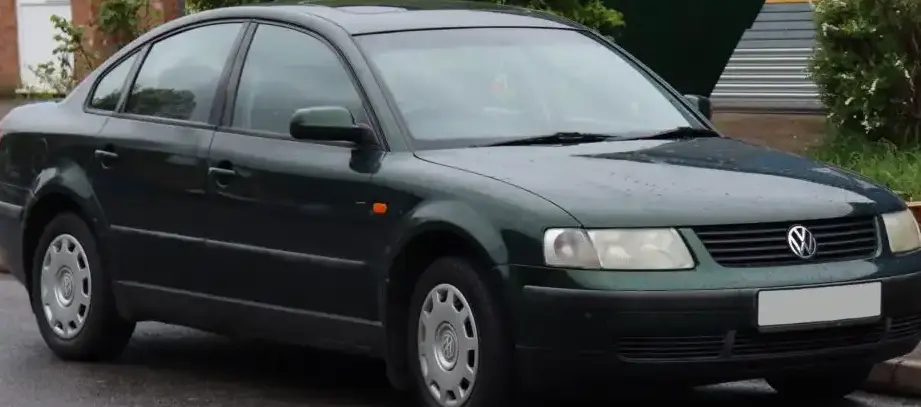
The Volkswagen Passat B5, produced between 1996 and 2000, represented a significant step forward for Volkswagen’s mid-size offering. Within the B5 range, the 1.9 TDI with an automatic transmission was a popular choice, particularly in European markets, offering a blend of fuel efficiency and comfortable cruising. This variant, powered by the AFN engine code, occupied a middle ground in the Passat B5 lineup, positioned below the more powerful petrol engines and the higher-output TDI variants, but above the base-level petrol options. It aimed to provide a practical and economical option for families and long-distance drivers.
Technical Specifications
| Brand | Volkswagen |
| Model | Passat |
| Generation | Passat (B5) |
| Type (Engine) | 1.9 TDI (110 Hp) Automatic |
| Start of production | 1996 |
| End of production | 2000 |
| Powertrain Architecture | Internal Combustion engine |
| Body type | Sedan |
| Seats | 5 |
| Doors | 4 |
| Fuel consumption (urban) | 7.8 l/100 km (30.2 US mpg, 36.2 UK mpg, 12.8 km/l) |
| Fuel consumption (extra urban) | 4.7 l/100 km (50 US mpg, 60.1 UK mpg, 21.3 km/l) |
| Fuel Type | Diesel |
| Acceleration 0 – 100 km/h | 12.1 sec |
| Acceleration 0 – 62 mph | 12.1 sec |
| Acceleration 0 – 60 mph | 11.5 sec |
| Maximum speed | 194 km/h (120.55 mph) |
| Weight-to-power ratio | 11.8 kg/Hp, 84.6 Hp/tonne |
| Weight-to-torque ratio | 5.5 kg/Nm, 180.8 Nm/tonne |
| Power | 110 Hp @ 4150 rpm |
| Power per litre | 58 Hp/l |
| Torque | 235 Nm @ 1900 rpm (173.33 lb.-ft. @ 1900 rpm) |
| Engine layout | Front, Longitudinal |
| Engine Model/Code | AFN |
| Engine displacement | 1896 cm3 (115.7 cu. in.) |
| Number of cylinders | 4 |
| Engine configuration | Inline |
| Cylinder Bore | 79.5 mm (3.13 in.) |
| Piston Stroke | 95.5 mm (3.76 in.) |
| Compression ratio | 19.5:1 |
| Number of valves per cylinder | 2 |
| Fuel injection system | Direct injection |
| Engine aspiration | Turbocharger, Intercooler |
| Valvetrain | OHC |
| Engine oil capacity | 3.8 l (4.02 US qt | 3.34 UK qt) |
| Coolant | 7.5 l (7.93 US qt | 6.6 UK qt) |
| Kerb Weight | 1300 kg (2866.01 lbs.) |
| Max. weight | 1850 kg (4078.55 lbs.) |
| Max load | 550 kg (1212.54 lbs.) |
| Trunk (boot) space – minimum | 475 l (16.77 cu. ft.) |
| Trunk (boot) space – maximum | 745 l (26.31 cu. ft.) |
| Fuel tank capacity | 62 l (16.38 US gal | 13.64 UK gal) |
| Length | 4670 mm (183.86 in.) |
| Width | 1740 mm (68.5 in.) |
| Height | 1460 mm (57.48 in.) |
| Wheelbase | 2700 mm (106.3 in.) |
| Front track | 1498 mm (58.98 in.) |
| Rear (Back) track | 1500 mm (59.06 in.) |
| Drivetrain Architecture | The Internal combustion engine (ICE) drives the front wheels of the vehicle. |
| Drive wheel | Front wheel drive |
| Number of gears and type of gearbox | 4 gears, automatic transmission |
| Front suspension | Coil spring |
| Rear suspension | Coil spring |
| Front brakes | Ventilated discs |
| Rear brakes | Disc |
| Assisting systems | ABS (Anti-lock braking system) |
| Steering type | Steering rack and pinion |
| Power steering | Hydraulic Steering |
| Tires size | 195/65 R15 |
| Wheel rims size | 6J x 15 |
INTRODUCTION
The Volkswagen Passat B5, launched in the mid-1990s, was a crucial model for Volkswagen, representing a significant upgrade in terms of design, technology, and refinement compared to its predecessor. The 1.9 TDI Automatic variant, utilizing the AFN engine, was a particularly popular choice in Europe, where diesel engines were favored for their fuel economy and torque. This combination offered a comfortable and practical option for buyers seeking a mid-size sedan with reasonable performance and low running costs. It was positioned as a sensible alternative to the more expensive and performance-oriented petrol models, and the higher-output TDI versions.
Powertrain & Engine Architecture
The heart of the Passat B5 1.9 TDI Automatic is the AFN engine, a 1.9-liter, four-cylinder diesel engine. This engine is a direct-injection diesel, utilizing a Bosch EDC (Electronic Diesel Control) system. Direct injection, a relatively new technology at the time, allowed for more precise fuel delivery, resulting in improved fuel economy, reduced emissions, and increased power output compared to older indirect injection systems. The engine features an overhead camshaft (OHC) valvetrain with two valves per cylinder. A turbocharger with an intercooler further enhances performance by forcing more air into the cylinders. The automatic transmission is a four-speed unit, designed to provide smooth and effortless gear changes. While not as sophisticated as modern automatic transmissions, it was a reliable and well-suited partner for the engine’s torque characteristics.
Driving Characteristics
The 110 horsepower and 235 Nm (173 lb-ft) of torque produced by the 1.9 TDI engine, coupled with the four-speed automatic transmission, resulted in a driving experience focused on usability rather than outright performance. Acceleration from 0-60 mph took around 11.5 to 12.1 seconds, which was adequate for everyday driving but noticeably slower than the more powerful petrol or TDI variants. The automatic transmission, while smooth, could sometimes feel hesitant during quick acceleration or overtaking maneuvers. The engine’s strong low-end torque, however, made it well-suited for cruising on highways and tackling inclines. The gear ratios were optimized for fuel efficiency, prioritizing comfortable long-distance travel over sporty driving dynamics. Compared to the manual transmission versions, the automatic offered greater convenience, but at the expense of some responsiveness and fuel economy.
Equipment & Trim Levels
The 1.9 TDI Automatic typically came with a reasonable level of standard equipment. This included central locking, electric windows, power steering, and an anti-lock braking system (ABS). Interior upholstery was typically cloth, with options for upgraded materials available. Dashboard configuration was fairly standard for the B5 Passat, with a functional and straightforward layout. Optional extras included air conditioning, a sunroof, alloy wheels, and a radio/cassette player. Higher trim levels, such as the Comfort or Trendline, added features like climate control, upgraded upholstery, and more sophisticated audio systems.
Chassis & Braking
The Passat B5 1.9 TDI Automatic utilized a coil spring suspension system at both the front and rear, providing a comfortable ride quality. Front brakes were ventilated discs, offering good stopping power, while rear brakes were solid discs. The suspension was tuned for comfort and stability, rather than sporty handling. The car featured a hydraulic power steering system, providing light and easy steering. Stabilizer bars were fitted to both the front and rear axles to reduce body roll during cornering.
Market Reception & Comparison
The Passat B5 1.9 TDI Automatic was generally well-received by automotive critics. It was praised for its fuel efficiency, comfortable ride, and practicality. However, some critics noted the relatively slow acceleration and the somewhat dated feel of the four-speed automatic transmission. Compared to the 1.8-liter petrol versions, the TDI offered significantly better fuel economy and more torque, but at the cost of some refinement. Compared to the higher-output TDI variants (such as the 130 hp or 150 hp versions), the 110 hp model offered a more affordable entry point into the Passat TDI range, but with less performance. Its reliability was also a strong point, making it a popular choice for fleet operators and private buyers alike.
Legacy
The AFN engine, found in the Passat B5 1.9 TDI Automatic, is known for its durability and reliability. With proper maintenance, these engines can easily exceed 200,000 miles. Today, the Passat B5 1.9 TDI Automatic remains a relatively affordable and practical used car option. While finding well-maintained examples can be challenging, they offer a compelling combination of fuel efficiency, comfort, and reliability. The engine’s robust construction and relatively simple design make it easier to maintain and repair compared to more modern diesel engines. It remains a popular choice for those seeking a dependable and economical mid-size sedan.