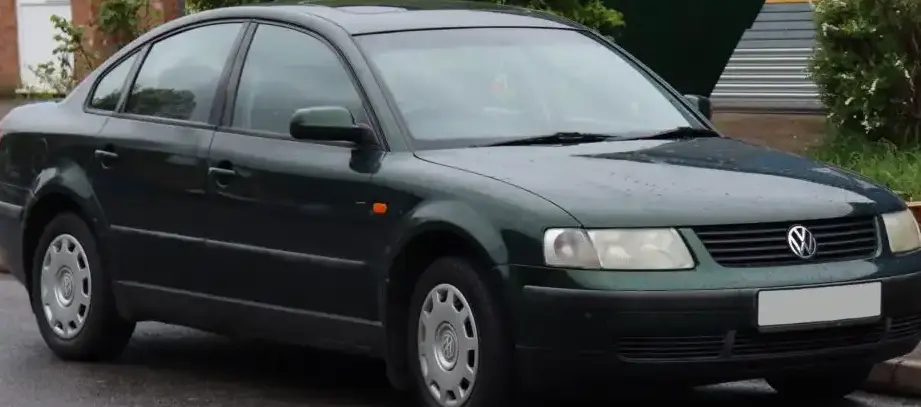
The Volkswagen Passat B5 1.9 TDI with 90 horsepower and an automatic transmission represents a significant offering in the mid-size sedan segment during its production run from July 1998 to September 2000. Positioned as an entry-level to mid-range trim within the B5 Passat lineup (which spanned various engine options and transmissions), this variant aimed to provide fuel efficiency and practicality for everyday commuting and family use. It was a key model for Volkswagen in Europe, where diesel engines and automatic transmissions were gaining popularity, and it saw limited sales in North America where the Passat was offered with gasoline engines only.
Technical Specifications
| Brand | Volkswagen |
| Model | Passat |
| Generation | Passat (B5) |
| Type (Engine) | 1.9 TDI (90 Hp) Automatic |
| Start of production | July, 1998 |
| End of production | September, 2000 |
| Powertrain Architecture | Internal Combustion engine |
| Body type | Sedan |
| Seats | 5 |
| Doors | 4 |
| Fuel consumption (urban) | 9 l/100 km (26.1 US mpg, 31.4 UK mpg, 11.1 km/l) |
| Fuel consumption (extra urban) | 5.2 l/100 km (45.2 US mpg, 54.3 UK mpg, 19.2 km/l) |
| Fuel consumption (combined) | 6.5 l/100 km (36.2 US mpg, 43.5 UK mpg, 15.4 km/l) |
| CO2 emissions | 176 g/km |
| Fuel Type | Diesel |
| Acceleration 0 – 100 km/h | 15.3 sec |
| Acceleration 0 – 62 mph | 15.3 sec |
| Acceleration 0 – 60 mph | 14.5 sec |
| Maximum speed | 177 km/h (109.98 mph) |
| Weight-to-power ratio | 15.4 kg/Hp, 65 Hp/tonne |
| Weight-to-torque ratio | 6.9 kg/Nm, 145.8 Nm/tonne |
| Power | 90 Hp @ 4000 rpm |
| Power per litre | 47.5 Hp/l |
| Torque | 202 Nm @ 1900 rpm (148.99 lb.-ft. @ 1900 rpm) |
| Engine layout | Front, Longitudinal |
| Engine Model/Code | AHU, AHH |
| Engine displacement | 1896 cm3 (115.7 cu. in.) |
| Number of cylinders | 4 |
| Engine configuration | Inline |
| Cylinder Bore | 79.5 mm (3.13 in.) |
| Piston Stroke | 95.5 mm (3.76 in.) |
| Compression ratio | 19.5:1 |
| Number of valves per cylinder | 2 |
| Fuel injection system | Direct injection |
| Engine aspiration | Turbocharger, Intercooler |
| Valvetrain | SOHC |
| Engine oil capacity | 3.8 l (4.02 US qt | 3.34 UK qt) |
| Coolant | 7.5 l (7.93 US qt | 6.6 UK qt) |
| Kerb Weight | 1385 kg (3053.4 lbs.) |
| Max. weight | 1860 kg (4100.6 lbs.) |
| Max load | 475 kg (1047.2 lbs.) |
| Trunk (boot) space – minimum | 475 l (16.77 cu. ft.) |
| Trunk (boot) space – maximum | 745 l (26.31 cu. ft.) |
| Fuel tank capacity | 62 l (16.38 US gal | 13.64 UK gal) |
| Max. roof load | 100 kg (220.46 lbs.) |
| Permitted trailer load with brakes (8%) | 1700 kg (3747.86 lbs.) |
| Permitted trailer load with brakes (12%) | 1600 kg (3527.4 lbs.) |
| Permitted trailer load without brakes | 650 kg (1433 lbs.) |
| Permitted towbar download | 75 kg (165.35 lbs.) |
| Length | 4675 mm (184.06 in.) |
| Width | 1740 mm (68.5 in.) |
| Height | 1459 mm (57.44 in.) |
| Wheelbase | 2707 mm (106.57 in.) |
| Front track | 1498 mm (58.98 in.) |
| Rear (Back) track | 1500 mm (59.06 in.) |
| Minimum turning circle | 11.4 m (37.4 ft.) |
| Drivetrain Architecture | The Internal combustion engine (ICE) drives the front wheels of the vehicle. |
| Drive wheel | Front wheel drive |
| Number of gears and type of gearbox | 4 gears, automatic transmission |
| Front suspension | Independent multi-link suspension |
| Rear suspension | Torsion |
| Front brakes | Ventilated discs |
| Rear brakes | Disc |
| Assisting systems | ABS (Anti-lock braking system) |
| Steering type | Steering rack and pinion |
| Power steering | Hydraulic Steering |
| Tires size | 195/65 R15 |
| Wheel rims size | 6J x 15 |
INTRODUCTION
The Volkswagen Passat B5, produced from 1996 to 2005, represented a significant leap forward for Volkswagen in terms of build quality, refinement, and technology. The 1.9 TDI 90 hp Automatic variant, introduced in July 1998 and continuing through September 2000, was a popular choice, particularly in European markets. Built on the 1HX0/A3 platform, this Passat offered a blend of practicality, fuel economy, and comfort. The 90 hp TDI engine, coupled with a four-speed automatic transmission, aimed to provide a relaxed driving experience for those prioritizing efficiency over outright performance. It sat below the more powerful TDI variants (like the 110 hp and later 130 hp versions) and the gasoline-powered models in the Passat B5 range.
Powertrain & Engine Architecture
The heart of this Passat variant is the 1.9-liter inline-four cylinder diesel engine, specifically the AHU or AHH engine code. These engines are known for their durability and relatively simple mechanical design. The engine utilizes a direct injection system, injecting fuel directly into the combustion chamber under extremely high pressure. This improves combustion efficiency and reduces emissions. A turbocharger with an intercooler is employed to increase power output, boosting the engine to 90 horsepower. The valvetrain is a single overhead camshaft (SOHC) design, keeping the engine relatively compact and lightweight. The four-speed automatic transmission is a conventional hydraulic automatic, offering smooth but not particularly quick shifts. It was chosen for its ease of use and suitability for everyday driving. The transmission’s gear ratios are geared towards fuel efficiency, with a relatively tall final drive.
Driving Characteristics
The 1.9 TDI 90 hp Automatic Passat B5 delivers a driving experience focused on comfort and fuel economy rather than sporty performance. Acceleration is modest, taking around 15.3 seconds to reach 62 mph (100 km/h). The automatic transmission contributes to a relaxed driving style, but it can feel somewhat sluggish when attempting quicker maneuvers or overtaking. The engine produces ample torque at low RPMs (202 Nm or 148.99 lb-ft at 1900 rpm), making it suitable for everyday driving and hauling passengers or cargo. Compared to the manual transmission versions of the same engine, the automatic suffers a slight performance penalty due to transmission losses. The higher-output TDI variants (110 hp and 130 hp) offer significantly more responsive acceleration and a more engaging driving experience, but at the cost of fuel economy.
Equipment & Trim Levels
The 1.9 TDI 90 hp Automatic Passat B5 typically came equipped with a reasonable level of standard features. These included power windows, central locking, power steering, and an ABS anti-lock braking system. Interior upholstery was typically cloth, with a functional but not overly luxurious dashboard layout. Optional extras included alloy wheels, a sunroof, climate control, and a radio/cassette player (or CD player in later models). Higher trim levels, such as the Comfort or Trendline, added features like upgraded upholstery, wood trim, and additional convenience items. The specific equipment levels varied depending on the market and individual customer choices.
Chassis & Braking
The Passat B5 features an independent multi-link front suspension, providing a comfortable ride and good handling characteristics. The rear suspension utilizes a torsion beam setup, which is simpler and more cost-effective but offers slightly less sophisticated handling. Brakes are ventilated discs on the front wheels and solid discs on the rear. The ABS system helps to maintain steering control during emergency braking. Stabilizer bars are fitted to both the front and rear axles to reduce body roll during cornering. The suspension and braking systems were tuned to provide a balance between comfort and safety, suitable for the vehicle’s weight and intended use.
Market Reception & Comparison
The 1.9 TDI 90 hp Automatic Passat B5 was generally well-received by automotive critics as a practical and fuel-efficient family sedan. However, some reviewers noted the engine’s lack of outright power and the automatic transmission’s somewhat sluggish performance. Compared to the more powerful TDI variants, this version offered better fuel economy but less excitement. Against gasoline-powered competitors, it provided superior fuel efficiency but often lacked the refinement and smoothness of their engines. Its fuel economy figures of around 36.2 US mpg combined were a major selling point, particularly in Europe where fuel prices are higher. Reliability was generally good, with the TDI engine proving to be durable and long-lasting.
Legacy
The 1.9 TDI engine, in its various iterations, has earned a reputation for exceptional reliability and longevity. The AHU and AHH engine codes used in this Passat variant are known to withstand high mileage with proper maintenance. Today, these cars are often found with well over 200,000 miles on the odometer. The automatic transmission, while not as robust as the manual gearbox, can also provide reliable service if properly maintained. In the used car market, the 1.9 TDI 90 hp Automatic Passat B5 represents a relatively affordable and practical option for those seeking a fuel-efficient and dependable family sedan. However, potential buyers should be aware of the age-related issues common to older vehicles, such as corrosion and wear and tear on suspension components.