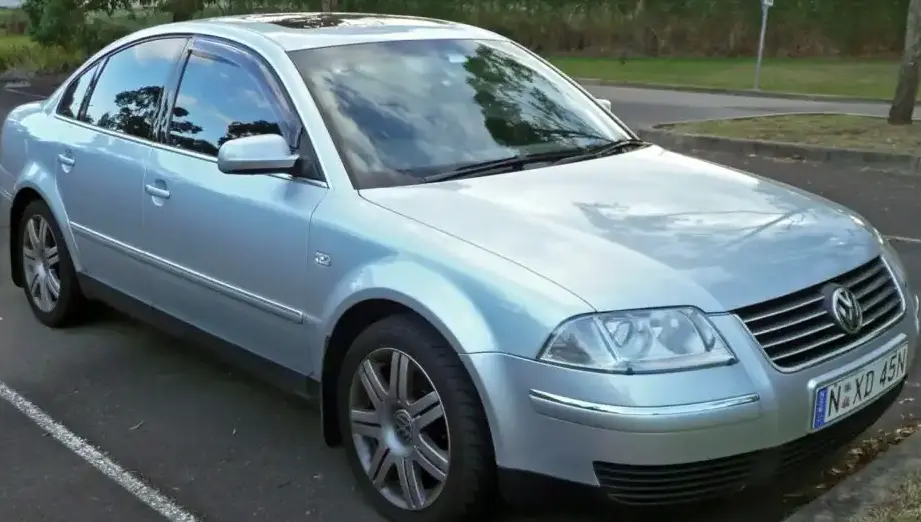
The Volkswagen Passat B5.5 1.8 Turbo 20V, produced from 2000 to 2005, represented a significant mid-cycle refresh of the popular B5 Passat. This variant, equipped with the 1.8-liter turbocharged four-cylinder engine producing 150 horsepower, occupied a crucial position in the Passat lineup, offering a balance of performance, fuel efficiency, and affordability. It was primarily marketed in Europe and other global markets, serving as a mainstream option within the Passat range. This model sat between the base, lower-powered engines and the more expensive, performance-oriented VR6 variants.
Technical Specifications
| Brand | Volkswagen |
| Model | Passat |
| Generation | Passat (B5.5) |
| Type (Engine) | 1.8 Turbo 20V (150 Hp) |
| Start of production | 2000 year |
| End of production | 2005 year |
| Powertrain Architecture | Internal Combustion engine |
| Body type | Sedan |
| Seats | 5 |
| Doors | 4 |
| Fuel consumption (economy) – urban (NEDC) | 11.5 l/100 km (20.5 US mpg, 24.6 UK mpg, 8.7 km/l) |
| Fuel consumption (economy) – extra urban (NEDC) | 6.5 l/100 km (36.2 US mpg, 43.5 UK mpg, 15.4 km/l) |
| Fuel consumption (economy) – combined (NEDC) | 8.3 l/100 km (28.3 US mpg, 34 UK mpg, 12 km/l) |
| CO2 emissions (NEDC) | 199 g/km |
| Fuel Type | Petrol (Gasoline) |
| Acceleration 0 – 100 km/h | 9.2 sec |
| Acceleration 0 – 62 mph | 9.2 sec |
| Acceleration 0 – 60 mph | 8.7 sec |
| Maximum speed | 221 km/h (137.32 mph) |
| Emission standard | Euro 4 |
| Weight-to-power ratio | 10.3 kg/Hp, 97.5 Hp/tonne |
| Weight-to-torque ratio | 7.3 kg/Nm, 136.5 Nm/tonne |
| Power | 150 Hp @ 5700 rpm |
| Power per litre | 84.2 Hp/l |
| Torque | 210 Nm @ 1750 rpm (154.89 lb.-ft. @ 1750 rpm) |
| Engine layout | Front, Longitudinal |
| Engine Model/Code | AWT |
| Engine displacement | 1781 cm3 (108.68 cu. in.) |
| Number of cylinders | 4 |
| Engine configuration | Inline |
| Cylinder Bore | 81 mm (3.19 in.) |
| Piston Stroke | 86.4 mm (3.4 in.) |
| Compression ratio | 9.5:1 |
| Number of valves per cylinder | 5 |
| Fuel injection system | Multi-port manifold injection |
| Engine aspiration | Turbocharger, Intercooler |
| Valvetrain | DOHC |
| Engine oil capacity | 3.5 l (3.7 US qt | 3.08 UK qt) |
| Coolant | 7 l (7.4 US qt | 6.16 UK qt) |
| Kerb Weight | 1539 kg (3392.91 lbs.) |
| Max. weight | 1940 kg (4276.97 lbs.) |
| Max load | 401 kg (884.05 lbs.) |
| Trunk (boot) space – minimum | 475 l (16.77 cu. ft.) |
| Trunk (boot) space – maximum | 800 l (28.25 cu. ft.) |
| Fuel tank capacity | 62 l (16.38 US gal | 13.64 UK gal) |
| Max. roof load | 100 kg (220.46 lbs.) |
| Permitted trailer load with brakes (12%) | 1300 kg (2866.01 lbs.) |
| Permitted trailer load without brakes | 650 kg (1433 lbs.) |
| Permitted towbar download | 75 kg (165.35 lbs.) |
| Length | 4703 mm (185.16 in.) |
| Width | 1746 mm (68.74 in.) |
| Height | 1462 mm (57.56 in.) |
| Wheelbase | 2703 mm (106.42 in.) |
| Front track | 1515 mm (59.65 in.) |
| Rear (Back) track | 1515 mm (59.65 in.) |
| Minimum turning circle (turning diameter) | 11.4 m (37.4 ft.) |
| Drivetrain Architecture | The Internal combustion engine (ICE) drives the front wheels of the vehicle. |
| Drive wheel | Front wheel drive |
| Number of gears and type of gearbox | 5 gears, manual transmission |
| Front suspension | Independent multi-link suspension, Transverse stabilizer |
| Rear suspension | Trailing arm, Torsion |
| Front brakes | Ventilated discs |
| Rear brakes | Disc |
| Assisting systems | ABS (Anti-lock braking system) |
| Steering type | Steering rack and pinion |
| Power steering | Hydraulic Steering |
| Tires size | 195/65 R15 |
| Wheel rims size | 6J x 15 |
Powertrain & Engine Architecture
The heart of this Passat variant is the 1.8-liter, 20-valve turbocharged inline-four engine, typically identified by the engine code AWT. This engine was a mainstay of the Volkswagen Group’s offerings during this period. It featured a cast iron block and an aluminum cylinder head, incorporating a dual overhead camshaft (DOHC) design for each cylinder bank, resulting in the 20-valve configuration. The turbocharger, coupled with an intercooler, significantly boosted power output compared to naturally aspirated 1.8-liter engines. Fuel delivery was managed by a multi-port fuel injection system. The engine’s design prioritized a balance between performance and fuel economy. A 5-speed manual transmission was the standard offering, providing a relatively direct connection between the engine and the front wheels. An optional 4-speed automatic transmission was also available, though it impacted performance and fuel economy.
Driving Characteristics
The 150-horsepower 1.8T engine, paired with the 5-speed manual transmission, provided adequate performance for everyday driving. Acceleration from 0 to 60 mph took approximately 8.7 seconds, and top speed was around 137 mph. While not a sports car, the engine delivered a usable amount of torque, making overtaking maneuvers relatively easy. The turbocharger did introduce a degree of turbo lag, meaning there was a slight delay between pressing the accelerator and feeling the full power delivery. Compared to the more powerful VR6 models, the 1.8T offered a more economical driving experience, but lacked the VR6’s outright acceleration and refined engine note. The automatic transmission, while offering convenience, noticeably dulled acceleration and increased fuel consumption. The gear ratios were tuned for fuel efficiency rather than outright performance.
Equipment & Trim Levels
The 1.8 Turbo 20V Passat B5.5 typically came with a reasonable level of standard equipment. This included power windows, power locks, air conditioning, and an AM/FM radio. Higher trim levels, such as the GLS, offered options such as leather upholstery, a sunroof, alloy wheels, and a more advanced audio system. Safety features like ABS were standard. The interior design was functional and relatively understated, focusing on practicality and comfort. The specific trim level determined the level of interior finish and the availability of optional extras. Base models were fairly spartan, while higher trims offered a more luxurious experience.
Chassis & Braking
The Passat B5.5 featured an independent multi-link front suspension and a torsion beam rear suspension. This setup provided a good balance between ride comfort and handling. The front brakes were ventilated discs, while the rear brakes were solid discs. ABS was standard, enhancing braking performance and stability. The suspension tuning was geared towards providing a comfortable ride for passengers, rather than aggressive handling. The steering was hydraulic power-assisted, offering a reasonable level of feedback. The weight distribution was fairly balanced, contributing to predictable handling characteristics.
Market Reception & Comparison
The Passat B5.5 1.8 Turbo 20V was generally well-received by automotive critics. It was praised for its comfortable ride, spacious interior, and fuel efficiency. However, some critics noted the turbo lag and the relatively modest performance compared to the VR6 models. In terms of reliability, the 1.8T engine was generally considered to be robust, but issues with the turbocharger, cooling system, and occasionally the PCV valve were occasionally reported. Compared to the diesel variants, the 1.8T offered a more refined driving experience but lower fuel economy. The automatic transmission versions were often criticized for their sluggish performance.
Legacy
The Volkswagen Passat B5.5 1.8 Turbo 20V remains a popular choice in the used car market today. Its combination of affordability, practicality, and reasonable performance makes it an attractive option for buyers seeking a comfortable and reliable mid-size sedan. The 1.8T engine, while not without its potential issues, is generally considered to be durable and relatively easy to maintain. Parts availability is good, and the Passat B5.5 has developed a reputation as a solid and dependable vehicle. While not a performance icon, it represents a well-rounded and practical choice for everyday transportation, and the manual transmission versions are particularly sought after by enthusiasts.