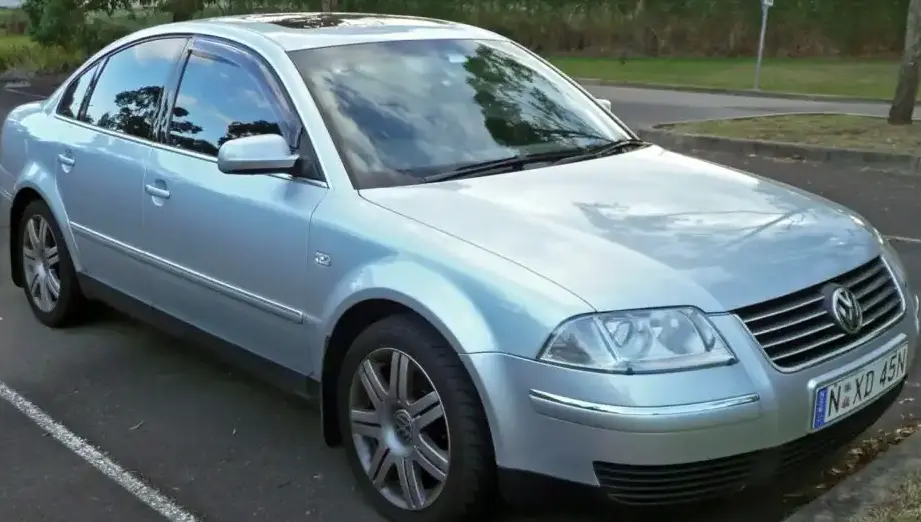
The Volkswagen Passat B5.5 1.9 TDI 130 hp 4MOTION, produced from September 2000 to December 2004, represents a significant iteration of Volkswagen’s mid-size offering. Positioned as a premium trim within the B5.5 generation (internally designated as the 3B6 platform), this variant combined the fuel efficiency and torque of Volkswagen’s renowned 1.9-liter TDI engine with the added security and capability of Volkswagen’s 4MOTION all-wheel-drive system. It was primarily marketed in Europe, where diesel engines and all-wheel drive were highly valued for their practicality and performance in varied weather conditions. This model aimed to provide a balance between economy, performance, and all-weather capability, appealing to drivers seeking a comfortable and capable family sedan.
Technical Specifications
| Brand | Volkswagen |
| Model | Passat |
| Generation | Passat (B5.5) |
| Type (Engine) | 1.9 TDI (130 Hp) 4MOTION |
| Start of production | September, 2000 |
| End of production | December, 2004 |
| Powertrain Architecture | Internal Combustion engine |
| Body type | Sedan |
| Seats | 5 |
| Doors | 4 |
| Fuel consumption (urban) | 8.5 l/100 km (27.7 US mpg, 33.2 UK mpg, 11.8 km/l) |
| Fuel consumption (extra urban) | 5.3 l/100 km (44.4 US mpg, 53.3 UK mpg, 18.9 km/l) |
| Fuel consumption (combined) | 6.5 l/100 km (36.2 US mpg, 43.5 UK mpg, 15.4 km/l) |
| CO2 emissions | 176 g/km |
| Fuel Type | Diesel |
| Acceleration 0 – 100 km/h | 10.4 sec |
| Acceleration 0 – 62 mph | 10.4 sec |
| Acceleration 0 – 60 mph | 9.9 sec |
| Maximum speed | 204 km/h (126.76 mph) |
| Emission standard | EURO 3 |
| Weight-to-power ratio | 13 kg/Hp, 76.7 Hp/tonne |
| Weight-to-torque ratio | 5.5 kg/Nm, 182.9 Nm/tonne |
| Power | 130 Hp @ 4000 rpm |
| Power per litre | 68.6 Hp/l |
| Torque | 310 Nm @ 1900 rpm (228.64 lb.-ft. @ 1900 rpm) |
| Engine layout | Front, Longitudinal |
| Engine Model/Code | AVF |
| Engine displacement | 1896 cm3 (115.7 cu. in.) |
| Number of cylinders | 4 |
| Engine configuration | Inline |
| Cylinder Bore | 79.5 mm (3.13 in.) |
| Piston Stroke | 95.5 mm (3.76 in.) |
| Compression ratio | 19:1 |
| Number of valves per cylinder | 2 |
| Fuel injection system | Pump-nozzle (Unit Injector) |
| Engine aspiration | Turbocharger, Intercooler |
| Valvetrain | SOHC |
| Engine oil capacity | 4 l (4.23 US qt | 3.52 UK qt) |
| Coolant | 7 l (7.4 US qt | 6.16 UK qt) |
| Kerb Weight | 1695 kg (3736.84 lbs.) |
| Max. weight | 2100 kg (4629.71 lbs.) |
| Max load | 405 kg (892.87 lbs.) |
| Trunk (boot) space – minimum | 400 l (14.13 cu. ft.) |
| Trunk (boot) space – maximum | 725 l (25.6 cu. ft.) |
| Fuel tank capacity | 62 l (16.38 US gal | 13.64 UK gal) |
| Max. roof load | 100 kg (220.46 lbs.) |
| Permitted trailer load with brakes (12%) | 1700 kg (3747.86 lbs.) |
| Permitted trailer load without brakes | 750 kg (1653.47 lbs.) |
| Permitted towbar download | 85 kg (187.39 lbs.) |
| Length | 4703 mm (185.16 in.) |
| Width | 1746 mm (68.74 in.) |
| Height | 1462 mm (57.56 in.) |
| Wheelbase | 2703 mm (106.42 in.) |
| Minimum turning circle | 11.4 m (37.4 ft.) |
| Drivetrain Architecture | The Internal combustion engine (ICE) drives permanently the four wheels of the vehicle. |
| Drive wheel | All wheel drive (4×4) |
| Number of gears and type of gearbox | 6 gears, manual transmission |
| Front suspension | Independent multi-link suspension, Transverse stabilizer |
| Rear suspension | Double wishbone, Transverse stabilizer |
| Front brakes | Ventilated discs |
| Rear brakes | Disc |
| Assisting systems | ABS (Anti-lock braking system) |
| Steering type | Steering rack and pinion |
| Power steering | Hydraulic Steering |
| Tires size | 205/60 R15 |
| Wheel rims size | 7J x 15 |
Powertrain & Engine Architecture
The heart of this Passat variant is the 1.9-liter, four-cylinder diesel engine, specifically the AVF engine code. This engine is a longitudinal inline-four, meaning it’s mounted lengthwise in the engine bay. It utilizes a sophisticated pump-nozzle (unit injector) fuel injection system, a hallmark of Volkswagen’s TDI engines of the era. This system delivers highly precise fuel metering directly into the combustion chamber, contributing to both efficiency and reduced emissions. The engine features a single overhead camshaft (SOHC) operating two valves per cylinder. A turbocharger with an intercooler is employed to boost power and torque, providing 130 horsepower at 4000 rpm and a substantial 310 Nm (228.64 lb-ft) of torque at a low 1900 rpm. This torque output is a key characteristic of TDI engines, providing strong pulling power and excellent drivability. The engine’s 19:1 compression ratio is typical for a diesel engine, maximizing combustion efficiency. The 6-speed manual transmission was standard, offering well-spaced gear ratios to optimize both fuel economy and performance.
Driving Characteristics
The 1.9 TDI 130 hp 4MOTION Passat offered a compelling driving experience. While not a sports sedan, the engine’s abundant torque made it feel surprisingly quick and responsive in everyday driving situations. The 4MOTION all-wheel-drive system provided excellent traction, particularly in inclement weather or on slippery surfaces. The 6-speed manual transmission allowed drivers to keep the engine in its optimal power band, maximizing acceleration and minimizing fuel consumption. Compared to the higher-output TDI variants (like the 150 hp or 180 hp versions), this 130 hp model prioritized fuel economy and refinement over outright performance. It felt less strained at higher speeds and offered a more relaxed cruising experience. Compared to the gasoline-powered Passats, the TDI offered significantly better fuel economy and a more robust low-end torque delivery.
Equipment & Trim Levels
The 1.9 TDI 4MOTION typically came with a good level of standard equipment. This included features like air conditioning, power windows, central locking, and an upgraded audio system. Interior upholstery was typically cloth, with options for leather available. Dashboard trim was often woodgrain or metallic finish. Optional extras included sunroofs, upgraded audio systems with CD changers, and parking sensors. The B5.5 Passat generally offered a comfortable and well-appointed interior, reflecting its position as a mid-range to premium vehicle.
Chassis & Braking
The Passat B5.5 featured an independent multi-link suspension at the front and a double wishbone suspension at the rear, providing a comfortable ride and good handling characteristics. Stabilizer bars were fitted to both axles to reduce body roll. Brakes consisted of ventilated discs at the front and solid discs at the rear. The ABS (Anti-lock Braking System) was standard, enhancing safety and control during braking. The 4MOTION system utilized a viscous coupling to distribute power between the front and rear axles as needed, providing optimal traction in various conditions.
Market Reception & Comparison
The Passat 1.9 TDI 4MOTION was well-received by automotive critics in Europe. It was praised for its fuel efficiency, strong torque, comfortable ride, and all-weather capability. Compared to other trims in the Passat lineup, the 1.9 TDI 4MOTION offered a compelling balance of performance and economy. While the more powerful gasoline engines offered quicker acceleration, they lacked the TDI’s fuel efficiency and low-end torque. The 1.9 TDI 4MOTION was often seen as a practical and sensible choice for drivers who prioritized usability and reliability.
Legacy
The 1.9 TDI engine, particularly the AVF code, is known for its durability and reliability. With proper maintenance, these engines can accumulate high mileage. The 4MOTION system is also generally robust and dependable. In the used car market today, the Passat B5.5 1.9 TDI 4MOTION remains a popular choice for those seeking a reliable and fuel-efficient family sedan. However, potential buyers should be aware of the age-related issues common to older vehicles, such as wear and tear on suspension components and potential issues with the turbocharger. Despite its age, the Passat B5.5 1.9 TDI 4MOTION continues to be a respected and capable vehicle, representing a high point in Volkswagen’s diesel technology.