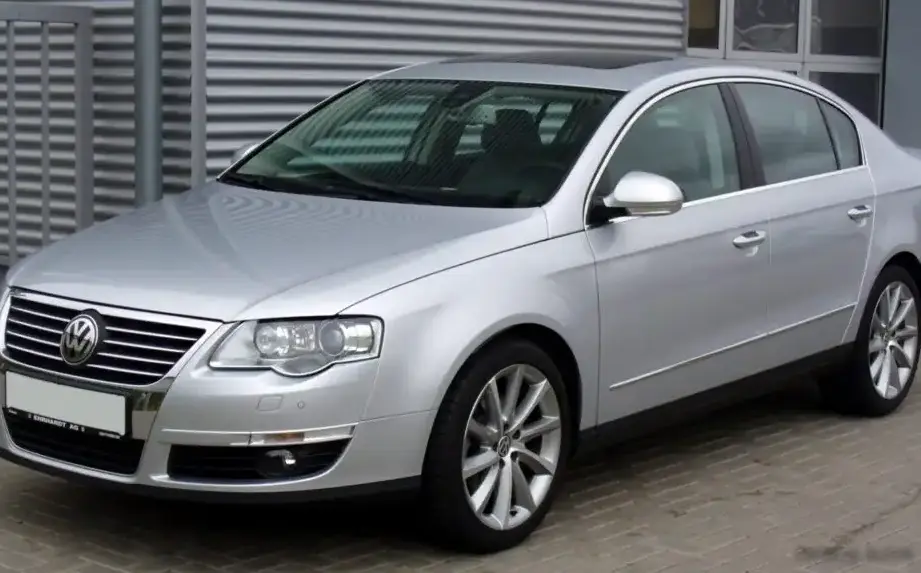
The Volkswagen Passat B6 2.0 TSI Tiptronic, produced from January 2008 to July 2010, represented a significant step forward in performance and technology for the mid-size Passat lineup. Positioned as a mid-range to upper-mid-range offering, it bridged the gap between the more economical 1.4 TSI models and the performance-oriented variants. This variant was primarily sold in the European market, where it competed with other premium sedans like the Audi A4, BMW 3 Series, and Mercedes-Benz C-Class. The B6 generation Passat, built on the Volkswagen Group’s B6 platform (shared with the Audi A4 and Škoda Superb), aimed to provide a more refined and sophisticated driving experience than its predecessor.
Technical Specifications
| Brand | Volkswagen |
| Model | Passat |
| Generation | Passat (B6) |
| Type (Engine) | 2.0 TSI (200 Hp) Tiptronic |
| Start of production | January, 2008 |
| End of production | July, 2010 |
| Powertrain Architecture | Internal Combustion engine |
| Body type | Sedan |
| Seats | 5 |
| Doors | 4 |
| Fuel consumption (urban) | 12.1 l/100 km (19.4 US mpg, 23.3 UK mpg, 8.3 km/l) |
| Fuel consumption (extra urban) | 6.4 l/100 km (36.8 US mpg, 44.1 UK mpg, 15.6 km/l) |
| Fuel consumption (combined) | 8.5 l/100 km (27.7 US mpg, 33.2 UK mpg, 11.8 km/l) |
| CO2 emissions | 199 g/km |
| Fuel Type | Petrol (Gasoline) |
| Acceleration 0 – 100 km/h | 7.8 sec |
| Acceleration 0 – 62 mph | 7.8 sec |
| Acceleration 0 – 60 mph | 7.4 sec |
| Maximum speed | 230 km/h (142.92 mph) |
| Emission standard | Euro 4 |
| Weight-to-power ratio | 6.9 kg/Hp, 144.1 Hp/tonne |
| Weight-to-torque ratio | 5 kg/Nm, 201.7 Nm/tonne |
| Power | 200 Hp @ 5500 rpm |
| Power per litre | 100.8 Hp/l |
| Torque | 280 Nm @ 1800 rpm (206.52 lb.-ft. @ 1800 rpm) |
| Engine layout | Front, Transverse |
| Engine Model/Code | BPY, CAWB, CCTA, CCZA |
| Engine displacement | 1984 cm3 (121.07 cu. in.) |
| Number of cylinders | 4 |
| Engine configuration | Inline |
| Cylinder Bore | 82.5 mm (3.25 in.) |
| Piston Stroke | 92.8 mm (3.65 in.) |
| Compression ratio | 9.6:1 |
| Number of valves per cylinder | 4 |
| Fuel injection system | Direct injection |
| Engine aspiration | Turbocharger, Intercooler |
| Valvetrain | DOHC |
| Engine oil capacity | 4.6 l (4.86 US qt | 4.05 UK qt) |
| Kerb Weight | 1388 kg (3060.02 lbs.) |
| Max. weight | 2070 kg (4563.57 lbs.) |
| Max load | 682 kg (1503.55 lbs.) |
| Trunk (boot) space – minimum | 565 l (19.95 cu. ft.) |
| Trunk (boot) space – maximum | 1091 l (38.53 cu. ft.) |
| Fuel tank capacity | 70 l (18.49 US gal | 15.4 UK gal) |
| Max. roof load | 100 kg (220.46 lbs.) |
| Permitted trailer load with brakes (8%) | 1800 kg (3968.32 lbs.) |
| Permitted trailer load with brakes (12%) | 1600 kg (3527.4 lbs.) |
| Permitted trailer load without brakes | 750 kg (1653.47 lbs.) |
| Permitted towbar download | 90 kg (198.42 lbs.) |
| Length | 4765 mm (187.6 in.) |
| Width | 1820 mm (71.65 in.) |
| Width including mirrors | 2004 mm (78.9 in.) |
| Height | 1472 mm (57.95 in.) |
| Wheelbase | 2709 mm (106.65 in.) |
| Front track | 1552 mm (61.1 in.) |
| Rear (Back) track | 1551 mm (61.06 in.) |
| Front overhang | 965 mm (37.99 in.) |
| Rear overhang | 1091 mm (42.95 in.) |
| Drag coefficient (Cd) | 0.281 |
| Minimum turning circle | 11.4 m (37.4 ft.) |
| Drivetrain Architecture | The Internal combustion engine (ICE) drives the front wheels of the vehicle. |
| Drive wheel | Front wheel drive |
| Number of gears and type of gearbox | 6 gears, automatic transmission |
| Front suspension | Spring Strut |
| Rear suspension | Coil spring |
| Front brakes | Ventilated discs |
| Rear brakes | Disc |
| Assisting systems | ABS (Anti-lock braking system) |
| Steering type | Steering rack and pinion |
| Tires size | 215/55 R16 |
| Wheel rims size | 7J x 16 |
Powertrain & Engine Architecture
At the heart of the Passat 2.0 TSI Tiptronic lies the EA886 engine family, specifically the 2.0-liter turbocharged four-cylinder. Engine codes varied depending on the specific market and year, including BPY, CAWB, CCTA, and CCZA. This engine featured direct fuel injection (FSI), a six-port cylinder head, and a variable valve timing system on both the intake and exhaust sides. The turbocharger, typically a K04 unit, provided significant boost, contributing to the engine’s 200 horsepower output at 5500 rpm and 280 Nm (206 lb-ft) of torque available from a low 1800 rpm. The ‘Tiptronic’ transmission was a six-speed automatic gearbox, offering both fully automatic operation and a manual shift mode for greater driver control. This transmission was known for its smooth shifts, but wasn’t as quick or fuel-efficient as some of the newer dual-clutch transmissions (DSG) that would become prevalent in later models.
Driving Characteristics
The 2.0 TSI Tiptronic offered a compelling blend of performance and comfort. Acceleration from 0 to 100 km/h (0-62 mph) took approximately 7.8 seconds, making it noticeably quicker than the base 1.4 TSI models. The readily available torque meant strong in-gear acceleration, useful for overtaking maneuvers. However, compared to the six-speed manual version of the 2.0 TSI, the Tiptronic transmission did introduce a slight performance penalty due to torque converter losses. The automatic transmission’s shift programming prioritized smoothness over outright speed, resulting in a more relaxed driving experience. The gear ratios were tuned for a balance between fuel economy and responsiveness, with a relatively tall sixth gear for highway cruising.
Equipment & Trim Levels
The 2.0 TSI Tiptronic typically came equipped with a generous level of standard features. These included climate control, power windows and mirrors, a CD stereo system (often upgradable to a premium sound system), alloy wheels, and ABS brakes. Higher trim levels added features such as leather upholstery, sunroof, parking sensors, and upgraded infotainment systems. Interior upholstery was often a cloth or a combination of cloth and leatherette, with full leather options available as an upgrade. The dashboard layout was functional and well-designed, with a focus on ergonomics.
Chassis & Braking
The Passat B6 featured a MacPherson strut front suspension and a multi-link rear suspension, providing a comfortable and controlled ride. The 2.0 TSI models generally had slightly stiffer suspension components compared to the base models to handle the increased power. Braking systems consisted of ventilated front discs and solid rear discs. ABS (Anti-lock Braking System) was standard. The steering was a rack-and-pinion system, offering precise and responsive handling.
Market Reception & Comparison
The Passat 2.0 TSI Tiptronic was generally well-received by automotive critics. It was praised for its refined engine, comfortable ride, and spacious interior. However, some reviewers noted that the Tiptronic transmission wasn’t as engaging as a manual gearbox and that fuel economy, while respectable, wasn’t class-leading. Compared to the 1.4 TSI, the 2.0 TSI offered a significant performance boost, while the more powerful V6 models provided even greater performance at a higher price point. The 1.9 TDI diesel variant offered superior fuel economy but lacked the 2.0 TSI’s outright acceleration.
Legacy
The EA886 2.0 TSI engine proved to be a robust and reliable unit when properly maintained. The Tiptronic transmission, while not without its quirks, generally held up well over time. Today, Passat B6 2.0 TSI Tiptronic models are readily available on the used car market and represent a good value for those seeking a comfortable and capable mid-size sedan. Common maintenance items include regular oil changes, timing belt replacement (depending on engine code), and inspection of the turbocharger and fuel injectors. The engine’s tuning potential also makes it a popular choice for enthusiasts looking for a platform for modifications.