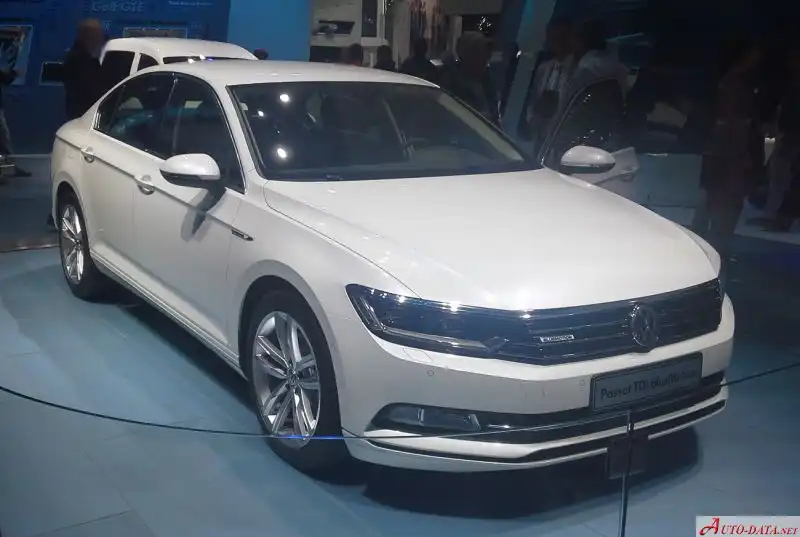
The Volkswagen Passat B8 2.0 TDI (150 hp) represents a significant iteration of Volkswagen’s globally successful mid-size sedan. Produced from 2014 to 2019, this variant occupied a central position within the B8 Passat lineup, offering a balance between fuel efficiency, performance, and practicality. It was primarily aimed at the European market, where diesel engines held a substantial share, but was also available in other regions. The B8 generation marked a shift for the Passat, incorporating a more sophisticated design, advanced technology, and a lighter platform compared to its predecessor.
Technical Specifications
| Brand | Volkswagen |
| Model | Passat |
| Generation | Passat (B8) |
| Type (Engine) | 2.0 TDI (150 Hp) |
| Start of production | 2014 |
| End of production | 2019 |
| Powertrain Architecture | Internal Combustion engine |
| Body type | Sedan |
| Seats | 5 |
| Doors | 4 |
| Fuel consumption (urban) | 4.7-4.8 l/100 km (50-49 US mpg) |
| Fuel consumption (extra urban) | 3.6-3.8 l/100 km (65.3-61.9 US mpg) |
| Fuel consumption (combined) | 4.0-4.1 l/100 km (58.8-57.4 US mpg) |
| CO2 emissions | 106-109 g/km |
| Fuel Type | Diesel |
| Acceleration 0 – 100 km/h | 8.7 sec |
| Acceleration 0 – 62 mph | 8.7 sec |
| Acceleration 0 – 60 mph | 8.3 sec |
| Maximum speed | 220 km/h (136.7 mph) |
| Emission standard | Euro 6 |
| Weight-to-power ratio | 9.8 kg/Hp |
| Weight-to-torque ratio | 4.3 kg/Nm |
| Power | 150 Hp @ 3500-4000 rpm |
| Torque | 340 Nm @ 1750-3000 rpm (250.77 lb.-ft.) |
| Engine layout | Front, Transverse |
| Engine Model/Code | CRLB, DBGA, DCYA, DFEA, DFGA |
| Engine displacement | 1968 cm3 (120.09 cu. in.) |
| Number of cylinders | 4 |
| Engine configuration | Inline |
| Number of valves per cylinder | 4 |
| Fuel injection system | Diesel Commonrail |
| Engine aspiration | Turbocharger, Intercooler |
| Engine oil capacity | 4.7 l (4.97 US qt | 4.14 UK qt) |
| Kerb Weight | 1475 kg (3251.82 lbs.) |
| Max. weight | 2020 kg (4453.34 lbs.) |
| Max load | 545 kg (1201.52 lbs.) |
| Trunk (boot) space – minimum | 586 l (20.69 cu. ft.) |
| Trunk (boot) space – maximum | 1152 l (40.68 cu. ft.) |
| Fuel tank capacity | 66 l (17.44 US gal | 14.52 UK gal) |
| Length | 4767 mm (187.68 in.) |
| Width | 1832 mm (72.13 in.) |
| Height | 1456 mm (57.32 in.) |
| Wheelbase | 2791 mm (109.88 in.) |
| Front track | 1584 mm (62.36 in.) |
| Rear (Back) track | 1568 mm (61.73 in.) |
| Minimum turning circle | 11.7 m (38.39 ft.) |
| Drivetrain Architecture | Front wheel drive |
| Number of gears | 6 |
| Type of gearbox | Manual transmission |
| Front brakes | Ventilated discs |
| Assisting systems | ABS (Anti-lock braking system) |
| Steering type | Steering rack and pinion |
| Tires size | 215/60 R16; 215/55 R17 |
| Wheel rims size | 6.5J x 16; 7.0J x 17 |
Powertrain & Engine Architecture
The heart of the Passat B8 2.0 TDI (150 hp) is the Volkswagen Group’s EA288 series of diesel engines. Specifically, this variant utilized engine codes such as CRLB, DBGA, DCYA, DFEA, and DFGA, depending on the production year and market. These engines are characterized by their common-rail direct injection system, which delivers fuel at extremely high pressure for optimized combustion. The 2.0-liter inline-four cylinder engine features a turbocharger with an intercooler, enhancing power output and efficiency. The engine employs four valves per cylinder and a sophisticated variable geometry turbocharger (VGT) to provide a broad torque curve. The 6-speed manual transmission was standard, offering precise gear changes and contributing to the car’s overall efficiency.
Driving Characteristics
The 150 hp 2.0 TDI with a manual transmission provided a balanced driving experience. While not overtly sporty, it offered sufficient power for comfortable highway cruising and everyday driving. The maximum torque of 340 Nm (250.77 lb-ft) available from 1750-3000 rpm ensured strong acceleration in most situations. The gear ratios were tuned for fuel economy, with taller gearing in higher gears to reduce engine speed at cruising speeds. Compared to the more powerful 2.0 TDI variants (e.g., 184 hp or 240 hp), this version felt less urgent in acceleration, but it offered significantly better fuel economy. Against the petrol engines, the TDI provided superior torque and fuel efficiency, albeit with a slightly more audible engine note.
Equipment & Trim Levels
The 2.0 TDI (150 hp) typically came in mid-range trim levels, such as ‘Trendline’ or ‘Comfortline’ in Europe. Standard equipment often included air conditioning, a touchscreen infotainment system, alloy wheels, and a suite of safety features like ABS, ESP, and multiple airbags. Optional extras included leather upholstery, a panoramic sunroof, navigation system, adaptive cruise control, and parking sensors. Interior upholstery was typically cloth, with higher trims offering partial leather options. The dashboard layout was clean and functional, with a focus on ergonomics and ease of use.
Chassis & Braking
The B8 Passat utilized Volkswagen’s Modular Transverse Matrix (MQB) platform, which contributed to its lighter weight and improved rigidity. The front suspension consisted of MacPherson struts, while the rear suspension employed a multi-link setup. This configuration provided a comfortable ride and good handling characteristics. Braking systems varied depending on the trim level, with lower trims featuring disc brakes on the front and drum brakes on the rear. Higher trims typically had disc brakes on all four wheels. The steering was precise and well-weighted, providing good feedback to the driver.
Market Reception & Comparison
The Passat B8 2.0 TDI (150 hp) was well-received by automotive critics for its fuel efficiency, comfortable ride, and spacious interior. It was often praised as a practical and sensible choice for families and commuters. Compared to other diesel-powered vehicles in its class, the Passat offered a competitive combination of performance, economy, and refinement. However, some critics noted that the interior design, while functional, lacked the premium feel of some rivals. Fuel economy figures consistently hovered around 4.0-4.1 l/100 km (58.8-57.4 US mpg), making it one of the most efficient vehicles in its segment.
Legacy
The EA288 engine family, including the 2.0 TDI variants used in the B8 Passat, has proven to be relatively reliable, although early versions were subject to some issues related to the diesel particulate filter (DPF) and exhaust gas recirculation (EGR) systems. With proper maintenance, these engines can achieve high mileage. In the used car market, the Passat B8 2.0 TDI (150 hp) remains a popular choice due to its fuel efficiency, practicality, and relatively affordable price. It continues to be a well-regarded vehicle for those seeking a comfortable and economical mid-size sedan.