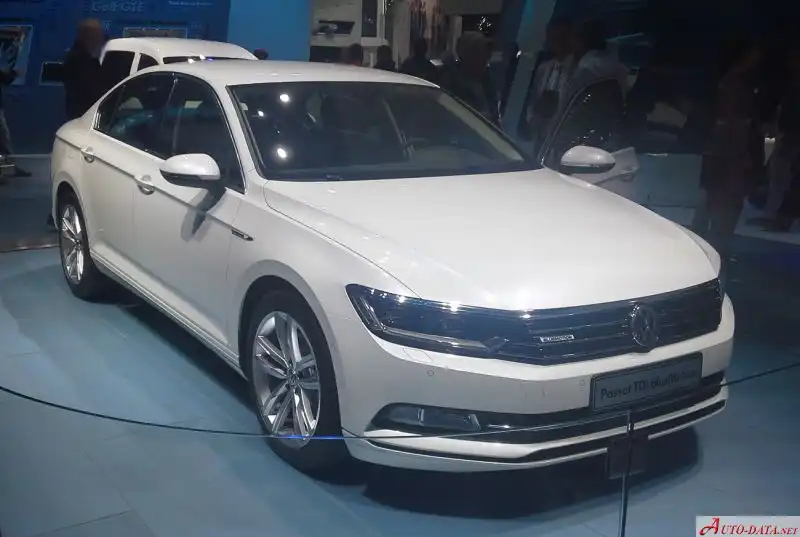
The Volkswagen Passat B8 2.0 TDI (150 hp) DSG represents a significant iteration of Volkswagen’s mid-size sedan, produced from 2014 to 2019. Positioned as a popular choice within the European market, and increasingly seen in North America as a diesel alternative, this variant offered a blend of fuel efficiency, comfortable ride quality, and practical space. It was a core model within the B8 generation, built on the Modular Transverse Matrix (MQB) platform, shared with other Volkswagen Group vehicles like the Audi A3 and Skoda Octavia. This particular configuration – the 2.0-liter TDI engine paired with the dual-clutch DSG transmission – aimed to provide a refined driving experience for those prioritizing economy and ease of use.
Technical Specifications
| Brand | Volkswagen |
| Model | Passat |
| Generation | Passat (B8) |
| Type (Engine) | 2.0 TDI (150 Hp) DSG |
| Start of production | 2014 |
| End of production | 2019 |
| Powertrain Architecture | Internal Combustion engine |
| Body type | Sedan |
| Seats | 5 |
| Doors | 4 |
| Fuel consumption (urban) | 5.2-5.3 l/100 km (45.2 – 44.4 US mpg) |
| Fuel consumption (extra urban) | 4.0-4.1 l/100 km (58.8 – 57.4 US mpg) |
| Fuel consumption (combined) | 4.4-4.5 l/100 km (53.5 – 52.3 US mpg) |
| CO2 emissions | 116-119 g/km |
| Fuel Type | Diesel |
| Acceleration 0 – 100 km/h | 8.7 sec |
| Acceleration 0 – 62 mph | 8.7 sec |
| Acceleration 0 – 60 mph | 8.3 sec |
| Maximum speed | 218 km/h (135.46 mph) |
| Emission standard | Euro 6 |
| Weight-to-power ratio | 10 kg/Hp |
| Weight-to-torque ratio | 4.4 kg/Nm |
| Power | 150 Hp @ 3500-4000 rpm |
| Torque | 340 Nm @ 1750-3000 rpm (250.77 lb.-ft.) |
| Engine layout | Front, Transverse |
| Engine Model/Code | CRLB, DBGA, DCYA, DFEA, DFGA |
| Engine displacement | 1968 cm3 (120.09 cu. in.) |
| Number of cylinders | 4 |
| Engine configuration | Inline |
| Number of valves per cylinder | 4 |
| Fuel injection system | Diesel Commonrail |
| Engine aspiration | Turbocharger, Intercooler |
| Engine oil capacity | 4.7 l (4.97 US qt | 4.14 UK qt) |
| Kerb Weight | 1501 kg (3309.14 lbs.) |
| Max. weight | 2040 kg (4497.43 lbs.) |
| Max load | 539 kg (1188.29 lbs.) |
| Trunk (boot) space – minimum | 586 l (20.69 cu. ft.) |
| Trunk (boot) space – maximum | 1152 l (40.68 cu. ft.) |
| Fuel tank capacity | 66 l (17.44 US gal | 14.52 UK gal) |
| Length | 4767 mm (187.68 in.) |
| Width | 1832 mm (72.13 in.) |
| Height | 1456 mm (57.32 in.) |
| Wheelbase | 2791 mm (109.88 in.) |
| Front track | 1584 mm (62.36 in.) |
| Rear (Back) track | 1568 mm (61.73 in.) |
| Minimum turning circle | 11.7 m (38.39 ft.) |
| Drivetrain Architecture | Front wheel drive |
| Number of gears | 6 |
| Type of gearbox | automatic transmission DSG |
| Front brakes | Ventilated discs |
| Assisting systems | ABS (Anti-lock braking system) |
| Steering type | Steering rack and pinion |
| Tires size | 215/60 R16; 215/55 R17 |
| Wheel rims size | 6.5J x 16; 7.0J x 17 |
Powertrain & Engine Architecture
At the heart of the Passat B8 2.0 TDI (150 hp) DSG lies the Volkswagen Group’s EA288 series of diesel engines. The specific engine codes used for this output level included CRLB, DBGA, DCYA, DFEA, and DFGA, depending on the year and market. This is a common rail, direct injection diesel engine featuring a turbocharger with an intercooler. The common rail system, operating at extremely high pressures, allows for precise fuel metering and optimized combustion. The engine utilizes a four-valve-per-cylinder configuration and a single overhead camshaft. The 150 hp variant was typically tuned for efficiency rather than outright performance, prioritizing fuel economy and reduced emissions. The DSG (Direct-Shift Gearbox) is a seven-speed dual-clutch transmission. It offers quicker and smoother gear changes compared to a traditional automatic, contributing to both performance and fuel efficiency. The DSG operates by pre-selecting the next gear, allowing for near-instantaneous shifts when commanded.
Driving Characteristics
The 2.0 TDI (150 hp) DSG Passat offered a comfortable and refined driving experience. While not a sports sedan, the engine provided adequate power for everyday driving and highway cruising. The DSG transmission contributed to responsive acceleration, particularly during overtaking maneuvers. The peak torque of 340 Nm (250.77 lb-ft) available from 1750-3000 rpm meant that the engine felt strong and flexible in most situations. Compared to the more powerful 2.0 TDI variants (e.g., 184 hp or 240 hp), this version felt less urgent in its acceleration. However, it also offered superior fuel economy. The DSG transmission’s gear ratios were optimized for both fuel efficiency and performance, with taller gears for highway cruising and shorter gears for quicker acceleration. Compared to a manual transmission, the DSG offered convenience and ease of use, particularly in urban traffic.
Equipment & Trim Levels
The 2.0 TDI (150 hp) DSG typically occupied a mid-range position in the Passat B8 lineup. Standard equipment often included air conditioning, a touchscreen infotainment system, alloy wheels, and a suite of safety features such as ABS, ESP, and multiple airbags. Higher trim levels added features like leather upholstery, a sunroof, navigation system, and advanced driver-assistance systems (ADAS) such as adaptive cruise control and lane-keeping assist. Interior upholstery was typically cloth on the base models, with leather options available on higher trims. Dashboard configurations were generally consistent across the range, with a focus on ergonomics and user-friendliness.
Chassis & Braking
The Passat B8 featured a MacPherson strut front suspension and a multi-link rear suspension. This setup provided a good balance between ride comfort and handling. The suspension was tuned for comfort, absorbing bumps and imperfections in the road effectively. Braking systems varied depending on the trim level. Base models typically featured ventilated disc brakes at the front and drum brakes at the rear. Higher trims often included ventilated disc brakes on all four wheels. ABS (Anti-lock Braking System) and ESP (Electronic Stability Program) were standard features, enhancing safety and stability.
Market Reception & Comparison
The Passat B8 2.0 TDI (150 hp) DSG was well-received by critics for its fuel efficiency, comfortable ride, and spacious interior. It was often praised as a practical and sensible choice for families and commuters. Compared to the higher-output TDI variants, this version offered a more affordable price point and better fuel economy. However, it lacked the same level of performance. Compared to gasoline-powered Passats, the TDI offered significantly better fuel economy, but diesel engines were often subject to higher taxes and stricter emissions regulations in some markets. Reliability was generally good, although some owners reported issues with the DSG transmission and the diesel particulate filter (DPF).
Legacy
The Volkswagen Passat B8 2.0 TDI (150 hp) DSG remains a popular choice in the used car market. Its combination of fuel efficiency, practicality, and comfort continues to appeal to buyers. The EA288 engine, while subject to some scrutiny regarding emissions, has proven to be relatively durable when properly maintained. The DSG transmission, while potentially requiring more frequent servicing than a traditional automatic, offers a smooth and responsive driving experience. However, potential buyers should be aware of the potential for DPF issues and the importance of regular maintenance to ensure long-term reliability.