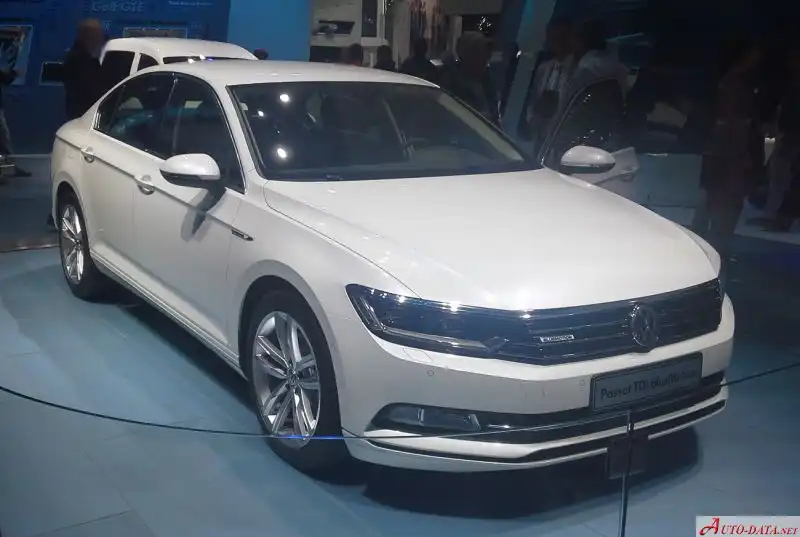
The Volkswagen Passat B8 2.0 TDI (190 hp) represents a significant iteration of Volkswagen’s mid-size sedan, produced from 2014 to 2019. Positioned as a premium offering within the B8 generation (which spanned 2014-2023), this variant aimed to balance fuel efficiency with respectable performance, catering to European drivers seeking a comfortable and capable long-distance cruiser. It was a key model in Volkswagen’s lineup, competing with rivals like the Ford Mondeo, Opel Insignia, and BMW 3 Series. The B8 Passat marked a shift towards a more sophisticated design and increased use of technology compared to its predecessor.
Technical Specifications
| Brand | Volkswagen |
| Model | Passat |
| Generation | Passat (B8) |
| Type (Engine) | 2.0 TDI (190 Hp) |
| Start of production | 2014 |
| End of production | 2019 |
| Powertrain Architecture | Internal Combustion engine |
| Body type | Sedan |
| Seats | 5 |
| Doors | 4 |
| Fuel consumption (urban) | 4.9 l/100 km (48 US mpg, 57.6 UK mpg, 20.4 km/l) |
| Fuel consumption (extra urban) | 3.7 – 3.6 l/100 km (63.6 – 65.3 US mpg, 76.3 – 78.5 UK mpg, 27 – 27.8 km/l) |
| Fuel consumption (combined) | 4.1 l/100 km (57.4 US mpg, 68.9 UK mpg, 24.4 km/l) |
| CO2 emissions | 107 – 106 g/km |
| Fuel Type | Diesel |
| Acceleration 0 – 100 km/h | 7.9 sec |
| Acceleration 0 – 62 mph | 7.9 sec |
| Acceleration 0 – 60 mph | 7.5 sec |
| Maximum speed | 237 km/h (147.26 mph) |
| Emission standard | Euro 6 |
| Weight-to-power ratio | 7.9 kg/Hp, 126.2 Hp/tonne |
| Weight-to-torque ratio | 3.8 kg/Nm, 265.8 Nm/tonne |
| Power | 190 Hp @ 3500-4000 rpm |
| Power per litre | 96.5 Hp/l |
| Torque | 400 Nm @ 1750-3000 rpm (295.02 lb.-ft. @ 1750-3000 rpm) |
| Engine layout | Front, Transverse |
| Engine Model/Code | DDAA, DFCA |
| Engine displacement | 1968 cm3 (120.09 cu. in.) |
| Number of cylinders | 4 |
| Engine configuration | Inline |
| Number of valves per cylinder | 4 |
| Fuel injection system | Diesel Commonrail |
| Engine aspiration | Turbocharger, Intercooler |
| Engine oil capacity | 4.7 l (4.97 US qt | 4.14 UK qt) |
| Kerb Weight | 1505 kg (3317.96 lbs.) |
| Max. weight | 2080 kg (4585.62 lbs.) |
| Max load | 575 kg (1267.66 lbs.) |
| Trunk (boot) space – minimum | 586 l (20.69 cu. ft.) |
| Trunk (boot) space – maximum | 1152 l (40.68 cu. ft.) |
| Fuel tank capacity | 66 l (17.44 US gal | 14.52 UK gal) |
| Length | 4767 mm (187.68 in.) |
| Width | 1832 mm (72.13 in.) |
| Height | 1456 mm (57.32 in.) |
| Wheelbase | 2791 mm (109.88 in.) |
| Front track | 1584 mm (62.36 in.) |
| Rear (Back) track | 1568 mm (61.73 in.) |
| Ride height (ground clearance) | 145 mm (5.71 in.) |
| Minimum turning circle | 11.7 m (38.39 ft.) |
| Approach angle | 13.4° |
| Departure angle | 12.3° |
| Drivetrain Architecture | Front wheel drive |
| Number of gears | 6 |
| Type of gearbox | Manual transmission |
| Front brakes | Ventilated discs |
| Rear brakes | Disc |
Powertrain & Engine Architecture
The heart of the Passat 2.0 TDI (190 hp) is the Volkswagen Group’s EA288 series of diesel engines. Specifically, this variant typically utilized the DDAA or DFCA engine codes. These engines are characterized by their common-rail direct injection system, which delivers fuel at extremely high pressure for optimized combustion. The 2.0-liter inline-four cylinder engine features a turbocharger with an intercooler, boosting power output to 190 horsepower and 400 Nm (295 lb-ft) of torque. The engine employs four valves per cylinder and a sophisticated variable geometry turbocharger (VGT) to enhance responsiveness across the rev range. The six-speed manual transmission was standard, providing a balance between fuel economy and driver engagement. The engine also incorporated a diesel particulate filter (DPF) to meet stringent Euro 6 emissions standards.
Driving Characteristics
The 2.0 TDI (190 hp) Passat offered a refined driving experience. The engine delivered strong low-end torque, making it well-suited for everyday driving and overtaking maneuvers. Acceleration from 0 to 60 mph took approximately 7.5-7.9 seconds, placing it firmly in the performance bracket for its class. The six-speed manual transmission allowed for precise control, although the gear ratios were tuned more for fuel efficiency than outright acceleration. Compared to lower-powered TDI variants (like the 105 hp or 150 hp versions), the 190 hp model provided a noticeably more spirited driving experience. However, it didn’t quite match the responsiveness of the petrol-powered TSI engines available in the Passat lineup. The front-wheel-drive configuration provided predictable handling, but could exhibit some torque steer under hard acceleration.
Equipment & Trim Levels
The 2.0 TDI (190 hp) Passat typically occupied a mid-to-high trim level within the B8 range. Standard equipment often included alloy wheels, automatic climate control, a touchscreen infotainment system with Bluetooth connectivity, and a suite of safety features such as ABS, ESP, and multiple airbags. Higher trim levels added features like leather upholstery, a premium sound system, parking sensors, and adaptive cruise control. Optional extras included a panoramic sunroof, navigation system, and various driver assistance systems. Interior upholstery was generally cloth on lower trims, upgrading to leather or Alcantara on higher-spec models. The dashboard layout was clean and modern, with a focus on ergonomics and ease of use.
Chassis & Braking
The B8 Passat utilized a MacPherson strut front suspension and a multi-link rear suspension, providing a comfortable and controlled ride. The suspension was tuned to prioritize comfort, but still offered decent handling characteristics. Braking duties were handled by ventilated discs at the front and solid discs at the rear. ABS (Anti-lock Braking System) and ESP (Electronic Stability Program) were standard features, enhancing safety and stability. Stabilizer bars were fitted to both the front and rear axles to reduce body roll during cornering. The chassis was designed to minimize noise, vibration, and harshness (NVH), contributing to a refined driving experience.
Market Reception & Comparison
The Passat 2.0 TDI (190 hp) was generally well-received by automotive critics. It was praised for its fuel efficiency, comfortable ride, and spacious interior. However, some reviewers noted that the styling was somewhat conservative compared to rivals. Compared to the lower-powered TDI variants, the 190 hp model offered a significant performance upgrade, justifying the higher price tag for drivers who prioritized driving enjoyment. Against petrol-powered alternatives, the TDI offered superior fuel economy, making it an attractive option for high-mileage drivers. Reliability was generally good, although some owners reported issues with the DPF system, a common concern with modern diesel engines.
Legacy
The Volkswagen Passat B8 2.0 TDI (190 hp) remains a popular choice in the used car market. Its combination of fuel efficiency, comfort, and practicality makes it a compelling option for buyers seeking a well-rounded mid-size sedan. The EA288 engine, while prone to some issues like DPF clogging if not properly maintained, is generally considered robust and reliable. Regular servicing and the use of high-quality diesel fuel are essential to ensure long-term reliability. The B8 Passat represents a high point in Volkswagen’s sedan offerings, offering a refined and capable driving experience that continues to appeal to drivers today.