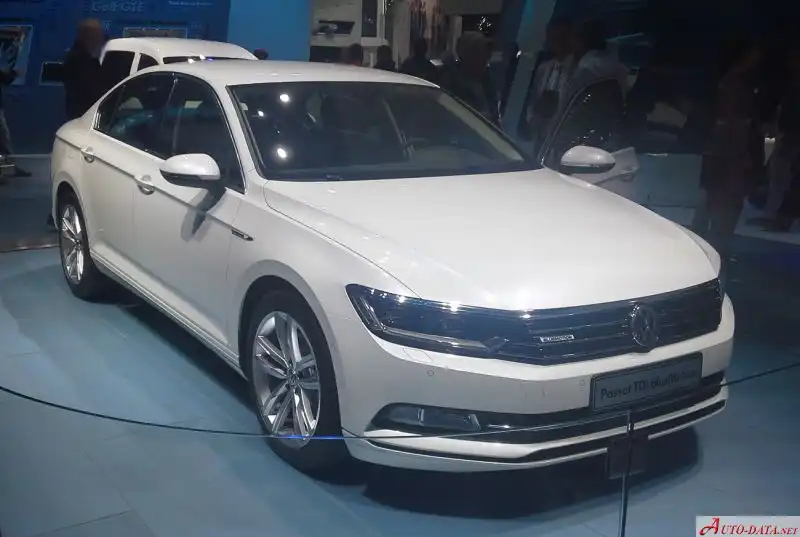
The Volkswagen Passat B8 2.0 TDI (190 hp) DSG represents a significant iteration of Volkswagen’s mid-size sedan, produced from 2014 to 2019. Positioned as a premium offering within the B8 generation, this variant combined a potent turbocharged diesel engine with Volkswagen’s renowned dual-clutch DSG transmission. It was a key model in the European market, where diesel engines remained highly popular due to their fuel efficiency and torque characteristics. The B8 Passat marked a shift for the model, moving to the MQB platform, resulting in weight reduction and improved interior space. This specific 2.0 TDI variant aimed to balance performance, economy, and refinement for discerning buyers.
Technical Specifications
| Brand | Volkswagen |
| Model | Passat |
| Generation | Passat (B8) |
| Type (Engine) | 2.0 TDI (190 Hp) DSG |
| Start of production | 2014 |
| End of production | 2019 |
| Powertrain Architecture | Internal Combustion engine |
| Body type | Sedan |
| Seats | 5 |
| Doors | 4 |
| Fuel consumption (urban) | 5.4 l/100 km (43.6 US mpg, 52.3 UK mpg, 18.5 km/l) |
| Fuel consumption (extra urban) | 4.0-4.1 l/100 km (58.8 – 57.4 US mpg, 70.6 – 68.9 UK mpg, 25 – 24.4 km/l) |
| Fuel consumption (combined) | 4.5-4.6 l/100 km (52.3 – 51.1 US mpg, 62.8 – 61.4 UK mpg, 22.2 – 21.7 km/l) |
| CO2 emissions | 118-119 g/km |
| Fuel Type | Diesel |
| Acceleration 0 – 100 km/h | 7.7 sec |
| Acceleration 0 – 62 mph | 7.7 sec |
| Acceleration 0 – 60 mph | 7.3 sec |
| Maximum speed | 235 km/h (146.02 mph) |
| Emission standard | Euro 6 |
| Weight-to-power ratio | 8.2 kg/Hp, 122.7 Hp/tonne |
| Weight-to-torque ratio | 3.9 kg/Nm, 258.2 Nm/tonne |
| Power | 190 Hp @ 3500-4000 rpm |
| Torque | 400 Nm @ 1750-3000 rpm (295.02 lb.-ft. @ 1750-3000 rpm) |
| Engine layout | Front, Transverse |
| Engine Model/Code | DDAA, DFCA |
| Engine displacement | 1968 cm3 (120.09 cu. in.) |
| Number of cylinders | 4 |
| Engine configuration | Inline |
| Number of valves per cylinder | 4 |
| Fuel injection system | Diesel Commonrail |
| Engine aspiration | Turbocharger, Intercooler |
| Engine oil capacity | 4.7 l (4.97 US qt | 4.14 UK qt) |
| Kerb Weight | 1549 kg (3414.96 lbs.) |
| Max. weight | 2110 kg (4651.75 lbs.) |
| Max load | 561 kg (1236.79 lbs.) |
| Trunk (boot) space – minimum | 586 l (20.69 cu. ft.) |
| Trunk (boot) space – maximum | 1152 l (40.68 cu. ft.) |
| Fuel tank capacity | 66 l (17.44 US gal | 14.52 UK gal) |
| Length | 4767 mm (187.68 in.) |
| Width | 1832 mm (72.13 in.) |
| Height | 1456 mm (57.32 in.) |
| Wheelbase | 2791 mm (109.88 in.) |
| Front track | 1584 mm (62.36 in.) |
| Rear (Back) track | 1568 mm (61.73 in.) |
| Minimum turning circle | 11.7 m (38.39 ft.) |
| Drivetrain Architecture | Front wheel drive |
| Number of gears and type of gearbox | 6 gears, automatic transmission DSG |
| Front brakes | Ventilated discs |
| Assisting systems | ABS (Anti-lock braking system) |
| Steering type | Steering rack and pinion |
| Tires size | 215/60 R16; 215/55 R17 |
| Wheel rims size | 6.5J x 16; 7.0J x 17 |
INTRODUCTION
The Volkswagen Passat B8 2.0 TDI 190 hp DSG, launched in 2014, was a cornerstone of the Passat lineup in Europe and other markets where diesel remained dominant. Built on the modular transverse matrix (MQB) platform, the B8 represented a significant leap forward in terms of weight reduction, interior space, and technology. This particular variant occupied a mid-to-high range position within the B8 Passat offerings, appealing to buyers seeking a blend of performance, fuel efficiency, and comfort. It served as a direct replacement for the previous generation Passat’s 2.0 TDI models, offering increased power and improved refinement.
Powertrain & Engine Architecture
At the heart of the Passat 2.0 TDI 190 DSG lies the Volkswagen Group’s EA288 series of diesel engines. The engine codes DDAA and DFCA were commonly used for this output. This 1968cc inline-four cylinder engine featured common rail direct injection, a turbocharger with an intercooler, and four valves per cylinder. The common rail system, operating at extremely high pressures, allowed for precise fuel metering and optimized combustion. The turbocharger provided significant boost, contributing to the engine’s 190 horsepower output at 3500-4000 rpm and a substantial 400 Nm (295 lb-ft) of torque available from 1750-3000 rpm. The engine also incorporated a diesel particulate filter (DPF) to meet stringent Euro 6 emissions standards. Paired with the engine was the 6-speed DSG (Direct-Shift Gearbox), a dual-clutch transmission known for its rapid shifts and efficiency. The DSG’s programming was tailored to provide smooth operation in everyday driving while offering quick downshifts for overtaking or spirited driving.
Driving Characteristics
The 2.0 TDI 190 hp DSG Passat offered a compelling driving experience. The readily available torque meant strong acceleration from low engine speeds, making it effortless to navigate city traffic or execute highway passing maneuvers. The DSG transmission contributed to this responsiveness, providing near-instantaneous gear changes. While not a sports sedan, the Passat 2.0 TDI offered a composed and stable ride. The DSG’s shift points were generally well-chosen, optimizing for both fuel economy and performance. Compared to the lower-powered 1.6 TDI variants, the 2.0 TDI provided a noticeable increase in performance, feeling significantly more capable when fully loaded or tackling uphill climbs. Compared to the higher-performance petrol variants, the TDI prioritized fuel efficiency and torque over outright horsepower, making it a more practical choice for long-distance driving.
Equipment & Trim Levels
The Passat 2.0 TDI 190 DSG typically came well-equipped, reflecting its mid-to-high range positioning. Standard features often included air conditioning, a touchscreen infotainment system with Bluetooth connectivity, alloy wheels, and a comprehensive suite of safety features such as ABS, ESP, and multiple airbags. Higher trim levels, such as Highline or R-Line, added features like leather upholstery, heated seats, a larger infotainment screen with navigation, adaptive cruise control, and parking sensors. Optional extras included a panoramic sunroof, upgraded sound system, and various driver assistance systems.
Chassis & Braking
The B8 Passat utilized a MacPherson strut front suspension and a multi-link rear suspension, providing a comfortable and controlled ride. The suspension was tuned to balance handling and comfort, offering a good compromise for everyday driving. Braking duties were handled by ventilated disc brakes at the front and typically solid disc brakes at the rear, providing ample stopping power. The electronic stability program (ESP) and anti-lock braking system (ABS) were standard, enhancing safety and control. Stabilizer bars were fitted front and rear to reduce body roll during cornering.
Market Reception & Comparison
The Passat 2.0 TDI 190 DSG was generally well-received by automotive critics. It was praised for its refined engine, comfortable ride, spacious interior, and fuel efficiency. Critics noted that the DSG transmission contributed to a smooth and responsive driving experience. Compared to the lower-powered TDI variants, the 190 hp version offered a significant performance upgrade without sacrificing fuel economy. Compared to petrol-powered Passats, the TDI offered superior fuel economy and torque, making it a popular choice for drivers covering long distances. However, some critics pointed to the higher initial cost of diesel models compared to their petrol counterparts.
Legacy
The Volkswagen Passat B8 2.0 TDI 190 DSG has proven to be a relatively reliable powertrain. The EA288 engine, while subject to some early issues with DPF and EGR systems, has generally proven durable with proper maintenance. The DSG transmission, while requiring occasional servicing, is also known for its longevity. On the used car market, these Passats remain popular due to their blend of practicality, comfort, and fuel efficiency. However, potential buyers should be aware of the potential for DPF issues and ensure that the vehicle has been properly maintained. The B8 Passat, and this variant in particular, represents a high point in Volkswagen’s diesel technology, offering a compelling package for those seeking a refined and efficient mid-size sedan.