
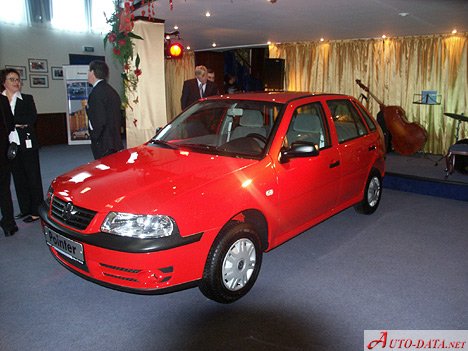
The Volkswagen Pointer 1.8 i (100 Hp): A Pragmatic Performer for Emerging Markets
The Volkswagen Pointer 1.8 i (100 Hp) represents a significant chapter in Volkswagen’s strategy for emerging markets, particularly in Latin America, during the mid-2000s. Produced from 2005 to 2006, this five-door hatchback was a rebadged version of the Volkswagen Gol G3, a highly popular and robust model specifically developed for regions outside of North America and Western Europe. Positioned as a versatile and economical compact car, the Pointer aimed to offer Volkswagen’s renowned build quality and reliability in an accessible package, catering to the needs of families and individual drivers seeking a dependable daily driver.
Unlike its European or North American counterparts like the Golf or Jetta, the Pointer was engineered with the specific demands of its target markets in mind, including varied road conditions and a strong emphasis on affordability and ease of maintenance. The 1.8 i variant, with its 100 horsepower engine, struck a balance between fuel efficiency and adequate performance, making it a competitive offering in the bustling compact segment of countries like Brazil and Mexico.
Engine and Performance: The Heart of the Volkswagen Pointer 1.8 i (100 Hp)
Powering the Volkswagen Pointer 1.8 i (100 Hp) was a robust 1.8-liter (1781 cm³ or 108.68 cu. in.) naturally aspirated inline-four gasoline engine. This powerplant, known for its durability and straightforward design, delivered a respectable 100 horsepower at 5250 rpm. Torque output stood at 118.75 lb.-ft. (161 Nm) available at a relatively low 3000 rpm, providing ample pulling power for city driving and highway cruising. An interesting characteristic for a front-wheel-drive compact of its era, the engine featured a front, longitudinal layout, a design choice that could influence weight distribution and packaging.
The engine’s power was channeled to the front wheels via a standard 5-speed manual transmission, offering drivers direct control over the vehicle’s dynamics and contributing to its economical operation. In terms of performance, the Pointer 1.8 i was capable of accelerating from 0 to 60 mph in a reasonable 10.7 seconds, with a top speed reaching 111.85 mph (180 km/h). These figures placed it competitively within its segment, providing sufficient performance for typical driving scenarios.
Fuel efficiency was a key selling point for the Pointer. The 1.8 i model achieved an urban fuel consumption of 25.6 US mpg (9.2 l/100 km) and an impressive extra-urban economy of 36.8 US mpg (6.4 l/100 km). With a 13.47 US gallon (51 liter) fuel tank, the Pointer offered a decent range between fill-ups, a crucial factor for consumers in markets where fuel costs and long-distance travel were considerations.
Design and Features: Practicality Meets Purpose
The design of the Volkswagen Pointer 1.8 i (100 Hp) was characterized by its functional and unpretentious hatchback form. As a 5-door vehicle with seating for five, it prioritized interior space and cargo versatility, essential attributes for a family car in its primary markets. Its compact dimensions – a length of 154.17 inches (3916 mm), a width of 63.82 inches (1621 mm), and a height of 55.71 inches (1415 mm) – made it agile and easy to maneuver in congested urban environments, while a wheelbase of 97.17 inches (2468 mm) contributed to a stable ride.
Despite its compact exterior, the Pointer offered a practical interior. The trunk space, at 10.06 cu. ft. (285 liters), was adequate for daily errands and small luggage, with the rear seats likely offering a fold-down function to expand cargo capacity. The vehicle’s kerb weight of 2171.55 lbs (985 kg) underscored its lightweight construction, contributing to both its performance and fuel economy.
Underneath, the Pointer featured a straightforward suspension setup: spring struts at the front and coil springs at the rear, a common configuration for compact cars of the era, balancing comfort and cost-effectiveness. Braking duties were handled by front disc brakes and rear drum brakes, a reliable and proven system for its class. For enhanced safety, the Pointer 1.8 i was equipped with an Anti-lock Braking System (ABS), a significant feature for a compact vehicle in 2005, offering improved control during emergency braking situations. Steering was managed by a responsive rack and pinion system, and the car rode on 185/60 R14 tires fitted to 6J x 14-inch wheel rims.
Technical Specifications
| Category | Specification |
|---|---|
| Brand | Volkswagen |
| Model | Pointer |
| Generation | Pointer |
| Type (Engine) | 1.8 i (100 Hp) |
| Start of Production | 2005 year |
| End of Production | 2006 year |
| Powertrain Architecture | Internal Combustion engine |
| Body Type | Hatchback |
| Seats | 5 |
| Doors | 5 |
| Performance Specs | |
| Fuel Consumption (economy) – urban | 25.6 US mpg (9.2 l/100 km) |
| Fuel Consumption (economy) – extra urban | 36.8 US mpg (6.4 l/100 km) |
| Fuel Type | Petrol (Gasoline) |
| Acceleration 0 – 60 mph | 10.7 sec |
| Acceleration 0 – 100 km/h | 11.3 sec |
| Maximum Speed | 111.85 mph (180 km/h) |
| Weight-to-power ratio | 9.9 kg/Hp, 101.5 Hp/tonne |
| Weight-to-torque ratio | 6.1 kg/Nm, 163.5 Nm/tonne |
| Engine Specs | |
| Power | 100 Hp @ 5250 rpm. |
| Power per liter | 56.1 Hp/l |
| Torque | 118.75 lb.-ft. (161 Nm) @ 3000 rpm. |
| Engine Layout | Front, Longitudinal |
| Engine Displacement | 1.8 l (1781 cm³, 108.68 cu. in.) |
| Number of Cylinders | 4 |
| Engine Configuration | Inline |
| Cylinder Bore | 3.19 in. (81 mm) |
| Piston Stroke | 3.4 in. (86.4 mm) |
| Number of Valves per Cylinder | 2 |
| Fuel Injection System | Multi-port manifold injection |
| Engine Aspiration | Naturally aspirated engine |
| Space, Volume and Weights | |
| Kerb Weight | 2171.55 lbs (985 kg) |
| Trunk (boot) space – minimum | 10.06 cu. ft. (285 l) |
| Fuel Tank Capacity | 13.47 US gal (51 l) |
| Dimensions | |
| Length | 154.17 in. (3916 mm) |
| Width | 63.82 in. (1621 mm) |
| Height | 55.71 in. (1415 mm) |
| Wheelbase | 97.17 in. (2468 mm) |
| Front Track | 54.65 in. (1388 mm) |
| Rear (Back) Track | 54.49 in. (1384 mm) |
| Drivetrain, Brakes and Suspension Specs | |
| Drivetrain Architecture | Front-wheel drive with Internal Combustion engine |
| Drive Wheel | Front wheel drive |
| Number of Gears and Type of Gearbox | 5 gears, manual transmission |
| Front Suspension | Spring Strut |
| Rear Suspension | Coil spring |
| Front Brakes | Disc |
| Rear Brakes | Drum |
| Assisting Systems | ABS (Anti-lock braking system) |
| Steering Type | Steering rack and pinion |
| Tires Size | 185/60 R14 |
| Wheel Rims Size | 6J x 14 |
Legacy and Market Impact
The Volkswagen Pointer, specifically the Volkswagen Pointer 1.8 i (100 Hp) model, carved out a significant niche in the Latin American automotive landscape during its production run. Its reputation was built on Volkswagen’s strong brand image for reliability and robust engineering, characteristics highly valued in markets where vehicles often face demanding conditions. The Pointer was widely regarded as a practical, economical, and durable choice for consumers seeking dependable transportation without unnecessary frills.
In its primary markets, the Pointer faced stiff competition from other locally produced or adapted compact models, including the Chevrolet Corsa, Fiat Palio, Ford Fiesta, and Renault Clio. What set the Pointer apart was its strong association with the Volkswagen Gol, a perennial best-seller in Brazil and other countries, which instilled confidence in its mechanical integrity and widespread availability of parts and service.
The historical significance of the Pointer lies in its role as part of Volkswagen’s broader strategy to offer tailored products for specific global regions. While not a technological pioneer, its enduring appeal stemmed from its honest approach to basic mobility. It was a car designed to perform its duties reliably, efficiently, and affordably, reflecting the pragmatic needs of its target demographic. The Pointer contributed to Volkswagen’s continued dominance in the compact segment in Latin America, solidifying the brand’s position as a leader in providing accessible and dependable vehicles for a wide range of consumers. Its legacy is that of a workhorse, a testament to Volkswagen’s ability to adapt its core values of quality and engineering to diverse global markets.
