Introduction to the Volkswagen Polo I (86) 1.3 (60 Hp)
The Volkswagen Polo I (86) 1.3 (60 Hp) represents a significant chapter in Volkswagen’s storied history, marking the brand’s successful foray into the burgeoning supermini segment. Introduced in 1975, the first-generation Polo, internally designated Type 86, was a direct response to the growing demand for smaller, more economical, and practical vehicles in the European market. Positioned beneath the hugely successful Golf, the Polo quickly established itself as a compact and affordable option, embodying the spirit of accessible motoring that Volkswagen had championed for decades with the Beetle. This specific variant, featuring a 1.3-liter engine producing 60 horsepower, was available from 1977 to 1981, offering a compelling blend of performance and fuel efficiency for its era.
The Polo I was not merely a scaled-down version of its larger siblings; it was a thoughtfully engineered car designed from the ground up to meet the specific needs of urban and suburban drivers. Its front-wheel-drive layout, water-cooled engine, and hatchback body style were hallmarks of Volkswagen’s modern design philosophy, moving away from the rear-engined, air-cooled architecture that had defined the company for so long. The 1.3-liter engine, while modest by today’s standards, provided respectable performance for a vehicle of its size and weight, making it a popular choice among first-time car buyers, small families, and those seeking an efficient daily driver. Its enduring appeal in its primary European market underscores its robust construction and practical design, cementing its place as a classic example of late 1970s automotive engineering.
Engine and Performance: The Heart of the Volkswagen Polo I (86)
At the core of the Volkswagen Polo I (86) 1.3 (60 Hp) lay a transversely mounted, front-wheel-drive internal combustion engine. This powertrain architecture was a relatively modern approach for Volkswagen, building on the success of the Golf and Scirocco. The engine itself was an inline-four cylinder unit, designated by the code HH, featuring a displacement of 1272 cubic centimeters (77.62 cubic inches). With a bore of 75 mm (2.95 inches) and a piston stroke of 72 mm (2.83 inches), it was designed for a good balance of low-end torque and high-revving power, characteristic of smaller European engines.
This naturally aspirated engine delivered a peak output of 60 horsepower at 5600 revolutions per minute, a commendable figure for a compact car in the late 1970s. Its torque output stood at 95 Newton-meters (70.07 lb.-ft.) available at a relatively low 3400 rpm, ensuring decent pulling power for city driving and moderate highway speeds. The fuel delivery system, specified as single-point injection, was a somewhat advanced feature for a mainstream economy car of this vintage, although it would become more common in the subsequent decade. With a compression ratio of 8.2:1 and two valves per cylinder, the engine prioritized reliability and efficiency.
Power was transmitted to the front wheels via a robust 4-speed manual transmission, a common setup for economy cars of the era. This combination allowed the Polo I 1.3 (60 Hp) to achieve a 0-60 mph acceleration time of 12.3 seconds, with a top speed of 94.45 mph (152 km/h). While not a performance car, these figures were perfectly adequate for the traffic conditions and speed limits prevalent in Europe at the time. Fuel economy was a strong suit, with a combined rating of 28.3 US miles per gallon (8.3 liters per 100 km), making it an economical choice during a period of increasing fuel costs. The engine’s modest 3-liter oil capacity and 4-liter coolant capacity further underscored its straightforward and cost-effective maintenance profile.
Design and Features: Practicality in a Compact Package
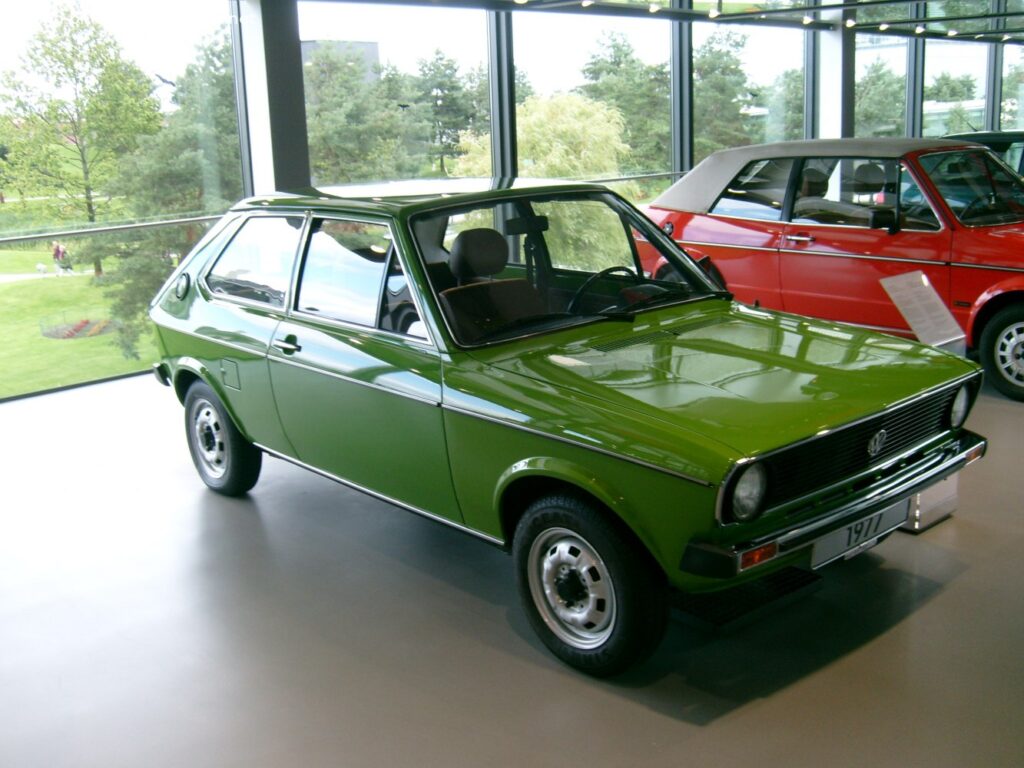
The design of the Volkswagen Polo I (86) 1.3 (60 Hp) was a testament to functional minimalism, reflecting the prevailing automotive design trends of the late 1970s. As a 3-door hatchback, it offered a practical and versatile body style that was rapidly gaining popularity over traditional sedans. The hatchback configuration provided easy access to the cargo area and the flexibility to expand luggage space by folding down the rear seats. With a minimum trunk volume of 10.06 cubic feet (285 liters) and a maximum of 31.78 cubic feet (900 liters), the Polo offered impressive utility for its compact exterior dimensions.
Measuring 137.8 inches (3500 mm) in length, 61.38 inches (1559 mm) in width, and 52.91 inches (1344 mm) in height, the Polo I was undeniably small, a characteristic that made it incredibly agile and easy to maneuver in congested urban environments. Its tight turning circle of 31.5 feet (9.6 meters) further enhanced its city-friendly nature. The car’s relatively low curb weight of 1510.17 pounds (685 kg) contributed to both its sprightly performance and its fuel efficiency. The design was clean and unadorned, featuring simple lines, large glass areas for good visibility, and a relatively upright stance. The drag coefficient (Cd) of 0.39 was typical for a vehicle of its era and class, indicating a design that balanced aesthetics with basic aerodynamic considerations.
Inside, the Polo I offered seating for five, though it was more comfortable for four adults on longer journeys. The interior focused on durability and straightforward functionality, typical of Volkswagen. Features were basic by modern standards, prioritizing essentials over luxuries. Owners could expect manual windows, a simple heating and ventilation system, and a clear, uncluttered instrument panel displaying vital information. Safety features were rudimentary compared to contemporary vehicles, consisting primarily of seatbelts and the inherent structural integrity of the vehicle. Despite its simplicity, the Polo’s interior was well-built and designed to withstand the rigors of daily use, contributing to its reputation for reliability and longevity.
Technical Specifications
| Category | Specification | Value |
|---|---|---|
| Brand | Volkswagen | |
| Model | Polo | |
| Generation | Polo I (86) | |
| Type (Engine) | 1.3 (60 Hp) | |
| Start of Production | 1977 year | |
| End of Production | 1981 year | |
| Powertrain Architecture | Internal Combustion engine | |
| Body Type | Hatchback | |
| Seats | 5 | |
| Doors | 3 | |
| Performance Specs | ||
| Fuel Consumption (Combined) | 8.3 l/100 km (28.3 US mpg) | |
| Fuel Type | Petrol (Gasoline) | |
| Acceleration 0-60 mph | 12.3 sec | |
| Maximum Speed | 94.45 mph (152 km/h) | |
| Weight-to-Power Ratio | 11.4 kg/Hp (87.6 Hp/tonne) | |
| Weight-to-Torque Ratio | 7.2 kg/Nm (138.7 Nm/tonne) | |
| Engine Specs | ||
| Power | 60 Hp @ 5600 rpm | |
| Power per Liter | 47.2 Hp/l | |
| Torque | 70.07 lb.-ft. @ 3400 rpm (95 Nm) | |
| Engine Layout | Front, Transverse | |
| Engine Model/Code | HH | |
| Engine Displacement | 1272 cm³ (77.62 cu. in.) | |
| Number of Cylinders | 4 | |
| Engine Configuration | Inline | |
| Cylinder Bore | 2.95 in. (75 mm) | |
| Piston Stroke | 2.83 in. (72 mm) | |
| Compression Ratio | 8.2:1 | |
| Number of Valves per Cylinder | 2 | |
| Fuel Injection System | Single-point injection | |
| Engine Aspiration | Naturally aspirated engine | |
| Engine Oil Capacity | 3.17 US qt (3 l) | |
| Coolant Capacity | 4.23 US qt (4 l) | |
| Space, Volume and Weights | ||
| Kerb Weight | 1510.17 lbs. (685 kg) | |
| Max. Weight | 2425.08 lbs. (1100 kg) | |
| Max Load | 914.92 lbs. (415 kg) | |
| Trunk (boot) Space – Minimum | 10.06 cu. ft. (285 l) | |
| Trunk (boot) Space – Maximum | 31.78 cu. ft. (900 l) | |
| Fuel Tank Capacity | 9.51 US gal (36 l) | |
| Dimensions | ||
| Length | 137.8 in. (3500 mm) | |
| Width | 61.38 in. (1559 mm) | |
| Height | 52.91 in. (1344 mm) | |
| Wheelbase | 91.73 in. (2330 mm) | |
| Front Track | 51.02 in. (1296 mm) | |
| Rear (Back) Track | 51.02 in. (1296 mm) | |
| Drag Coefficient (Cd) | 0.39 | |
| Minimum Turning Circle | 31.5 ft. (9.6 m) | |
| Drivetrain, Brakes and Suspension Specs | ||
| Drivetrain Architecture | The Internal combustion engine (ICE) drives the front wheels of the vehicle. | |
| Drive Wheel | Front wheel drive | |
| Number of Gears and Type of Gearbox | 4 gears, manual transmission | |
Legacy and Market Impact of the Volkswagen Polo I (86)
The Volkswagen Polo I (86) carved out a significant niche for itself in the European automotive landscape, becoming a foundational model for Volkswagen’s future success in the compact car segment. Its introduction represented a crucial strategic move for the German automaker, allowing it to compete effectively against a growing wave of popular superminis. Before the Polo, Volkswagen’s smallest offering was the Beetle, a car whose design was becoming increasingly dated by the mid-1970s. The Polo, alongside the Golf, solidified Volkswagen’s modern, front-wheel-drive, water-cooled identity.
In its primary markets, particularly West Germany, the UK, France, and Italy, the Polo was highly regarded for its robust build quality, reliable mechanics, and economical operation. These attributes were especially appealing during a decade marked by energy crises and a demand for more sensible transportation. The 1.3 (60 Hp) variant, in particular, offered a sweet spot in the lineup, providing a good balance of power for varied driving conditions without compromising on fuel efficiency. Its direct competitors included well-established models like the Ford Fiesta Mk1, the Renault 5, and the Fiat 127, all vying for dominance in the fiercely contested supermini category. The Polo distinguished itself with its more refined driving dynamics and a perception of superior engineering quality, hallmarks that would become synonymous with the Volkswagen brand.
The Polo I’s impact extended beyond just sales figures; it helped democratize modern automotive technology, making features like front-wheel drive and efficient hatchback packaging accessible to a broader audience. Its design, while unassuming, was timeless enough to age gracefully, and many examples remained on European roads for decades, a testament to their durability. This first generation laid the groundwork for the Polo to evolve into one of Volkswagen’s most enduring and successful model lines, consistently ranking among the best-selling cars in Europe. The decisions made in its conception – compact size, practical interior, efficient powertrain – created a blueprint that subsequent generations would refine and expand upon, ensuring the Polo’s continued relevance in a constantly evolving automotive market. Its legacy is one of practicality, reliability, and an understated yet profound influence on the European compact car segment.