Volkswagen Polo II (86C) 1.3 CAT (75 Hp): A European Compact Car Icon
The Volkswagen Polo II (86C) 1.3 CAT (75 Hp) represents a significant chapter in the history of compact automobiles, embodying the German automaker’s commitment to efficiency, practicality, and accessible engineering for the European market. Produced from 1989 to 1994, this specific variant of the second-generation Polo, internally designated 86C, stood out for its inclusion of a catalytic converter (“CAT”) as standard, a progressive move for its time that underscored an early focus on environmental responsibility in the mass-market segment. While never officially sold in the United States, the Polo II (86C) was a ubiquitous sight on European roads, serving as a reliable and economical daily driver for millions, cementing its legacy as a foundational model in the supermini category.
Evolution of the Volkswagen Polo II (86C)
The second-generation Polo, launched in 1981, built upon the success of its predecessor by offering improved space, comfort, and a more modern design. The 86C platform was versatile, spawning several body styles including a hatchback (often referred to as the “breadvan” due to its boxy rear), a coupé, and a sedan (Derby/Classic). The 1989-1994 models, like the 1.3 CAT (75 Hp) variant, represent the later phase of the 86C’s production run, incorporating refinements and technology updates, most notably the widespread adoption of catalytic converters. This particular model, with its 1.3-liter engine, was a popular choice, striking an excellent balance between performance and fuel economy for urban and extra-urban driving conditions prevalent across Europe.
Engine and Performance of the Volkswagen Polo II (86C)
At the heart of the Volkswagen Polo II (86C) 1.3 CAT (75 Hp) was a robust and well-proven 1.3-liter (1275 cm3 or 77.81 cu. in.) inline-four gasoline engine, designated with the code 3F. This naturally aspirated unit featured a Single Overhead Camshaft (SOHC) valvetrain with two valves per cylinder, a common and reliable configuration for mass-market engines of its era. Fuel delivery was managed by a multi-port manifold injection system, which provided more precise fuel metering compared to older carburetor systems, contributing to improved efficiency and lower emissions.
The engine produced a respectable 75 horsepower at 5900 rpm, a healthy output for a compact car of its size and weight. Torque peaked at 73.76 lb.-ft. (100 Nm) at a relatively low 3200 rpm, ensuring decent low-end responsiveness for city driving. Power was transmitted to the front wheels via a smooth-shifting 5-speed manual transmission, a standard setup that offered a good blend of performance and fuel economy on highways. The drivetrain architecture, with the internal combustion engine driving the front wheels, was a hallmark of Volkswagen’s compact car design, optimizing interior space and traction.
Performance figures for the Volkswagen Polo II (86C) 1.3 CAT (75 Hp) were competitive for its class. It could accelerate from 0 to 60 mph in a brisk 11.3 seconds (0-100 km/h in 11.9 seconds), making it capable of keeping up with traffic. The top speed was rated at 106.88 mph (172 km/h), demonstrating its capability for longer journeys on autobahns or motorways. The car’s low curb weight of 1719.61 lbs. (780 kg) contributed significantly to its nimble handling and efficient power-to-weight ratio of 96.2 Hp per tonne (10.4 kg/Hp).
Fuel economy was a strong suit for this Polo variant, reflecting its design as an economical commuter. The combined fuel consumption was rated at 31.8 US mpg (7.4 l/100 km), with extra-urban driving yielding an impressive 43.6 US mpg (5.4 l/100 km). Even in urban conditions, it achieved 28.7 US mpg (8.2 l/100 km). These figures, combined with a 11.1 US gallon (42 liter) fuel tank, provided a practical range for everyday use, which was crucial for its target demographic in Europe.
Design and Features
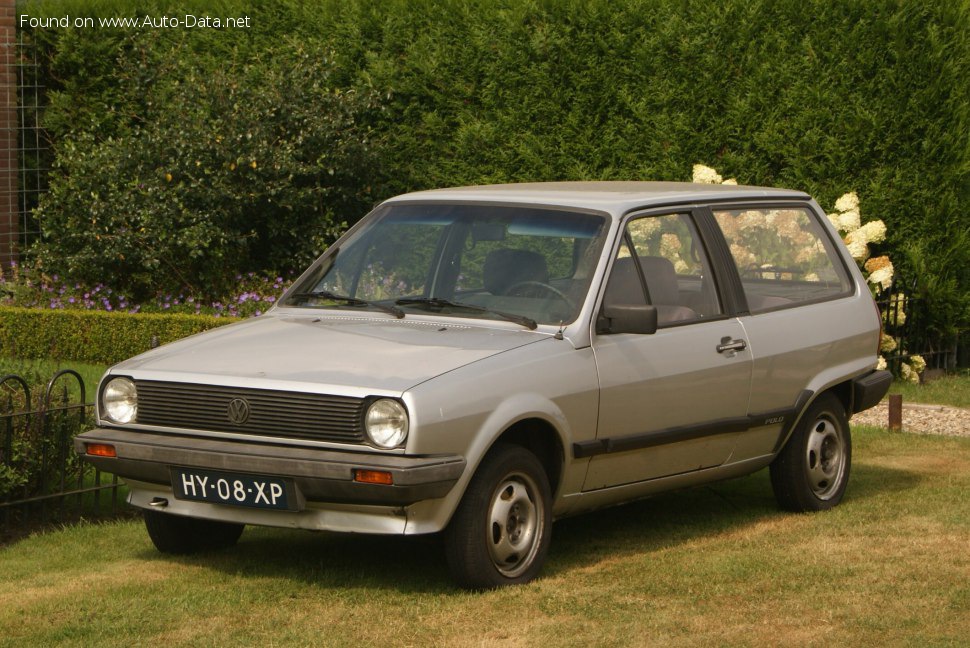
The Volkswagen Polo II (86C) 1.3 CAT (75 Hp) was offered in a practical 3-door hatchback body style, a popular configuration in Europe for its blend of compact dimensions and versatile cargo capacity. The design language of the 86C was distinctly functional and understated, characteristic of Volkswagen’s ethos during that era. Its boxy silhouette maximized interior space within a small footprint, contributing to its reputation as a highly usable urban vehicle.
Measuring 148.23 inches (3765 mm) in length, 61.81 inches (1570 mm) in width, and 53.15 inches (1350 mm) in height, the Polo II (86C) was adept at navigating narrow city streets and fitting into tight parking spaces. Despite its compact exterior, the interior offered seating for five, making it a viable option for small families or groups. The wheelbase of 91.93 inches (2335 mm) provided a stable ride for its class. Cargo capacity was another practical highlight, with a minimum trunk space of 8.48 cu. ft. (240 liters) that could expand significantly to 36.37 cu. ft. (1030 liters) with the rear seats folded, allowing for considerable versatility when hauling groceries or luggage.
Underneath, the Polo featured a straightforward and robust suspension setup, with coil springs at both the front and rear, providing a comfortable yet competent ride. Steering was managed by a reliable rack and pinion system, offering direct feedback and easy maneuverability. Braking duties were handled by disc brakes at the front, offering good stopping power, complemented by drum brakes at the rear, a common and cost-effective solution for compact cars of the period. The car rode on 155/70 R13 tires mounted on 4.5J x 13 wheel rims, a modest size that prioritized ride comfort and fuel efficiency over aggressive handling.
Technical Specifications
| Volkswagen Polo II (86C) 1.3 CAT (75 Hp) – Technical Specifications | |
|---|---|
| General Information | |
| Brand | Volkswagen |
| Model | Polo |
| Generation | Polo II (86C) |
| Type (Engine) | 1.3 CAT (75 Hp) |
| Production Start | 1989 |
| Production End | 1994 |
| Powertrain Architecture | Internal Combustion Engine |
| Body Type | Hatchback |
| Seats | 5 |
| Doors | 3 |
| Performance Specifications | |
| Fuel Consumption (Urban) | 8.2 l/100 km (28.7 US mpg) |
| Fuel Consumption (Extra Urban) | 5.4 l/100 km (43.6 US mpg) |
| Fuel Consumption (Combined) | 7.4 l/100 km (31.8 US mpg) |
| Fuel Type | Petrol (Gasoline) |
| Acceleration 0-60 mph | 11.3 sec |
| Acceleration 0-100 km/h | 11.9 sec |
| Maximum Speed | 106.88 mph (172 km/h) |
| Weight-to-Power Ratio | 10.4 kg/Hp (96.2 Hp/tonne) |
| Weight-to-Torque Ratio | 7.8 kg/Nm (128.2 Nm/tonne) |
| Engine Specifications | |
| Power | 75 Hp @ 5900 rpm |
| Power per Liter | 58.8 Hp/l |
| Torque | 73.76 lb.-ft. @ 3200 rpm (100 Nm @ 3200 rpm) |
| Engine Layout | Front, Transverse |
| Engine Model/Code | 3F |
| Engine Displacement | 1275 cm3 (77.81 cu. in.) |
| Number of Cylinders | 4 |
| Engine Configuration | Inline |
| Cylinder Bore | 2.95 in. (75 mm) |
| Piston Stroke | 2.83 in. (72 mm) |
| Compression Ratio | 10:1 |
| Valves per Cylinder | 2 |
| Fuel Injection System | Multi-port manifold injection |
| Engine Aspiration | Naturally aspirated |
| Valvetrain | SOHC |
| Engine Oil Capacity | 3.7 US qt (3.5 l) |
| Coolant Capacity | 5.92 US qt (5.6 l) |
| Space, Volume and Weights | |
| Kerb Weight | 1719.61 lbs. (780 kg) |
| Max. Weight | 2711.69 lbs. (1230 kg) |
| Max Load | 992.08 lbs. (450 kg) |
| Trunk (Boot) Space – Minimum | 8.48 cu. ft. (240 l) |
| Trunk (Boot) Space – Maximum | 36.37 cu. ft. (1030 l) |
| Fuel Tank Capacity | 11.1 US gal (42 l) |
| Dimensions | |
| Length | 148.23 in. (3765 mm) |
| Width | 61.81 in. (1570 mm) |
| Height | 53.15 in. (1350 mm) |
| Wheelbase | 91.93 in. (2335 mm) |
| Front Track | 51.97 in. (1320 mm) |
| Rear Track | 52.95 in. (1345 mm) |
| Drivetrain, Brakes and Suspension | |
| Drivetrain Architecture | Front-wheel drive, Internal Combustion Engine |
| Drive Wheel | Front-wheel drive |
| Number of Gears | 5 |
| Type of Gearbox | Manual transmission |
| Front Suspension | Coil spring |
| Rear Suspension | Coil spring |
| Front Brakes | Disc |
| Rear Brakes | Drum |
| Steering Type | Steering rack and pinion |
| Tires Size | 155/70 R13 |
| Wheel Rims Size | 4.5J x 13 |
Legacy and Market Impact of the Volkswagen Polo II (86C)
The Volkswagen Polo II (86C), particularly variants like the 1.3 CAT (75 Hp), left an indelible mark on the European automotive landscape. It reinforced Volkswagen’s reputation for building durable, sensible, and economical vehicles that resonated with a broad spectrum of buyers. In its primary markets, the Polo II was seen as a step up from entry-level economy cars but remained more accessible than the larger Golf, effectively carving out a crucial niche for Volkswagen in the competitive supermini segment.
Its main competitors in Europe included other popular compacts such as the Ford Fiesta, Opel Corsa (known as Vauxhall Nova in the UK), Fiat Uno, and the then-new Renault Clio. The Polo II (86C) consistently competed strongly against these rivals by offering a perception of superior build quality, robust engineering, and a more refined driving experience for its class. The introduction of the catalytic converter as standard on models like the 1.3 CAT (75 Hp) also gave it an edge in an increasingly environmentally conscious market, anticipating stricter emissions regulations that would become commonplace in the 1990s.
The legacy of the Polo II (86C) is one of understated success and widespread influence. It was a testament to Volkswagen’s engineering philosophy of creating cars that were not just affordable but also reliable and long-lasting. Many examples of the 86C generation remained on European roads for decades, a testament to their inherent durability and ease of maintenance. For many, it served as a first car or a dependable family vehicle, embodying the practical virtues that Volkswagen championed.
Today, the Polo II (86C) is recognized as a classic example of 1980s and early 1990s European automotive design and engineering. While it may not possess the exotic appeal of high-performance sports cars, its historical significance lies in its role as a workhorse that democratized reliable transportation. It laid much of the groundwork for the subsequent generations of the Polo, which continued to evolve and remain a cornerstone of Volkswagen’s global product lineup. The 1.3 CAT (75 Hp) variant, in particular, stands as a symbol of the era’s transition towards more environmentally responsible automotive technology, blending performance with a forward-thinking approach to emissions control.