Volkswagen Polo III (6N/6KV) 1.4 16V (100 Hp): A European Subcompact Powerhouse
The Volkswagen Polo III, internally designated 6N and 6KV for different body variants, represents a significant evolution for Volkswagen’s popular supermini (subcompact) segment. Launched in 1994 and produced until 2002, the third generation Polo aimed to build upon its predecessors’ success by offering improved refinement, safety, and a more contemporary design. The specific variant under review, the Volkswagen Polo III (6N/6KV) 1.4 16V (100 Hp), introduced in 1996 and produced through 1999, stood out as a particularly spirited option within the lineup. Positioned primarily in the European and other international markets, where compact and fuel-efficient vehicles are highly valued, the Polo 6N quickly became a benchmark for quality and driving dynamics in its class. Unlike its larger sibling, the Golf, the Polo was never officially imported to the United States, cementing its identity as a distinctly European offering tailored to the continent’s urban landscapes and diverse road conditions. This 1.4-liter, 16-valve model, boasting 100 horsepower, represented a sweet spot for buyers seeking a blend of everyday practicality with genuinely engaging performance for its size.
Engine and Performance of the Volkswagen Polo III (6N/6KV) 1.4 16V (100 Hp)
At the heart of this particular Polo variant was a sophisticated 1.4-liter (1390 cm3) inline four-cylinder engine, designated with the code AFH. This powertrain was a notable step up from the more ubiquitous 8-valve units found in many contemporary subcompacts. Featuring a Double Overhead Camshaft (DOHC) valvetrain and four valves per cylinder, it was designed for efficient breathing and higher revving capability. The multi-port manifold injection system ensured precise fuel delivery, contributing to both performance and fuel economy. This naturally aspirated engine produced a robust 100 horsepower at 6000 rpm, a significant output for a vehicle of its size and class in the mid-to-late 1990s. Its power-per-liter ratio of 71.9 horsepower per liter was quite respectable for the era.
Peak torque for the 1.4 16V engine was 94.41 lb.-ft. (128 Nm) delivered at 4400 rpm. This relatively broad torque band, combined with the engine’s willingness to rev, made for a surprisingly agile driving experience. Mated to a precise 5-speed manual transmission, the front-wheel-drive Polo 1.4 16V could accelerate from 0 to 60 mph in a brisk 10 seconds (0-100 km/h in 10.5 seconds). This placed it among the quicker cars in its segment, allowing for confident highway merging and spirited urban driving. The top speed was rated at 116.82 mph (188 km/h), further underscoring its capabilities beyond mere city commuting. With a kerb weight of just 2259.74 lbs. (1025 kg), the car boasted an excellent weight-to-power ratio of 10.3 kg per horsepower, making the most of its 100 HP output.
Design and Features of the Volkswagen Polo III (6N/6KV)
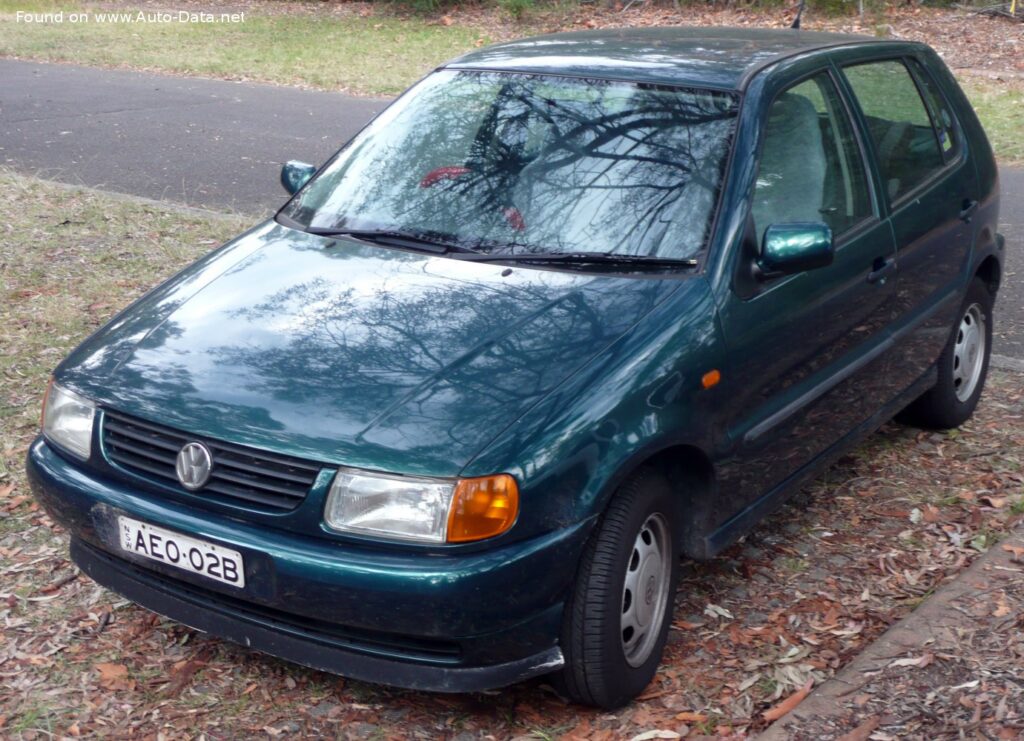
The Volkswagen Polo III (6N/6KV) marked a departure from the more angular styling of its predecessors, adopting a softer, more rounded aesthetic that aligned with Volkswagen’s design language of the mid-1990s, echoing cues from the contemporary Golf and Passat models. The car was offered in both 3-door and 5-door hatchback configurations, providing versatility to cater to different consumer needs. Its compact dimensions – 146.26 inches (3715 mm) in length, 65.16 inches (1655 mm) in width, and 55.91 inches (1420 mm) in height – made it an ideal vehicle for navigating congested European city streets and tight parking spaces, while its 94.49-inch (2400 mm) wheelbase contributed to a stable ride for its class.
Inside, the Polo 6N offered a well-appointed and ergonomically sound cabin, renowned for its build quality and use of durable materials, a hallmark of Volkswagen vehicles. Despite its compact exterior, it comfortably seated five occupants, though the rear seats were naturally best suited for two adults on longer journeys. The trunk space was practical, offering a minimum of 8.65 cu. ft. (245 liters) with the rear seats up, expandable to a generous 34.43 cu. ft. (975 liters) when the rear seats were folded down, enhancing its utility for cargo. Key features for the era included hydraulic power steering, providing good feedback and ease of maneuverability, and an Anti-lock Braking System (ABS) as an assisting system, which was becoming standard on many European models, significantly improving safety under hard braking conditions. The suspension setup, featuring wishbones at both the front and rear, contributed to a balanced ride and handling characteristic, while ventilated discs at the front and disc brakes at the rear provided confident stopping power. The car rode on 185/60 R14 tires with 14-inch wheel rims, a common specification for this segment.
Technical Specifications: Volkswagen Polo III (6N/6KV) 1.4 16V (100 Hp)
| Category | Specification | US Equivalent / Notes |
|---|---|---|
| General Information | ||
| Brand | Volkswagen | |
| Model | Polo | |
| Generation | Polo III (6N/6KV) | |
| Type (Engine) | 1.4 16V (100 Hp) | |
| Start of production | 1996 year | |
| End of production | 1999 year | |
| Powertrain Architecture | Internal Combustion engine | |
| Body type | Hatchback | |
| Seats | 5 | |
| Doors | 3-5 | |
| Performance Specs | ||
| Fuel Type | Petrol (Gasoline) | |
| Acceleration 0 – 60 mph | 10 sec | Calculated by Auto-Data.net |
| Acceleration 0 – 100 km/h | 10.5 sec | |
| Maximum speed | 188 km/h | 116.82 mph |
| Weight-to-power ratio | 10.3 kg/Hp | 97.6 Hp/tonne |
| Weight-to-torque ratio | 8 kg/Nm | 124.9 Nm/tonne |
| Engine Specs | ||
| Power | 100 Hp @ 6000 rpm | |
| Power per liter | 71.9 Hp/l | |
| Torque | 128 Nm @ 4400 rpm | 94.41 lb.-ft. @ 4400 rpm |
| Engine layout | Front, Transverse | |
| Engine Model/Code | AFH | |
| Engine displacement | 1390 cm3 | 84.82 cu. in. |
| Number of cylinders | 4 | |
| Engine configuration | Inline | |
| Cylinder Bore | 76.5 mm | 3.01 in. |
| Piston Stroke | 75.6 mm | 2.98 in. |
| Compression ratio | 10.5:1 | |
| Number of valves per cylinder | 4 | |
| Fuel injection system | Multi-port manifold injection | |
| Engine aspiration | Naturally aspirated engine | |
| Valvetrain | DOHC | |
| Engine oil capacity | 3.2 l | 3.38 US qt |
| Engine oil specification | Information not provided in data. | |
| Coolant | 5.6 l | 5.92 US qt |
| Space, Volume and Weights | ||
| Kerb Weight | 1025 kg | 2259.74 lbs. |
| Max. weight | 1450 kg | 3196.7 lbs. |
| Max load | 425 kg | 936.96 lbs. |
| Trunk (boot) space – minimum | 245 l | 8.65 cu. ft. |
| Trunk (boot) space – maximum | 975 l | 34.43 cu. ft. |
| Fuel tank capacity | 45 l | 11.89 US gal |
| Dimensions | ||
| Length | 3715 mm | 146.26 in. |
| Width | 1655 mm | 65.16 in. |
| Height | 1420 mm | 55.91 in. |
| Wheelbase | 2400 mm | 94.49 in. |
| Front track | 1351 mm | 53.19 in. |
| Rear (Back) track | 1384 mm | 54.49 in. |
| Drivetrain, Brakes and Suspension Specs | ||
| Drivetrain Architecture | The Internal combustion engine (ICE) drives the front wheels of the vehicle. | Front-wheel drive |
| Drive wheel | Front wheel drive | |
| Number of gears and type of gearbox | 5 gears, manual transmission | |
| Front suspension | Wishbone | |
| Rear suspension | Wishbone | |
| Front brakes | Ventilated discs | |
| Rear brakes | Disc | |
| Assisting systems | ABS (Anti-lock braking system) | |
| Steering type | Steering rack and pinion | |
| Power steering | Hydraulic Steering | |
| Tires size | 185/60 R14 | |
| Wheel rims size | 14 | |
Legacy and Market Impact
The Volkswagen Polo III (6N/6KV) was a resounding success for the German automaker, particularly in its primary European market. It solidified the Polo’s reputation as a premium offering in the competitive supermini segment, often referred to as the “baby Golf” due to its similar design philosophy and perceived quality. The 1.4 16V (100 Hp) variant, in particular, was lauded for offering a compelling blend of everyday usability with a surprising level of performance, making it a popular choice for younger drivers or those seeking a more engaging driving experience without stepping up to a larger, more expensive vehicle.
In Europe, the Polo 6N faced stiff competition from a host of well-established rivals. Key competitors included the Ford Fiesta, Opel Corsa (Vauxhall Corsa in the UK), Renault Clio, Peugeot 206, and Fiat Punto. Against these contenders, the Polo distinguished itself with its robust build quality, refined ride, and a perceived higher level of interior finish. While some rivals might have offered more radical styling or slightly lower price points, the Polo’s strength lay in its all-around competence and the strong brand loyalty Volkswagen commanded. Its reputation for reliability and solid engineering contributed to strong resale values, a significant factor for European car buyers.
The historical significance of the Polo III lies in its role in modernizing the supermini class. It brought features and refinement previously associated with larger cars down to a more accessible segment, including advanced engine technologies like DOHC and multi-valve configurations, and crucial safety features like ABS. For markets outside the USA, it continued Volkswagen’s tradition of producing practical, durable, and enjoyable small cars. Its absence from the American market was largely due to differing market preferences, where larger vehicles and different subcompact offerings (like the Golf-based Jetta or specific niche models) were prioritized over the smaller, more European-centric Polo. Nevertheless, the Polo III, especially in its more powerful 1.4 16V guise, remains a significant chapter in Volkswagen’s global history, representing a well-executed and highly influential vehicle that helped define the supermini segment for a generation.