Volkswagen Polo III (6N/6KV) 1.4 (60 Hp): A European Supermini Standard-Bearer
The Volkswagen Polo III, internally designated as the 6N/6KV series, represents a pivotal generation for Volkswagen’s popular supermini lineup. Launched in 1995 and produced until 1999, the Volkswagen Polo III (6N/6KV) was a significant evolution from its predecessor, sharing its platform with the contemporary SEAT Ibiza and Volkswagen Caddy. This generation marked a substantial leap in terms of refinement, safety, and interior space for the Polo, solidifying its position as a highly competitive offering in the fiercely contested European B-segment (supermini) market. While never officially sold in the United States, the Polo III was a ubiquitous sight on European roads, prized for its robust build quality, efficient powertrains, and practical hatchback design, making it a benchmark for small car engineering in its primary markets.
The 1.4-liter variant, specifically the 60 horsepower (Hp) model, was a cornerstone of the Polo III’s engine lineup, offering a sensible balance of fuel economy and adequate performance for urban commuting and short intercity trips. It was engineered to meet the demands of European drivers who valued compact dimensions, low running costs, and Volkswagen’s reputation for durability. Available in both 3-door and 5-door hatchback configurations, the Polo III catered to a wide range of buyers, from young singles to small families, emphasizing versatility and everyday usability.
Engine and Performance of the Volkswagen Polo III (6N/6KV) 1.4 (60 Hp)
At the heart of this particular Volkswagen Polo III model was a naturally aspirated 1.4-liter (1390 cm3, or 84.82 cubic inches) inline-four gasoline engine. Coded as AEX, AKV, or APQ, this powerplant was designed for efficiency and reliability, delivering 60 Hp at a modest 4700 revolutions per minute (rpm). Its power-per-liter figure stood at 43.2 Hp/l, characteristic of naturally aspirated engines of its era. Torque output was equally pragmatic, peaking at 116 Newton-meters (85.56 lb.-ft.) at 3000 rpm, providing sufficient low-end grunt for city driving and minimizing the need for constant gear changes.
The engine featured a multi-port manifold injection system and an Overhead Camshaft (OHC) valvetrain with two valves per cylinder, a common and proven configuration for economy cars of the mid-1990s. With a compression ratio of 10.2:1, it was optimized for regular unleaded gasoline. Power was channeled to the front wheels via a standard 5-speed manual transmission, offering direct engagement and maximizing the engine’s modest output.
In terms of performance, the Volkswagen Polo III (6N/6KV) 1.4 (60 Hp) was not built for speed but for practical mobility. It achieved 0 to 60 miles per hour (mph) in an estimated 14.7 seconds, with 0 to 62 mph (100 km/h) taking 15.5 seconds. The top speed was rated at 102.53 mph (165 km/h). Fuel economy was a strong point for this variant, with a combined rating of 37.3 US mpg (6.3 liters per 100 km), making it an economical choice for daily driving. Urban consumption was 27.7 US mpg (8.5 l/100 km), while extra-urban driving could yield an impressive 47 US mpg (5 l/100 km).
Design and Features
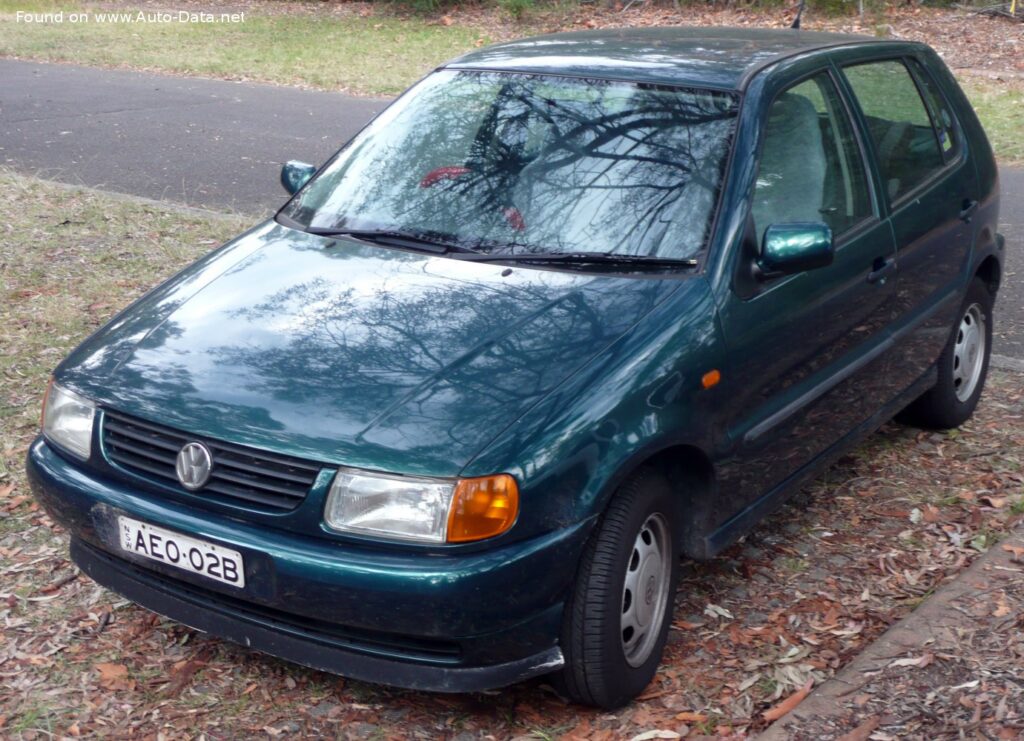
The Volkswagen Polo III (6N/6KV) adopted a more rounded and contemporary design compared to its boxier predecessors, aligning with the evolving aesthetic trends of the mid-1990s. Its hatchback body style was inherently practical, offering versatile cargo space. Customers could choose between a 3-door variant, emphasizing a sportier profile, or a 5-door model, providing easier access for rear passengers, both accommodating five occupants. With a length of 146.26 inches (3715 mm), a width of 65.16 inches (1655 mm), and a height of 55.91 inches (1420 mm), the Polo III remained compact, making it adept at navigating congested urban environments and fitting into tight parking spaces.
Inside, the Polo III offered an interior that was lauded for its quality materials and ergonomic layout, a hallmark of Volkswagen engineering. The trunk space was practical for a car of its size, ranging from 8.65 cubic feet (245 liters) with the rear seats up, expandable to 34.43 cubic feet (975 liters) with the seats folded down. This flexibility was crucial for its target market, allowing for everything from weekly grocery runs to hauling luggage for a weekend getaway.
Key features for the era included power steering (hydraulic), which made maneuvering at low speeds significantly easier. Safety was also a consideration, with the inclusion of an Anti-lock Braking System (ABS) as an available or standard feature, offering improved control during emergency braking. The braking system itself consisted of ventilated discs at the front for effective stopping power and drum brakes at the rear, a common setup for superminis to balance cost and performance. The car rode on 13-inch wheels fitted with 175/70 R13 tires, providing a comfortable ride and predictable handling.
Technical Specifications
| Category | Specification |
|---|---|
| Brand | Volkswagen |
| Model | Polo |
| Generation | Polo III (6N/6KV) |
| Type (Engine) | 1.4 (60 Hp) |
| Production Start | 1995 |
| Production End | 1999 |
| Powertrain Architecture | Internal Combustion Engine, Front-Wheel Drive |
| Body Type | Hatchback |
| Seats | 5 |
| Doors | 3-5 |
| Performance Specs | |
| Fuel Consumption (Urban) | 8.5 l/100 km (27.7 US mpg) |
| Fuel Consumption (Extra Urban) | 5 l/100 km (47 US mpg) |
| Fuel Consumption (Combined) | 6.3 l/100 km (37.3 US mpg) |
| Fuel Type | Petrol (Gasoline) |
| Acceleration 0-60 mph | 14.7 sec |
| Acceleration 0-62 mph (0-100 km/h) | 15.5 sec |
| Maximum Speed | 102.53 mph (165 km/h) |
| Weight-to-Power Ratio | 16.4 kg/Hp (60.9 Hp/tonne) |
| Weight-to-Torque Ratio | 8.5 kg/Nm (117.8 Nm/tonne) |
| Engine Specs | |
| Power | 60 Hp @ 4700 rpm |
| Power per Liter | 43.2 Hp/l |
| Torque | 116 Nm (85.56 lb.-ft.) @ 3000 rpm |
| Engine Layout | Front, Transverse |
| Engine Model/Code | AEX, AKV, APQ |
| Engine Displacement | 1390 cm3 (1.4 liters / 84.82 cu. in.) |
| Number of Cylinders | 4 |
| Engine Configuration | Inline |
| Cylinder Bore | 76.5 mm (3.01 in.) |
| Piston Stroke | 75.6 mm (2.98 in.) |
| Compression Ratio | 10.2:1 |
| Valves per Cylinder | 2 |
| Fuel Injection System | Multi-port manifold injection |
| Engine Aspiration | Naturally aspirated |
| Valvetrain | OHC |
| Engine Oil Capacity | 3.2 liters (3.38 US qt) |
| Coolant Capacity | 5.6 liters (5.92 US qt) |
| Space, Volume and Weights | |
| Curb Weight | 2171.55 lbs. (985 kg) |
| Max. Weight (GVWR) | 3086.47 lbs. (1400 kg) |
| Max Load | 914.92 lbs. (415 kg) |
| Trunk (Boot) Space – Minimum | 8.65 cu. ft. (245 liters) |
| Trunk (Boot) Space – Maximum | 34.43 cu. ft. (975 liters) |
| Fuel Tank Capacity | 11.89 US gal (45 liters) |
| Dimensions | |
| Length | 146.26 in. (3715 mm) |
| Width | 65.16 in. (1655 mm) |
| Height | 55.91 in. (1420 mm) |
| Wheelbase | 94.49 in. (2400 mm) |
| Front Track | 53.19 in. (1351 mm) |
| Rear Track | 54.49 in. (1384 mm) |
| Drivetrain, Brakes and Suspension Specs | |
| Drivetrain Architecture | Front-wheel drive |
| Drive Wheel | Front wheel drive |
| Number of Gears / Transmission Type | 5 gears, manual transmission |
| Front Suspension | Wishbone |
| Rear Suspension | Wishbone |
| Front Brakes | Ventilated discs |
| Rear Brakes | Drum |
| Assisting Systems | ABS (Anti-lock braking system) |
| Steering Type | Steering rack and pinion |
| Power Steering | Hydraulic Steering |
| Tires Size | 175/70 R13 |
| Wheel Rims Size | 13 inches |
Legacy and Market Impact
The Volkswagen Polo III (6N/6KV) 1.4 (60 Hp) was a significant contributor to the Polo’s enduring success in Europe. It built upon Volkswagen’s reputation for German engineering, offering a level of refinement, build quality, and perceived durability that often surpassed its direct competitors in the supermini segment. In a market where cost-effectiveness and practicality were paramount, the Polo III managed to inject a sense of premium quality, albeit on a smaller scale.
Its primary competitors included models like the Ford Fiesta, Opel Corsa (Vauxhall Corsa in the UK), Renault Clio, and Peugeot 206 (which arrived later in the Polo III’s production run). While some rivals offered more expressive styling or sportier driving dynamics in their higher-spec variants, the Polo III consistently delivered a balanced package of comfort, efficiency, and solid ergonomics. The 1.4-liter, 60 Hp engine, in particular, was seen as a reliable and economical workhorse, perfectly suited for the daily grind of urban and suburban European life. Its widespread adoption by driving schools and fleets further cemented its image as a dependable and easy-to-drive vehicle.
The Polo III’s impact extended beyond just sales figures; it helped redefine expectations for small cars. Its platform sharing strategy with other Volkswagen Group vehicles (like the SEAT Ibiza) demonstrated intelligent engineering and cost efficiency, allowing Volkswagen to offer advanced features and better refinement in a compact package. The strong resale value and robust build quality of the Polo III further enhanced its market position, making it a popular choice in the used car market for years after its production ceased.
Ultimately, the Volkswagen Polo III (6N/6KV) 1.4 (60 Hp) played a crucial role in maintaining the Polo’s status as one of Europe’s most beloved and successful superminis. It embodied Volkswagen’s philosophy of offering well-engineered, practical, and dependable vehicles, setting a high standard for its class and paving the way for future generations of the Polo to continue its legacy.