The Volkswagen Polo III (6N/6KV): A European Subcompact Stalwart
The Volkswagen Polo III, internally designated as the 6N/6KV, represents a pivotal moment in the evolution of Volkswagen’s popular subcompact (or “supermini” in European parlance) vehicle line. Launched in 1995 and produced until 1999, this generation marked a significant departure from its predecessors, adopting a new platform and a more contemporary design language that resonated strongly with European consumers. While the Polo has never been officially sold in the United States, it has consistently been one of Europe’s best-selling small cars, embodying Volkswagen’s core values of quality, practicality, and solid engineering in a compact package.
The specific variant under review, the 1.6 (75 Hp) model, was positioned as a capable and economical choice within the Polo III lineup. It offered a balanced blend of performance suitable for both urban commuting and longer journeys, coupled with the robust build quality expected from the German automaker. The Polo III (6N/6KV) was instrumental in solidifying Volkswagen’s market share in the highly competitive European subcompact segment, serving as a stepping stone for many drivers into the Volkswagen brand.
Engine & Performance of the Volkswagen Polo III (6N/6KV) 1.6 (75 Hp)
At the heart of the Volkswagen Polo III (6N/6KV) 1.6 (75 Hp) lies a 1.6-liter (1595 cubic centimeters or 97.33 cubic inches) naturally aspirated inline-four gasoline engine, designated with the internal code AEE. This powertrain was a well-proven unit within the Volkswagen Group, known for its reliability and straightforward design. It featured an Overhead Camshaft (OHC) valvetrain with two valves per cylinder, a common and efficient setup for its era, ensuring good low-end torque and reasonable fuel economy.
The engine produced a respectable 75 horsepower at 5200 rpm, which for a vehicle weighing just 2182.58 pounds (kerb weight), provided adequate motivation. Torque output stood at 99.57 lb.-ft. at a relatively low 2800 rpm, contributing to its tractable nature in city traffic and making it feel responsive off the line. Power was delivered to the front wheels via a smooth-shifting 5-speed manual transmission, a standard configuration for efficiency and driver engagement in this segment.
In terms of performance, the Polo III 1.6 (75 Hp) accelerated from 0 to 60 mph in a credible 11.6 seconds, with a top speed of 106.88 mph. While not a performance car, these figures were competitive for its class and perfectly suitable for its intended market. Fuel efficiency was also a strong point, with a combined fuel consumption rating of 35.1 US miles per gallon, making it an economical choice for daily driving. The multi-port manifold injection system ensured precise fuel delivery, optimizing both power and efficiency for the time.
Design & Features: Practicality and European Flair
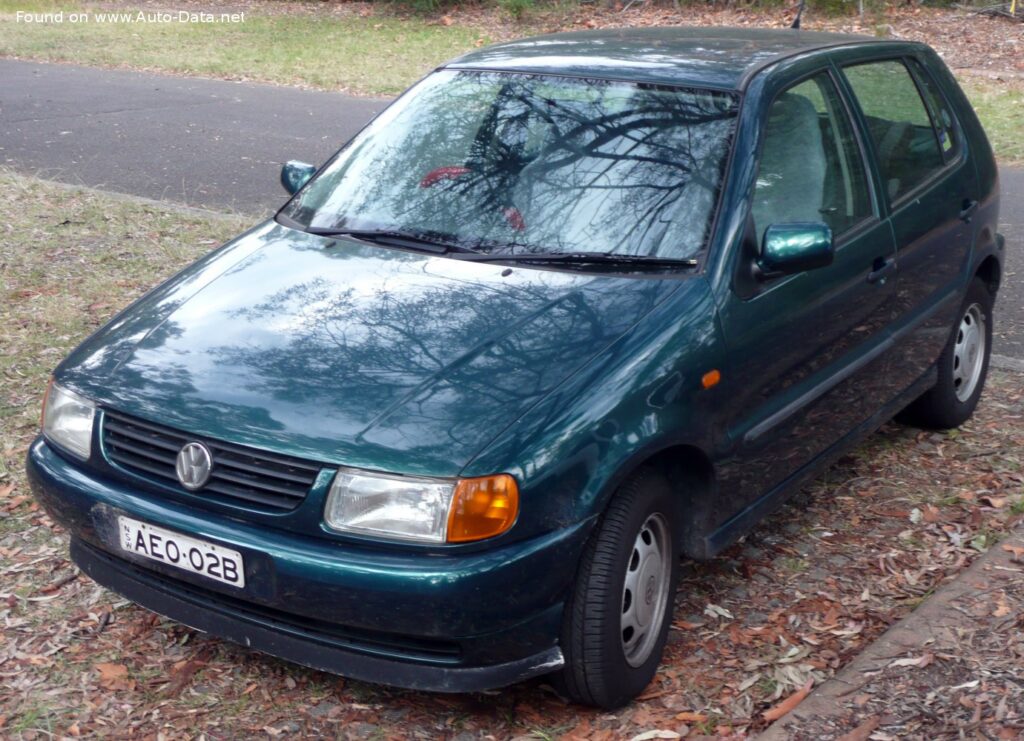
The design of the Volkswagen Polo III (6N/6KV) represented a significant evolutionary step for the model. Moving away from the more angular lines of the second generation, the 6N/6KV adopted a softer, more rounded aesthetic that was characteristic of Volkswagen’s design language in the mid-to-late 1990s. The model was offered in both 3-door and 5-door hatchback configurations, providing versatility to cater to different customer needs, from young singles to small families. The variant discussed here would have been available in either body style, both offering comfortable seating for five occupants.
Dimensions were compact, ideal for navigating narrow European city streets and tight parking spaces: 146.26 inches in length, 65.16 inches in width, and 55.91 inches in height, with a wheelbase of 94.49 inches. Despite its diminutive exterior, the Polo III was praised for its surprisingly spacious interior and practical cargo capacity. The trunk offered a minimum of 8.65 cubic feet of space, expanding to a generous 34.43 cubic feet with the rear seats folded down, showcasing its versatility for hauling groceries or weekend luggage.
Key features for the era included a hydraulic power steering system, making urban maneuvering effortless. The drivetrain employed a front-wheel-drive architecture, typical for compact cars, ensuring predictable handling. Suspension consisted of wishbones at both the front and rear, providing a comfortable ride quality balanced with stable handling. Braking duties were handled by ventilated discs at the front for effective stopping power, complemented by drum brakes at the rear, a common and cost-effective setup for vehicles in this class. The car rode on 13-inch wheels fitted with 175/70 R13 tires, prioritizing comfort and economy.
Technical Specifications
| Specification | Value |
|---|---|
| General Information | |
| Brand | Volkswagen |
| Model | Polo |
| Generation | Polo III (6N/6KV) |
| Type (Engine) | 1.6 (75 Hp) |
| Start of Production | 1995 year |
| End of Production | 1999 year |
| Powertrain Architecture | Internal Combustion Engine |
| Body Type | Hatchback |
| Seats | 5 |
| Doors | 3-5 |
| Performance Specs | |
| Fuel Consumption (Combined) | 35.1 US mpg (6.7 l/100 km) |
| Fuel Type | Petrol (Gasoline) |
| Acceleration 0 – 60 mph | 11.6 seconds |
| Maximum Speed | 106.88 mph (172 km/h) |
| Weight-to-Power Ratio | 13.2 kg/Hp (75.8 Hp/tonne) |
| Weight-to-Torque Ratio | 7.3 kg/Nm (136.4 Nm/tonne) |
| Engine Specs | |
| Power | 75 Hp @ 5200 rpm |
| Power per Liter | 47 Hp/l |
| Torque | 99.57 lb.-ft. @ 2800 rpm (135 Nm) |
| Engine Layout | Front, Transverse |
| Engine Model/Code | AEE |
| Engine Displacement | 1.6 liters (1595 cm3 / 97.33 cu. in.) |
| Number of Cylinders | 4 |
| Engine Configuration | Inline |
| Cylinder Bore | 3.19 in. (81 mm) |
| Piston Stroke | 3.05 in. (77.4 mm) |
| Compression Ratio | 9.8:1 |
| Number of Valves per Cylinder | 2 |
| Fuel Injection System | Multi-port manifold injection |
| Engine Aspiration | Naturally Aspirated |
| Valvetrain | OHC |
| Engine Oil Capacity | 3.7 US qt (3.5 l) |
| Coolant Capacity | 5.81 US qt (5.5 l) |
| Space, Volume and Weights | |
| Kerb Weight | 2182.58 lbs. (990 kg) |
| Max. Weight | 3086.47 lbs. (1400 kg) |
| Max Load | 903.9 lbs. (410 kg) |
| Trunk (Boot) Space – Minimum | 8.65 cu. ft. (245 l) |
| Trunk (Boot) Space – Maximum | 34.43 cu. ft. (975 l) |
| Fuel Tank Capacity | 11.89 US gal (45 l) |
| Dimensions | |
| Length | 146.26 in. (3715 mm) |
| Width | 65.16 in. (1655 mm) |
| Height | 55.91 in. (1420 mm) |
| Wheelbase | 94.49 in. (2400 mm) |
| Front Track | 53.19 in. (1351 mm) |
| Rear (Back) Track | 54.49 in. (1384 mm) |
| Drivetrain, Brakes and Suspension Specs | |
| Drivetrain Architecture | Front-wheel drive (ICE drives front wheels) |
| Drive Wheel | Front-wheel drive |
| Number of Gears and Type of Gearbox | 5 gears, manual transmission |
| Front Suspension | Wishbone |
| Rear Suspension | Wishbone |
| Front Brakes | Ventilated discs |
| Rear Brakes | Drum |
| Steering Type | Steering rack and pinion |
| Power Steering | Hydraulic Steering |
| Tires Size | 175/70 R13 |
| Wheel Rims Size | 13 inches |
Legacy & Market Impact of the Volkswagen Polo III (6N/6KV)
The Volkswagen Polo III (6N/6KV) cemented its legacy as a highly successful and influential model in the European subcompact segment. Its introduction in 1995 marked a significant step forward in terms of design, platform sharing, and overall refinement for the Polo nameplate. This generation was built on the new A03 platform, which it shared with its Spanish cousin, the SEAT Ibiza, demonstrating Volkswagen Group’s growing strategy of platform commonality to achieve economies of scale and improve product development efficiency.
The Polo III quickly earned a reputation for its robust build quality, reliable mechanicals, and mature driving dynamics, characteristics that were not always a given in the subcompact class of the 1990s. Its solid, “hewn from a block” feel gave it a perceived advantage over many of its competitors, which often felt lighter or less substantial. This perception of quality, combined with Volkswagen’s strong brand image in Europe, made it a perennial favorite among buyers seeking a dependable and practical small car.
In its primary markets, the Polo III faced stiff competition from a host of well-established rivals, including the Ford Fiesta, Opel Corsa, Renault Clio, Peugeot 206, and the Fiat Punto. Despite this fierce competition, the Polo consistently performed well in sales, appealing to a broad demographic from first-time drivers to small families needing a second car. Its blend of sensible engineering, ergonomic interior, and efficient powertrains like the 1.6 (75 Hp) variant ensured its enduring popularity.
Beyond its commercial success, the Polo III also played a crucial role in shaping the evolution of the supermini segment. It helped to raise expectations for what a small car could offer in terms of safety, comfort, and refinement. While not groundbreaking in terms of revolutionary technology, its incremental improvements and consistent quality set a high benchmark for its class. The 6N/6KV generation also laid the groundwork for future Polo models, establishing a design and engineering philosophy that would continue to define the car for decades to come. Even today, many examples of the Polo III can still be seen on European roads, a testament to its durability and lasting appeal.