Introduction: The Volkswagen Polo III (6N/6KV) 1.9 SDI (64 Hp)
The Volkswagen Polo III, internally designated as the 6N/6KV, marked a pivotal moment in the evolution of Volkswagen’s popular supermini lineup. Launched in 1994, this third-generation Polo represented a significant step forward in design, refinement, and mechanical sophistication compared to its predecessors. While never officially sold in the United States, the Polo III was a cornerstone of Volkswagen’s European strategy, competing fiercely in the highly competitive subcompact segment. Among its diverse powertrain options, the Volkswagen Polo III (6N/6KV) 1.9 SDI (64 Hp) variant stood out as a testament to robust engineering and exceptional fuel efficiency, particularly favored in markets where diesel fuel was prevalent and economy was a paramount concern. Produced until 2000, this model carved out a niche for itself as a reliable and economical workhorse, embodying the practical virtues Volkswagen was renowned for.
The 6N/6KV generation shared its platform with the contemporary SEAT Ibiza and, in some structural elements, with the larger Golf III, allowing for economies of scale and a level of refinement uncommon in its class. The 1.9 SDI engine, specifically, was a naturally aspirated direct injection diesel unit, designed for longevity and low running costs rather than blistering performance. This focus made the Volkswagen Polo III (6N/6KV) 1.9 SDI (64 Hp) an ideal choice for urban commuters and those requiring a dependable, frugal vehicle for longer journeys across Europe.
Engine & Performance: The Enduring Heart of the Volkswagen Polo III (6N/6KV)
At the core of the Volkswagen Polo III (6N/6KV) 1.9 SDI (64 Hp) lies its celebrated 1.9-liter naturally aspirated diesel engine. Codenamed AEY, this inline four-cylinder unit, with a displacement of 1896 cubic centimeters (115.7 cubic inches), was engineered for maximum durability and fuel economy. Unlike its turbocharged TDI siblings, the SDI (Suction Diesel Injection) engine relied on direct injection without forced induction, resulting in a simpler, inherently more reliable mechanical setup. This choice emphasized longevity and ease of maintenance, qualities highly prized by its target demographic.
The engine produced a modest 64 horsepower at 4200 revolutions per minute, complemented by a respectable 91.46 pound-feet of torque delivered at a low 2200 rpm. While these figures didn’t promise exhilarating acceleration, the strong low-end torque made the Polo SDI feel surprisingly capable in city traffic and on gentle inclines. Power was channeled to the front wheels via a robust 5-speed manual transmission, a common and effective setup for a vehicle of this class and era.
Performance metrics reflect the engine’s focus on efficiency over speed. The Volkswagen Polo III (6N/6KV) 1.9 SDI (64 Hp) could accelerate from 0 to 60 miles per hour in approximately 15 seconds, reaching a maximum speed of around 99.42 mph (160 km/h). These figures positioned it as a practical rather than a sporty option, perfectly suited for the speed limits and driving conditions prevalent in its primary European markets.
Where the 1.9 SDI truly shone was in its fuel economy. With a combined consumption rating of 42 US miles per gallon (5.6 liters per 100 kilometers), it offered exceptional frugality. On the open road, the extra-urban economy was even more impressive, achieving an estimated 53.5 US mpg (4.4 l/100 km), making it a cost-effective choice for longer commutes and travel. The 11.89 US gallon fuel tank capacity, combined with such efficiency, provided an excellent cruising range, a significant advantage for European drivers.
Design & Features: Practicality Meets Modern Aesthetics
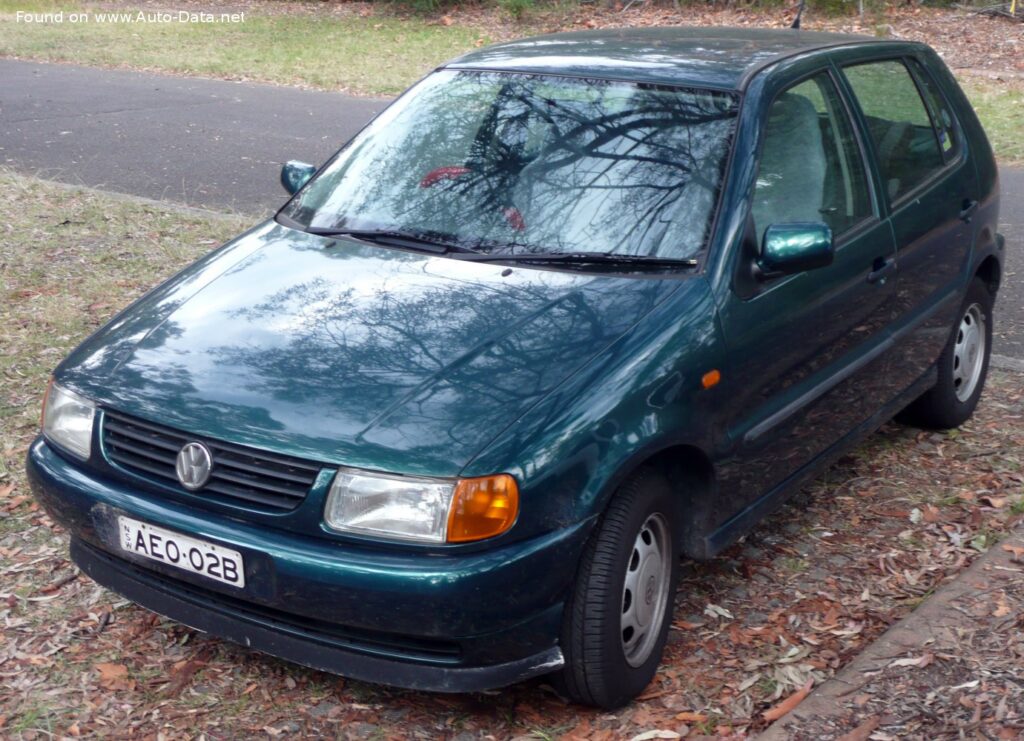
The design of the Volkswagen Polo III (6N/6KV) marked a significant departure from the more angular lines of its predecessor, the Polo II (86C). Adopting a rounded, more aerodynamic aesthetic, it aligned with Volkswagen’s contemporary design language seen in models like the Golf III. The Volkswagen Polo III (6N/6KV) 1.9 SDI (64 Hp) was offered in both 3-door and 5-door hatchback configurations, providing flexibility for different buyer needs. The overall length of 146.26 inches (3715 mm) and a width of 65.16 inches (1655 mm) made it compact enough for urban maneuverability yet spacious enough for comfortable travel.
Inside, the Polo III was designed with practicality and ergonomics in mind. It offered seating for five occupants, and while the rear seats might have been snug for three adults on long journeys, they were perfectly adequate for children or shorter trips. The trunk space was commendable for its class, offering a minimum of 8.65 cubic feet (245 liters) with the rear seats in place, expanding significantly to 34.43 cubic feet (975 liters) when the rear seats were folded down. This versatility made the Polo a popular choice for young families or individuals needing flexible cargo capacity.
The chassis and suspension setup of the Polo III contributed to its comfortable ride and predictable handling. It featured wishbone suspension at both the front and rear, a sophisticated arrangement for a supermini of its time, contributing to improved road holding and passenger comfort. Steering was managed by a hydraulic rack and pinion system, providing direct feedback to the driver. Braking duties were handled by ventilated discs at the front, offering good stopping power, and robust drum brakes at the rear. The vehicle rode on 13-inch wheels fitted with 175/70 R13 tires, a common size that balanced grip, ride comfort, and replacement cost.
While modern safety features like extensive airbags, stability control, or traction control were not standard across the board in 1994, the Polo III offered a solid structural foundation for its era. Volkswagen prioritized passive safety, and features such as anti-lock brakes (ABS) were typically available as options, becoming more common in later production years. The interior fit and finish, though utilitarian, upheld Volkswagen’s reputation for build quality and durability, ensuring that components would withstand years of use.
Technical Specifications
| Category | Specification | US Equivalent |
|---|---|---|
| Brand | Volkswagen | |
| Model | Polo | |
| Generation | Polo III (6N/6KV) | |
| Type (Engine) | 1.9 SDI (64 Hp) | |
| Production Start | 1994 | |
| Production End | 2000 | |
| Powertrain Architecture | Internal Combustion Engine | |
| Body Type | Hatchback | |
| Seats | 5 | |
| Doors | 3-5 | |
| Performance Specs | ||
| Fuel Consumption (Urban) | 7.7 l/100 km | 30.5 US mpg |
| Fuel Consumption (Extra Urban) | 4.4 l/100 km | 53.5 US mpg |
| Fuel Consumption (Combined) | 5.6 l/100 km | 42 US mpg |
| Fuel Type | Diesel | |
| Acceleration 0-60 mph | 15.0 sec (Calculated) | |
| Acceleration 0-62 mph (0-100 km/h) | 15.8 sec | |
| Maximum Speed | 160 km/h | 99.42 mph |
| Weight-to-power ratio | 16.2 kg/Hp | 35.7 lbs/Hp |
| Weight-to-torque ratio | 8.3 kg/Nm | 18.3 lbs/Nm |
| Engine Specs | ||
| Power | 64 Hp @ 4200 rpm | |
| Power per liter | 33.8 Hp/l | |
| Torque | 124 Nm @ 2200 rpm | 91.46 lb.-ft. @ 2200 rpm |
| Engine Layout | Front, Transverse | |
| Engine Model/Code | AEY | |
| Engine Displacement | 1896 cm3 | 1.9 Liters (115.7 cu. in.) |
| Number of Cylinders | 4 | |
| Engine Configuration | Inline | |
| Cylinder Bore | 79.5 mm | 3.13 in. |
| Piston Stroke | 95.5 mm | 3.76 in. |
| Compression Ratio | 19.5:1 | |
| Valves per Cylinder | 2 | |
| Fuel Injection System | Direct Injection | |
| Engine Aspiration | Naturally Aspirated | |
| Valvetrain | OHC | |
| Engine Oil Capacity | 4.7 l | 4.97 US qt |
| Space, Volume, and Weights | ||
| Kerb Weight | 1035 kg | 2281.78 lbs. |
| Max. Weight | 1435 kg | 3163.63 lbs. |
| Max Load | 400 kg | 881.85 lbs. |
| Trunk (boot) Space – Minimum | 245 l | 8.65 cu. ft. |
| Trunk (boot) Space – Maximum | 975 l | 34.43 cu. ft. |
| Fuel Tank Capacity | 45 l | 11.89 US gal |
| Dimensions | ||
| Length | 3715 mm | 146.26 in. |
| Width | 1655 mm | 65.16 in. |
| Height | 1420 mm | 55.91 in. |
| Wheelbase | 2400 mm | 94.49 in. |
| Front Track | 1351 mm | 53.19 in. |
| Rear (Back) Track | 1384 mm | 54.49 in. |
| Drivetrain, Brakes, and Suspension Specs | ||
| Drivetrain Architecture | Internal combustion engine drives front wheels | |
| Drive Wheel | Front Wheel Drive | |
| Number of Gears/Gearbox Type | 5 gears, manual transmission | |
| Front Suspension | Wishbone | |
| Rear Suspension | Wishbone | |
| Front Brakes | Ventilated Discs | |
| Rear Brakes | Drum | |
| Steering Type | Steering rack and pinion | |
| Power Steering | Hydraulic Steering | |
| Tires Size | 175/70 R13 | |
| Wheel Rims Size | 13 inches | |
Legacy & Market Impact: The Enduring Appeal of the Volkswagen Polo III (6N/6KV)
The Volkswagen Polo III (6N/6KV) left a significant mark on the European automotive landscape, particularly the Volkswagen Polo III (6N/6KV) 1.9 SDI (64 Hp) variant. In an era when small cars were increasingly demanded to offer comfort, safety, and efficiency alongside affordability, the Polo III managed to strike an admirable balance. Its robust construction and the legendary reliability of Volkswagen engineering ensured that it quickly gained a reputation for dependability, a crucial factor in the competitive supermini segment.
In its primary European markets, the Polo III faced stiff competition from formidable rivals such as the Ford Fiesta, Opel Corsa, Renault Clio, Peugeot 206, and Fiat Punto. What set the Polo apart, especially the SDI model, was its perceived quality and the promise of low running costs. The naturally aspirated 1.9 SDI engine, while not powerful, was renowned for its almost indestructible nature and exceptional fuel economy, making it a favorite among budget-conscious private buyers, fleet operators, and driving schools. This engine proved particularly popular in countries with favorable diesel fuel pricing and taxation structures, reinforcing its status as an economical champion.
The Polo III’s design, which was more rounded and modern than its predecessors, also helped it appeal to a broader audience. It offered a more refined driving experience than many of its contemporaries, with a comfortable ride and predictable handling that made it suitable for both city driving and longer highway stretches. The availability of both 3-door and 5-door body styles further broadened its appeal, catering to different lifestyle needs.
The historical significance of the Volkswagen Polo III (6N/6KV) lies in its role in cementing the Polo’s position as a premium offering in the supermini segment. It elevated expectations for small cars, demonstrating that a compact vehicle could offer a high level of refinement, safety (for its time), and practicality without compromising on efficiency. The SDI engine, in particular, highlighted Volkswagen’s commitment to diesel technology, paving the way for the widespread adoption of more advanced TDI engines in subsequent generations.
Even today, the Volkswagen Polo III (6N/6KV) 1.9 SDI (64 Hp) retains a strong following in certain markets as a highly durable and economical used car. Its simple mechanics, ease of repair, and the sheer longevity of its diesel powertrain ensure that many examples continue to serve reliably, a testament to its original design and engineering principles. The Polo III, and especially its frugal SDI variant, truly encapsulated the spirit of practical, reliable, and efficient motoring that Volkswagen aimed to deliver to the masses in Europe.