Introduction to the Volkswagen Polo IV (9N)
The Volkswagen Polo IV (9N) represents the fourth generation of Volkswagen’s popular supermini (also known as a subcompact in the US market context), a model line that has been a cornerstone of the German automaker’s global strategy, particularly in Europe. Launched in 2002, this iteration of the Polo brought a significant leap forward in terms of design, refinement, and technology compared to its predecessors. While never officially sold in the United States, the Polo has consistently been a top seller across Europe and other international markets, serving as Volkswagen’s entry-level offering below the venerable Golf. This article focuses on the specific variant equipped with the 1.2-liter 12V engine, producing 64 horsepower, which was available from 2002 to 2005. This particular powertrain epitomized the Polo’s mission: to provide an economical, reliable, and practical urban commuter.
The Polo IV (9N) was built on the Volkswagen Group’s A0 platform, shared with contemporary models like the SEAT Ibiza and Skoda Fabia, signifying a robust and well-engineered foundation. Its design language moved towards a more mature and upscale aesthetic, mirroring elements found in the larger Golf and Passat models of the era. The 1.2-liter 12V (64 Hp) model, typically offered in a versatile hatchback body style with either three or five doors, was engineered for fuel efficiency and low running costs, making it an ideal choice for first-time car buyers, urban dwellers, and budget-conscious families.
Engine and Performance of the Volkswagen Polo IV (9N) 1.2 i 12V (64 Hp)
Powertrain Overview
At the heart of this particular Volkswagen Polo IV (9N) variant was a compact, naturally aspirated 1.2-liter (1198 cm3 or 73.11 cu. in.) inline three-cylinder gasoline engine. Codenamed AZQ or BME, this powerplant was designed with efficiency and urban drivability in mind. Despite its small displacement, the engine featured a 12-valve configuration (four valves per cylinder), optimizing airflow and combustion efficiency for its size. Fuel delivery was handled by a multi-port manifold injection system, a common and reliable technology for the early 2000s, ensuring precise fuel metering.
The engine produced a modest 64 horsepower at 5400 rpm, translating to a power-per-liter figure of 53.4 Hp/l. Torque output was 82.61 lb.-ft. (112 Nm) delivered at a relatively low 3000 rpm, which contributed to its respectable city driving characteristics. This peak torque at lower revs meant the car felt adequately responsive in stop-and-go traffic, an important consideration for its primary European urban market. The engine was mounted transversely at the front, driving the front wheels through a five-speed manual transmission, a standard setup for its class that emphasized driver engagement and fuel economy.
Driving Dynamics and Efficiency
Performance figures for the Volkswagen Polo IV (9N) 1.2 i 12V (64 Hp) reflected its focus on economy rather than outright speed. The sprint from 0 to 60 mph was achieved in 14.2 seconds, with 0 to 100 km/h taking 14.9 seconds. The maximum speed was rated at 100.66 mph (162 km/h). While these numbers might seem leisurely by modern standards or compared to more powerful variants, they were entirely adequate for daily commuting and highway cruising within European speed limits.
Where this Polo truly shone was in its fuel efficiency. The combined fuel consumption was an impressive 37.3 US mpg (6.3 l/100 km). In urban driving, it achieved 30.9 US mpg (7.6 l/100 km), and on the extra-urban cycle, it reached an excellent 46.1 US mpg (5.1 l/100 km). These figures made it a very economical choice, especially in regions with high fuel prices. The 45-liter (11.89 US gallon) fuel tank provided a substantial cruising range, further enhancing its appeal as a practical long-distance compact car. Its weight-to-power ratio stood at 15.8 kg/Hp (63.4 Hp/tonne), and a weight-to-torque ratio of 9 kg/Nm (110.9 Nm/tonne) underscored its lightweight construction and efficient use of available power.
Design and Features
Exterior and Interior Design
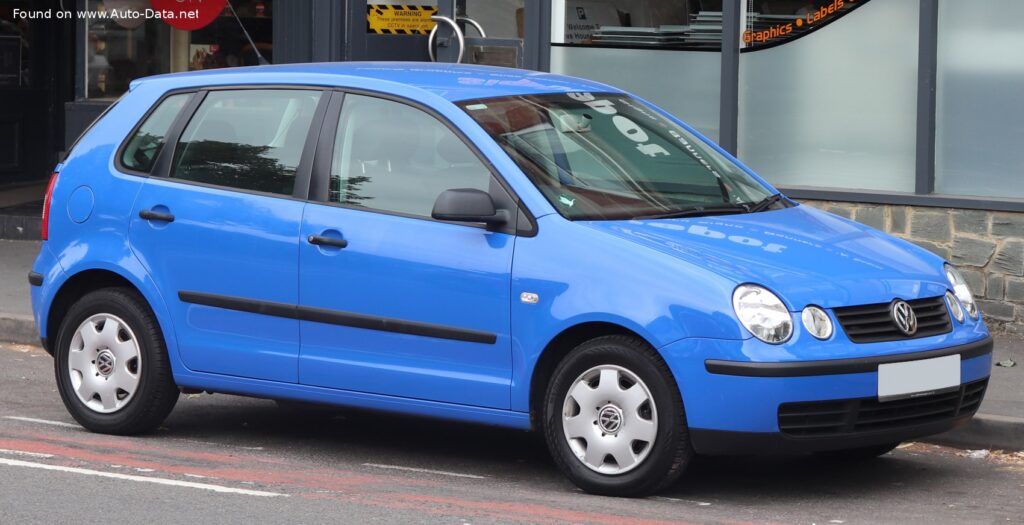
The Volkswagen Polo IV (9N) marked a significant departure from its predecessor’s design, adopting a more curvaceous and sophisticated aesthetic. Its overall length of 153.43 inches (3897 mm), width of 64.96 inches (1650 mm), and height of 57.68 inches (1465 mm) positioned it firmly within the supermini segment, making it highly maneuverable in congested city environments. The 96.85-inch (2460 mm) wheelbase contributed to a stable ride and surprising interior room for its class. The design featured distinct circular headlights, a departure from the squared-off lamps of the Polo 6N, giving it a friendly yet modern face.
Available in both 3-door and 5-door hatchback configurations, the Polo 9N offered versatility to cater to different buyer needs. The 5-door variant provided easier access to the rear seats, which comfortably accommodated three passengers for shorter journeys, or two with ample space. The interior emphasized functionality and quality, typical of Volkswagen. While not luxurious, the materials and build quality were generally considered superior to many rivals in its segment. The cabin layout was ergonomic, with controls logically placed for ease of use.
Practicality and Safety
Practicality was a strong suit of the Polo 9N. Despite its compact exterior, it offered a respectable trunk space of 9.53 cu. ft. (270 liters) with the rear seats in place, expanding to a generous 36.37 cu. ft. (1030 liters) when the rear seats were folded down. This made it capable of handling weekly groceries or luggage for a weekend trip. The vehicle’s maximum load capacity was 1190.5 lbs. (540 kg), further enhancing its utility.
In terms of safety, the Polo IV (9N) came equipped with essential features for its time. A key assisting system was ABS (Anti-lock Braking System), which significantly improved braking performance and control, especially in emergency situations. The braking system itself consisted of ventilated discs at the front and solid discs at the rear, providing reliable stopping power. The steering was a hydraulic rack and pinion system, offering direct and communicative feedback to the driver, a characteristic appreciated by many European drivers. The front suspension utilized coil springs, while the rear featured a trailing arm setup, a common and effective design for front-wheel-drive subcompacts, balancing comfort and handling. Standard tire size was 165/70 R14 on 14-inch wheel rims, chosen for a balance of comfort, grip, and low rolling resistance.
Technical Specifications: Volkswagen Polo IV (9N) 1.2 i 12V (64 Hp)
| Category | Specification | US/Imperial Equivalent |
|---|---|---|
General Information |
||
| Brand | Volkswagen | |
| Model | Polo IV (9N) | |
| Type (Engine) | 1.2 i 12V (64 Hp) | |
| Production Start | 2002 | |
| Production End | 2005 | |
| Body Type | Hatchback | |
| Seats | 5 | |
| Doors | 3-5 | |
Performance Specs |
||
| Fuel Type | Petrol (Gasoline) | |
| Fuel Consumption (Urban) | 7.6 l/100 km | 30.9 US mpg |
| Fuel Consumption (Extra Urban) | 5.1 l/100 km | 46.1 US mpg |
| Fuel Consumption (Combined) | 6.3 l/100 km | 37.3 US mpg |
| Acceleration 0-60 mph | 14.2 sec | |
| Acceleration 0-100 km/h | 14.9 sec | |
| Maximum Speed | 162 km/h | 100.66 mph |
| Weight-to-Power Ratio | 15.8 kg/Hp | 63.4 Hp/tonne |
Engine Specs |
||
| Power | 64 Hp @ 5400 rpm | |
| Torque | 112 Nm @ 3000 rpm | 82.61 lb.-ft. @ 3000 rpm |
| Engine Layout | Front, Transverse | |
| Engine Model/Code | AZQ, BME | |
| Engine Displacement | 1198 cm3 | 1.2 liters / 73.11 cu. in. |
| Number of Cylinders | 3 | Inline |
| Cylinder Bore | 76.5 mm | 3.01 in. |
| Piston Stroke | 86.9 mm | 3.42 in. |
| Compression Ratio | 10.5:1 | |
| Valves per Cylinder | 4 | |
| Fuel Injection System | Multi-port manifold injection | |
| Engine Aspiration | Naturally Aspirated | |
| Engine Oil Capacity | 2.8 l | 2.96 US qt |
| Coolant Capacity | 3.9 l | 4.12 US qt |
Space, Volume and Weights |
||
| Kerb Weight | 1010 kg | 2226.67 lbs. |
| Max. Weight | 1550 kg | 3417.17 lbs. |
| Max Load | 540 kg | 1190.5 lbs. |
| Trunk Space (Min) | 270 l | 9.53 cu. ft. |
| Trunk Space (Max) | 1030 l | 36.37 cu. ft. |
| Fuel Tank Capacity | 45 l | 11.89 US gal |
Dimensions |
||
| Length | 3897 mm | 153.43 in. |
| Width | 1650 mm | 64.96 in. |
| Height | 1465 mm | 57.68 in. |
| Wheelbase | 2460 mm | 96.85 in. |
| Front Track | 1435 mm | 56.5 in. |
| Rear Track | 1425 mm | 56.1 in. |
Drivetrain, Brakes and Suspension Specs |
||
| Drivetrain Architecture | Internal Combustion engine (ICE) drives the front wheels. | |
| Drive Wheel | Front Wheel Drive | |
| Gearbox Type | 5 gears, manual transmission | |
| Front Suspension | Coil spring | |
| Rear Suspension | Trailing arm | |
| Front Brakes | Ventilated discs | |
| Rear Brakes | Disc | |
| Assisting Systems | ABS (Anti-lock braking system) | |
| Steering Type | Steering rack and pinion | |
| Power Steering | Hydraulic Steering | |
| Tires Size | 165/70 R14 | |
| Wheel Rims Size | 14 inches | |
Legacy and Market Impact
The Volkswagen Polo IV (9N), particularly with its economical 1.2-liter 12V engine, continued the Polo lineage’s strong reputation for reliability, sensible engineering, and robust build quality. In its primary markets, predominantly Europe, it was positioned as a premium offering in the supermini segment, often commanding a slightly higher price than some of its direct competitors but justifying it with a more refined driving experience and a perception of superior longevity.
Its market impact was substantial. The Polo IV (9N) consistently ranked among the best-selling cars in several European countries, appealing to a broad demographic. For many, it served as an accessible entry point into the Volkswagen brand, offering a taste of German engineering and design at a more affordable price point than the Golf. It inherited Volkswagen’s characteristic solid feel, precise controls, and understated styling, which resonated well with a customer base that valued practicality and durability over flashy aesthetics.
Key competitors in the European supermini segment during the Polo 9N’s production years included formidable rivals such as the Ford Fiesta, Opel Corsa (Vauxhall Corsa in the UK), Renault Clio, Peugeot 206, and Fiat Punto. While some competitors might have offered more spirited performance or more flamboyant styling, the Polo distinguished itself through its perceived quality, comfortable ride, and strong resale values. The 1.2-liter engine variant specifically targeted buyers who prioritized low running costs and environmental friendliness, factors that gained increasing importance in the early 21st century.
The Volkswagen Polo IV (9N) proved to be a critical success for Volkswagen, solidifying the Polo’s role as a global compact car icon. It demonstrated Volkswagen’s ability to scale down its core brand values of quality, safety, and efficiency into a smaller, more accessible package. While it never crossed the Atlantic to grace American showrooms, its influence was felt globally as a benchmark for what a well-engineered supermini could be. Its blend of a practical hatchback body, efficient powertrain, and comprehensive safety features ensured its lasting legacy as a significant chapter in the Volkswagen Polo’s illustrious history.