The Volkswagen Polo IV (9N) 1.2 i (54 Hp): A European Supermini Standard
The Volkswagen Polo IV, internally designated as the 9N, represented the fourth generation of Volkswagen’s popular supermini car.
Launched in 2001 and produced until 2005, this iteration of the Polo was a significant model in its segment, particularly across European and
other international markets where compact, efficient vehicles are highly valued. The Volkswagen Polo IV (9N) 1.2 i (54 Hp),
the specific variant under review, served as an entry-level offering, prioritizing fuel economy and urban maneuverability over
outright performance. While the Polo line has never been officially sold in the United States, it has consistently been a
cornerstone of Volkswagen’s global strategy, embodying the brand’s reputation for solid engineering and practical design in a
smaller, more accessible package.
Positioned firmly within the highly competitive B-segment (or supermini class), the Polo IV (9N) succeeded the critically acclaimed
Polo III (6N) and brought a refreshed design, improved safety features, and a range of new powertrains to the market. Its role
was to provide a reliable, economical, and comfortable daily driver for individuals and small families navigating dense urban
environments and European highways. The 1.2 i (54 Hp) variant, with its modest three-cylinder engine, was particularly geared
towards first-time car buyers, those seeking minimal running costs, and drivers who primarily used their vehicle for city
commuting.
Engine and Performance of the Volkswagen Polo IV (9N) 1.2 i (54 Hp)
Under the hood of the Volkswagen Polo IV (9N) 1.2 i (54 Hp) lay a compact yet capable 1.2-liter, naturally aspirated, inline
three-cylinder petrol (gasoline) engine. Designated by engine codes AWY or BMD, this powerplant was a testament to Volkswagen’s
engineering prowess in creating efficient, small-displacement engines for the European market. With an engine displacement of
1198 cm³ (73.11 cubic inches), it delivered a peak power output of 54 horsepower (Hp) at 4750 revolutions per minute (rpm).
This translated to a power per liter figure of 45.1 Hp/l, a respectable efficiency for a naturally aspirated unit of its era.
Torque, crucial for urban driving and acceleration from a standstill, was rated at 106 Newton meters (Nm), which converts to
approximately 78.18 pound-feet (lb.-ft.), available at a relatively low 3000 rpm. This low-end torque characteristic made the
Polo IV 1.2 i feel responsive in city traffic, despite its modest horsepower rating. The engine utilized a multi-port manifold
injection system and featured two valves per cylinder, optimizing the air-fuel mixture for efficiency. Its compression ratio
stood at 10.8:1.
Power was delivered to the front wheels via a standard 5-speed manual transmission, a common and reliable setup for vehicles
in this segment. Performance figures for the Volkswagen Polo IV (9N) 1.2 i (54 Hp) reflected its economy-focused design.
Acceleration from 0 to 60 miles per hour (mph) was achieved in an estimated 16.6 seconds, while the 0 to 100 kilometers per
hour (km/h) sprint took 17.5 seconds. The maximum speed was 152 km/h, or approximately 94.45 mph. While these figures might
seem leisurely by American standards, they were entirely adequate for European city driving and maintaining pace on less
demanding highways.
Fuel efficiency was a key selling point for this variant. The urban fuel consumption was rated at 7.8 liters per 100 kilometers,
translating to about 30.2 US miles per gallon. On extra-urban cycles, the economy improved significantly to 4.8 l/100 km, or an
impressive 49 US mpg. This excellent fuel economy, combined with a 45-liter (11.89 US gallon) fuel tank, provided a substantial
driving range, making it an economical choice for daily commutes and longer journeys alike. The vehicle’s kerb weight of 980 kg
(2160.53 lbs) contributed to its agility and efficiency, resulting in a weight-to-power ratio of 18.1 kg/Hp.
Design and Features
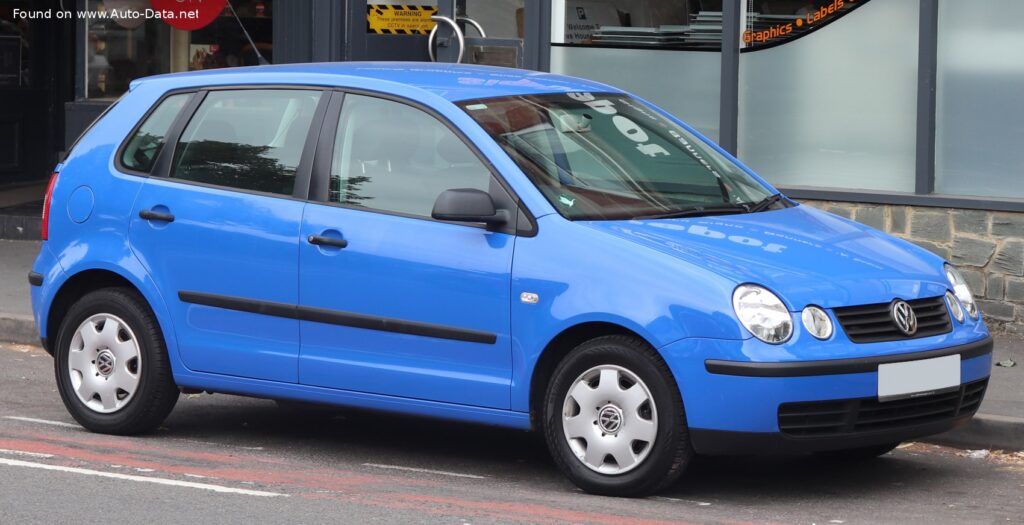
The Volkswagen Polo IV (9N) adopted a design language that was both contemporary and recognizably Volkswagen, drawing inspiration
from its larger sibling, the Golf. It featured a more rounded and muscular appearance compared to its predecessor, with distinctive
twin circular headlamps that gave it a unique identity. The Polo IV was offered as a versatile hatchback, available in both 3-door
and 5-door configurations, catering to different consumer needs for accessibility and sportiness. With a length of 3897 mm (153.43
inches), a width of 1650 mm (64.96 inches), and a height of 1465 mm (57.68 inches), it struck an excellent balance between interior
space and compact exterior dimensions. The wheelbase measured 2460 mm (96.85 inches), providing a stable ride for its class.
Inside, the Polo IV (9N) offered a well-appointed and ergonomically designed cabin typical of Volkswagen. The interior materials
were of good quality for the segment, and the layout was intuitive, focusing on functionality and driver comfort. It comfortably
seated five occupants, making it a practical choice for small families. Cargo capacity was also impressive for a supermini, with
a minimum trunk space of 270 liters (9.53 cubic feet). This could be expanded significantly to 1030 liters (36.37 cubic feet)
with the rear seats folded down, offering excellent versatility for carrying luggage or larger items.
In terms of safety, even the entry-level Volkswagen Polo IV (9N) 1.2 i (54 Hp) was equipped with essential features for its
time. An Anti-lock Braking System (ABS) was a standard assisting system, enhancing braking performance and control during emergency
stops. The braking system itself comprised ventilated discs at the front and reliable drum brakes at the rear. The steering
system featured a hydraulic rack and pinion setup, providing direct and communicative feedback to the driver, which was appreciated
for both city maneuvering and highway stability. The vehicle rode on 165/70 R14 tires mounted on 14-inch wheel rims, providing a
comfortable ride and adequate grip. Suspension consisted of coil springs at the front and a trailing arm setup at the rear,
tuned for a balance of comfort and handling.
Technical Specifications
| Category | Specification | US Equivalent |
|---|---|---|
| Brand | Volkswagen | |
| Model | Polo | |
| Generation | Polo IV (9N) | |
| Type (Engine) | 1.2 i (54 Hp) | |
| Start of Production | 2001 year | |
| End of Production | 2005 year | |
| Powertrain Architecture | Internal Combustion engine | |
| Body type | Hatchback | |
| Seats | 5 | |
| Doors | 3-5 | |
| Performance Specs | ||
| Fuel consumption (economy) – urban | 7.8 l/100 km | 30.2 US mpg |
| Fuel consumption (economy) – extra urban | 4.8 l/100 km | 49 US mpg |
| Fuel Type | Petrol (Gasoline) | |
| Acceleration 0 – 100 km/h | 17.5 sec | |
| Acceleration 0 – 60 mph | 16.6 sec | |
| Maximum speed | 152 km/h | 94.45 mph |
| Weight-to-power ratio | 18.1 kg/Hp | |
| Weight-to-torque ratio | 9.2 kg/Nm | |
| Engine Specs | ||
| Power | 54 Hp @ 4750 rpm. | |
| Power per liter | 45.1 Hp/l | |
| Torque | 106 Nm @ 3000 rpm. | 78.18 lb.-ft. @ 3000 rpm. |
| Engine layout | Front, Transverse | |
| Engine Model/Code | AWY, BMD | |
| Engine displacement | 1198 cm³ | 73.11 cu. in. |
| Number of cylinders | 3 | |
| Engine configuration | Inline | |
| Cylinder Bore | 76.5 mm | 3.01 in. |
| Piston Stroke | 86.9 mm | 3.42 in. |
| Compression ratio | 10.8:1 | |
| Number of valves per cylinder | 2 | |
| Fuel injection system | Multi-port manifold injection | |
| Engine aspiration | Naturally aspirated engine | |
| Engine oil capacity | 2.8 l | 2.96 US qt |
| Coolant | 3.9 l | 4.12 US qt |
| Space, Volume and Weights | ||
| Kerb Weight | 980 kg | 2160.53 lbs. |
| Max. weight | 1530 kg | 3373.07 lbs. |
| Max load | 550 kg | 1212.54 lbs. |
| Trunk (boot) space – minimum | 270 l | 9.53 cu. ft. |
| Trunk (boot) space – maximum | 1030 l | 36.37 cu. ft. |
| Fuel tank capacity | 45 l | 11.89 US gal |
| Dimensions | ||
| Length | 3897 mm | 153.43 in. |
| Width | 1650 mm | 64.96 in. |
| Height | 1465 mm | 57.68 in. |
| Wheelbase | 2460 mm | 96.85 in. |
| Front track | 1435 mm | 56.5 in. |
| Rear (Back) track | 1425 mm | 56.1 in. |
| Drivetrain, Brakes and Suspension Specs | ||
| Drivetrain Architecture | Front wheel drive | |
| Drive wheel | Front wheel drive | |
| Number of gears and type of gearbox | 5 gears, manual transmission | |
| Front suspension | Coil spring | |
| Rear suspension | Trailing arm | |
| Front brakes | Ventilated discs | |
| Rear brakes | Drum | |
| Assisting systems | ABS (Anti-lock braking system) | |
| Steering type | Steering rack and pinion | |
| Power steering | Hydraulic Steering | |
| Tires size | 165/70 R14 | |
| Wheel rims size | 14 | |
Legacy and Market Impact
The Volkswagen Polo IV (9N) 1.2 i (54 Hp) played a crucial role in maintaining Volkswagen’s dominance in the European supermini
segment during its production run from 2001 to 2005. While this particular 54 Hp variant was not known for its blistering
performance, its strengths lay in its exceptional fuel economy, robust build quality, and Volkswagen’s enduring reputation
for reliability. In a market where fuel prices and running costs are significant considerations, the 1.2-liter Polo offered
an attractive package for budget-conscious buyers and those seeking a dependable urban commuter.
The Polo IV faced stiff competition from a myriad of well-established rivals in Europe. Key competitors included the Ford Fiesta,
Opel Corsa (Vauxhall Corsa in the UK), Renault Clio, Peugeot 206, and Fiat Punto. Each of these models vied for market share
by offering varying blends of style, practicality, and driving dynamics. The Polo differentiated itself with its perceived
premium feel, solid Germanic engineering, and a more conservative, yet timeless, design aesthetic that appealed to a broad
customer base. Its interior quality and refinement were often cited as being a cut above many of its direct competitors.
From a historical perspective, the Polo IV (9N) continued the lineage of a nameplate that has been a consistent sales success
for Volkswagen since its introduction in 1975. The 9N generation further solidified the Polo’s standing as a benchmark in the
supermini class, often praised for its mature driving characteristics that mimicked those of larger cars. The availability of
multiple body styles (3-door and 5-door hatchback) and a wide range of engines, from economical petrol units like the 1.2 i
to more powerful petrol and diesel options, ensured its appeal to a diverse demographic.
The Volkswagen Polo IV (9N) 1.2 i (54 Hp), despite its entry-level status, contributed significantly to the model’s
overall success by offering an accessible entry point into the Volkswagen brand. Its impact can be seen in its strong residual
values and continued presence on European roads years after its production ceased, a testament to its durability and appeal.
It represented a sensible, well-engineered choice for millions of drivers, embodying the core values of the Volkswagen brand
in a compact, efficient, and practical package. Its legacy is one of quiet competence and widespread acceptance in markets
that demand efficiency and quality without compromise on everyday usability.